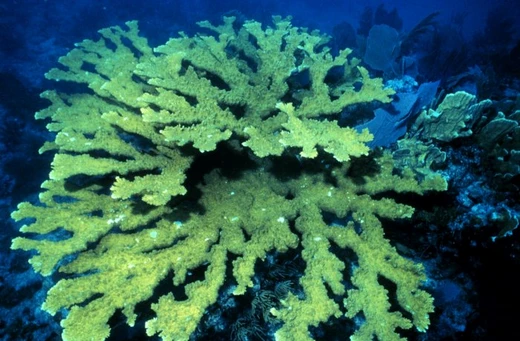
Acropora paniculata
A vulnerable plate-like coral from tropical shallow reefs.

Acropora paniculata is a coral species first recorded by Addison Emery Verrill in 1902. It forms plate-like colonies that can exceed one meter across and about 25 millimeters thick, with short branchlets. These branchlets are blue, grey, or cream and carry tube-shaped axial and incipient axial corallites at their tips, along with radial corallites. The species resembles Acropora jacquelineae. Its skeleton is made of aragonite, a form of calcium carbonate.
This coral lives in tropical, shallow marine reefs on upper slopes, including reef edges and sheltered lagoons, at depths between 10 and 35 meters. It is found across a broad but scattered range: the Indo-Pacific, East China Sea, western Pacific, Hawaiian Islands, central Pacific, Rodrigues, Society Islands, Johnston Atoll, Southeast Asia, Japan, and Eastern Australia. Although generally uncommon, it is locally common in places like Papua New Guinea. It occurs in five regions of Indonesia and at seven sites in the Marshall Islands. The species tolerates water temperatures between about 25.5 and 28.1°C.
The population is declining. Threats include climate change, coral disease, rising sea temperatures causing bleaching, reef destruction, predation by the crown-of-thorns starfish (Acanthaster planci), and human activity. It is listed as vulnerable on the IUCN Red List and appears in CITES Appendix II. Some populations may lie within Marine Protected Areas.
Quick Facts
- Taxon
- Acropora paniculata
Facts from the source article.
Lore & Background
Acropora paniculata forms colonies with plate-like structures over 1 m wide and 25 mm deep. The branches contain short branchlets that are blue, grey, or cream in color, with axial, incipient axial, and radial corallites. The incipient axial and axial corallites are tube-shaped, long, and thin, occurring on the tips of the branchlets. It resembles Acropora jacquelineae. Its mineralized tissue is composed of aragonite (calcium carbonate).
The species is found in marine, tropical, shallow reefs on upper slopes—on reef edges and in lagoons sheltered from strong waves—at depths between 10 and 35 m. It occurs over a large area including the Indo-Pacific, East China Sea, western Pacific, Hawaiian Islands, central Pacific, Rodrigues, Society Islands, Johnston Atoll, Southeast Asia, Japan, and Eastern Australia. It is uncommon overall but common in some areas such as Papua New Guinea, and occurs in five regions of Indonesia and at seven locations on the Marshall Islands. It is threatened by climate change, coral disease, rising sea temperatures leading to bleaching, reef destruction, predation by Acanthaster planci, and human activity.
Reader's Guide
Acropora paniculata holds significance as a species first described in 1902 by Addison Emery Verrill, contributing to the taxonomic understanding of acroporid corals. Its plate-like morphology and occurrence on upper reef slopes and sheltered lagoons at depths of 10 to 35 m illustrate a specific ecological niche. The species is listed as vulnerable on the IUCN Red List with a decreasing population, reflecting broader threats to coral reef ecosystems such as climate change, coral disease, rising sea temperatures causing bleaching, reef destruction, predation by Acanthaster planci, and human activities. Its inclusion in CITES Appendix II indicates international concern over its trade. Despite being uncommon over much of its wide range—spanning the Indo-Pacific, East China Sea, western Pacific, Hawaiian Islands, central Pacific, Rodrigues, Society Islands, Johnston Atoll, Southeast Asia, Japan, and Eastern Australia—it is common in specific areas like Papua New Guinea. The species occurs in five regions of Indonesia and at seven locations on the Marshall Islands, and may be found within Marine Protected Areas. Its presence across such a broad geographic area underscores the need for continued monitoring and conservation efforts.
Did You Know?
- Acropora paniculata was first described by Addison Emery Verrill in 1902.
- Its colonies are plate-like, over 1 m wide and 25 mm deep.
- It occurs at depths between 10 and 35 m on upper reef slopes and in sheltered lagoons.
More in Acropora Corals, Part 2 1-24
Spotted an error? Know more?
Reader corrections go straight into our review queue. Suggest an edit · How this site is sourced