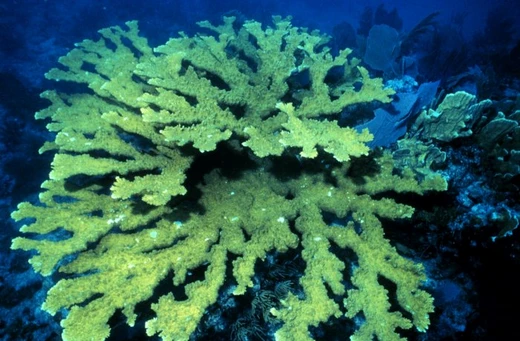
Acropora palmerae
An endangered acroporid coral found in Indo-Pacific shallow reefs.

Acropora palmerae is a coral species belonging to the acroporid family. It was first formally described by Wells in 1954. This coral is found across a wide geographic range, including the northern Indian Ocean, the central Indo-Pacific, Australia, Southeast Asia, Japan, the East China Sea, and the oceanic west Pacific. Specific locations include Palau, the Mariana Islands, American Samoa, the Andaman Islands, the Great Barrier Reef, Okinawa Island, Mauritius, Micronesia, the Cook Islands, and the Philippines. It inhabits tropical shallow reefs, particularly on flats that are exposed to strong wave action, as well as in lagoons, at depths ranging from the surface down to 12 metres.
The species forms encrusted colonies with irregular branches, which can sometimes exceed one metre in diameter. Its axial corallites are noticeable but not consistently shaped, while the radial corallites are mostly rasp-like. The colour of the coral is either pink-brown or green-brown. It closely resembles the species Acropora pinguis.
On the IUCN Red List, Acropora palmerae is classified as endangered, and its population is believed to be declining. It is also listed under Appendix II of CITES. While exact population figures are unknown, the species faces threats from the global loss of coral reefs, rising temperatures that cause coral bleaching, climate change, human activities, predation by the crown-of-thorns starfish (Acanthaster planci), and disease.
Quick Facts
- Taxon
- Acropora palmerae
Facts from the source article.
Lore & Background
Acropora palmerae was described by Wells in 1954. It occurs in encrusted colonies containing irregular branches; these colonies sometimes reach diameters of over 1 metre. Its axial corallites are obvious but inconsistent, and it has mainly rasp-like radial corallites. The species is pink- or green-brown in colour. It looks similar to Acropora pinguis.
The species is classed as endangered on the IUCN Red List and it is believed that its population is decreasing. Figures of its population are unknown, but it is likely to be threatened by the global reduction of coral reefs, the increase of temperature causing coral bleaching, climate change, human activity, the crown-of-thorns starfish (Acanthaster planci) and disease. It is also listed under Appendix II of CITES.
It occurs in the northern Indian Ocean, the central Indo-Pacific, Australia, Southeast Asia, Japan, the East China Sea and the oceanic west Pacific Ocean; it also occurs in Palau and the Mariana Islands, American Samoa, the Andaman Islands, the Great Barrier Reef, Okinawa Island, Mauritius, Micronesia, the Cook Islands and the Philippines. It is found at depths of between 0 and 12 metres in tropical shallow reefs on exposed flats or in lagoons.
Reader's Guide
Acropora palmerae is notable as an endangered species of acroporid coral with a wide distribution across the Indo-Pacific, including locations such as the Great Barrier Reef, Japan, and American Samoa. Its description by Wells in 1954 established its taxonomic identity. The species is characterized by encrusted colonies with irregular branches that can exceed 1 metre in diameter, and it exhibits pink- or green-brown coloration. It is found in shallow tropical reefs on wave-exposed flats and in lagoons at depths up to 12 metres. The species is listed as endangered on the IUCN Red List, with a decreasing population trend, though exact population figures are unknown. Threats include global coral reef reduction, temperature-induced bleaching, climate change, human activity, predation by the crown-of-thorns starfish, and disease. Its inclusion in Appendix II of CITES reflects international concern over its conservation. The species resembles Acropora pinguis, which may aid in field identification. Its presence across a broad geographic range, from the Indian Ocean to the Pacific, underscores its ecological role in shallow reef habitats, but ongoing pressures highlight the need for monitoring and protection.
Did You Know?
- It is found at depths from 0 to 12 metres on tropical shallow reefs.
- It is listed as endangered on the IUCN Red List and under Appendix II of CITES.
More in Acropora Corals, Part 2 1-24
Spotted an error? Know more?
Reader corrections go straight into our review queue. Suggest an edit · How this site is sourced