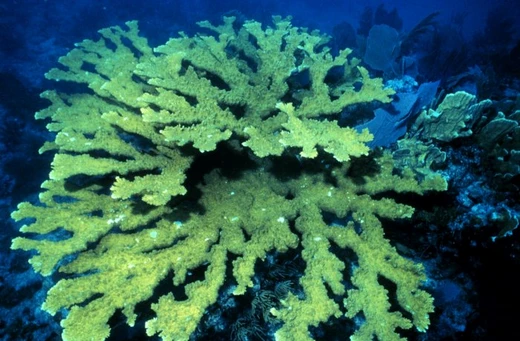
Acropora palmata
A fast-growing Caribbean reef-builder with antler-like branches.

Acropora palmata, commonly known as elkhorn coral, is a reef-building coral species found in the Caribbean. It is notable for its rapid growth rate and complex branching structure that resembles elk antlers, which provides habitat and shelter for many other reef species.
Quick Facts
- Taxon
- Acropora palmata
Facts from the source article.
Lore & Background
Elkhorn coral dominated the Caribbean in the early 1980s, but its population declined dramatically by about 97% between 1980 and 2006, when it was listed as threatened under the Endangered Species Act. The decline resulted from disease, algae growth, climate change, ocean acidification, and human activity. The species evolved during the Mid-Pliocene epoch, 5.2–2.58 million years ago, and thrived during glacial and interglacial events due to increased wave energy aiding fragmentation.
Elkhorn coral is a simultaneous hermaphrodite that spawns once per year after a full moon in late summer. Sexual reproduction requires two genetically distinct parents, and only about 50% of individuals are genetically unique, limiting successful reproduction. Asexual reproduction via fragmentation is much more common and can occur year-round, especially during storms or ship disturbances.
The coral's primary nutrients come from photosynthetic zooxanthellae living in its tissues, making it dependent on sunlight. It lives in shallow, turbulent waters 1 to 5 meters deep, where wave action promotes fragmentation. At night, it can filter-feed on zooplankton when water conditions block sunlight.
Reader's Guide
Elkhorn coral is a keystone reef-builder in the Caribbean, forming thick interlocking thickets that provide shelter for fish, crustaceans, and marine invertebrates. Its lattice-like branches create diverse habitats that support fish nurseries and protect fish from predators, increasing reef diversity and economic value for tourism. The species also offers storm protection by absorbing wave energy, reducing damage to beach shorelines and properties.
Historically, elkhorn coral, along with staghorn coral and star coral, comprised the southeastern reefs over the last 5,000 years. Its rapid growth rate of 5–10 cm per year and ability to reproduce through fragmentation allowed it to dominate Caribbean reefs. However, since the 1980s, populations have severely declined due to bleaching events, disease, and climate change. Conservation efforts under the Endangered Species Act now protect critical habitats in Florida, Puerto Rico, St. John, St. Thomas, and St. Croix, aiming to increase genetic variability and aid recovery.
Did You Know?
- Elkhorn coral can grow up to 13 cm (5 inches) in branch length per year, making it one of the fastest growing coral species.
- The species reproduces asexually most commonly through fragmentation, which can occur at any time of the year.
- Elkhorn coral was listed as threatened under the Endangered Species Act in May 2006.
- Only about 50% of elkhorn corals are genetically unique individuals, limiting successful sexual reproduction.
More in Acropora Corals, Part 2 1-24
Spotted an error? Know more?
Reader corrections go straight into our review queue. Suggest an edit · How this site is sourced