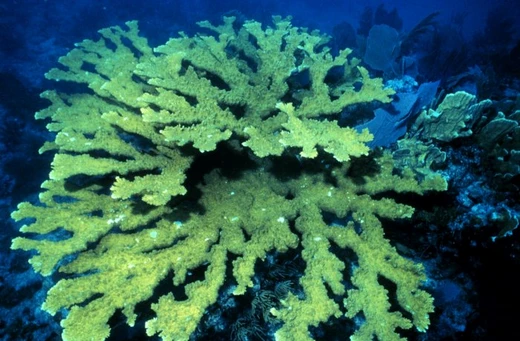
Acropora muricata
A near-threatened staghorn coral forming thickets up to 10 metres wide.

Acropora muricata, commonly called staghorn coral, is a species of acroporid coral found in tropical shallow reefs, slopes of reefs, and lagoons at depths of 5 to 30 m. It was described by Dana in 1846 and is notable for forming large arborescent colonies that can reach diameters of up to 10 metres.
Quick Facts
- Taxon
- Acropora muricata
Facts from the source article.
Lore & Background
Acropora muricata occurs in arborescent colonies that form thickets with diameters of up to 10 metres. Its branches vary from being short in shallower water to less clumped in deeper water. The axial corallites protrude from the branches, and the radial corallites are tube-shaped. The coral is blue, brown, or cream, with pale branch ends. It looks similar to Acropora teres.
The species was originally described as Millepora muricata by Linnaeus in 1758. It is found in the Gulf of Aden, the Red Sea, Indian Ocean, Persian Gulf, Australia, central Indo-Pacific, Japan, Southeast Asia, the East China Sea, and the oceanic central and western Pacific Ocean. Its population figures are unknown, but it is thought to be decreasing due to threats such as global decline of coral reefs, temperature increase causing coral bleaching, climate change, human activity, the crown-of-thorns starfish (Acanthaster planci), and disease.
Reader's Guide
Acropora muricata is significant as a widespread reef-building coral across the Indo-Pacific and Red Sea regions. Its ability to form large thickets up to 10 metres in diameter makes it an important structural component of shallow reef slopes and lagoons. The species is classed as Near Threatened on the IUCN Red List, with a decreasing population trend, though exact figures are unknown. It is listed under Appendix II of CITES, reflecting concern over international trade. Threats include global coral reef decline, rising temperatures causing bleaching, climate change, human activity, predation by the crown-of-thorns starfish (Acanthaster planci), and disease. The coral's variable branch morphology—shorter in shallow water and less clumped in deeper water—suggests adaptation to different light and flow conditions. Its resemblance to Acropora teres may cause identification challenges in the field. The species was originally described by Linnaeus in 1758 as Millepora muricata, and later by Dana in 1846 under its current name.
Did You Know?
- It forms colonies up to 10 metres in diameter.
- Its branches are shorter in shallower water and less clumped in deeper water.
Frequently Asked Questions
What is Acropora muricata?
It's a staghorn coral that builds sprawling, tree-like branching colonies across tropical shallow reefs, reef slopes, and lagoons. Dana first gave it a formal scientific description back in 1846.
Where does Acropora muricata typically grow?
You'll most often spot it in sunlit, flow-rich zones between 5 and 30 metres deep, clinging to reef flats, slopes, and lagoon edges. It favours the same kind of well-lit tropical shallow-water habitats that most acroporids call home.
How big can a single Acropora muricata colony get?
Under favourable conditions a colony can spread to a diameter of roughly 10 metres, producing dense, arborescent thickets of spiny branches. That scale makes it one of the more visually striking staghorn species on a reef.
Who described Acropora muricata and when?
The species was formally named by Dana in 1846, giving it a fairly long taxonomic pedigree. The epithet 'muricata' nods to the small spiny, tooth-like projections that line its branches.
What is the conservation status of Acropora muricata?
The IUCN currently classifies it as Near Threatened, a nod to ongoing pressure from warming sea temperatures, sedimentation, and coastal development. Populations are trending downward in several regions, though the species is not yet in immediate danger of disappearing.
More in Acropora Corals, Part 2 1-24
Spotted an error? Know more?
Reader corrections go straight into our review queue. Suggest an edit · How this site is sourced