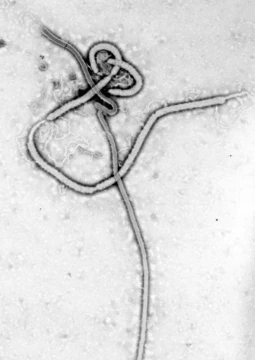
Ebola virus
A highly lethal filovirus causing severe hemorrhagic fever in humans.

Ebola virus (EBOV) is the sole member of the species Zaire ebolavirus within the genus Orthoebolavirus and the cause of the majority of human deaths from Ebola virus disease (EVD). It was the cause of the 2013–2016 epidemic in western Africa, which resulted in at least 28,646 suspected cases and 11,323 confirmed deaths. The virus is a Risk Group 4 Pathogen requiring Biosafety Level 4-equivalent containment and is listed as a Category A Bioterrorism Agent.
- Field
- Virology
- Known for
- Causing Ebola virus disease (EVD) and the 2013–2016 western Africa epidemic
- Genome type
- Single-stranded negative-sense RNA, ~19,000 nucleotides
- Fatality rate
- Up to 83 to 90 percent
- Natural reservoir
- Bats, particularly fruit bats
Lore & Background
Ebola virus and its genus were originally named for Zaire (now the Democratic Republic of the Congo), where it was first described, and was initially suspected to be a new strain of Marburg virus. The virus has been called Ebola virus since its discovery in 1976; the 2010 taxonomic revision renamed the species to Zaire ebolavirus and the genus to Orthoebolavirus, not the virus itself. The virus is the single member of the species Zaire ebolavirus, assigned to the genus Orthoebolavirus, family Filoviridae, order Mononegavirales. Its natural reservoir is believed to be bats, particularly fruit bats, and it is primarily transmitted through body fluids.
Reader's Guide
Ebola virus is significant as one of the most lethal pathogens known, with a fatality rate up to 83 to 90 percent. It caused the 2013–2016 western Africa epidemic, the largest EVD outbreak on record, with over 28,000 suspected cases and more than 11,000 confirmed deaths. The virus's high mortality and potential for bioterrorism have led to its classification as a select agent and a US Category A Priority Pathogen. Research has identified host proteins NPC1 and TIM-1 as critical for viral entry, offering potential therapeutic targets. The virus mutates rapidly, with a rate comparable to seasonal influenza, complicating vaccine and treatment development. Its genome encodes seven structural proteins, and its replication cycle involves host cell machinery. Understanding Ebola virus ecology and transmission remains crucial for outbreak prevention and control.
Did You Know?
- Ebola virus has a fatality rate of up to 83 to 90 percent.
- The natural reservoir of Ebola virus is believed to be bats, particularly fruit bats.
- The EBOV genome is a single-stranded RNA approximately 19,000 nucleotides long.
More in Zoonoses 1-24
Spotted an error? Know more?
Reader corrections go straight into our review queue. Suggest an edit · How this site is sourced