Balantidiasis
Protozoan infection from pigs, often asymptomatic.

National Museum of Health and Medicine · CC BY 2.0
Balantidiasis is an infection caused by the protozoan *Balantidium coli*. This parasite is the only ciliated protozoan known to infect humans, and it is the largest protozoan parasite to do so. The disease is zoonotic, meaning it spreads from animals to people, primarily through the fecal-oral route. Pigs are the main reservoir, though the parasite also occurs frequently in rats and has been found in several non-human primates, including chimpanzees, white-handed gibbons, squirrel monkeys, sacred baboons, and Japanese macaques. In a Japanese study of 56 mammalian species, *B. coli* was present in all wild boars tested and in five primate species; other research has also identified it in members of the order Carnivora.
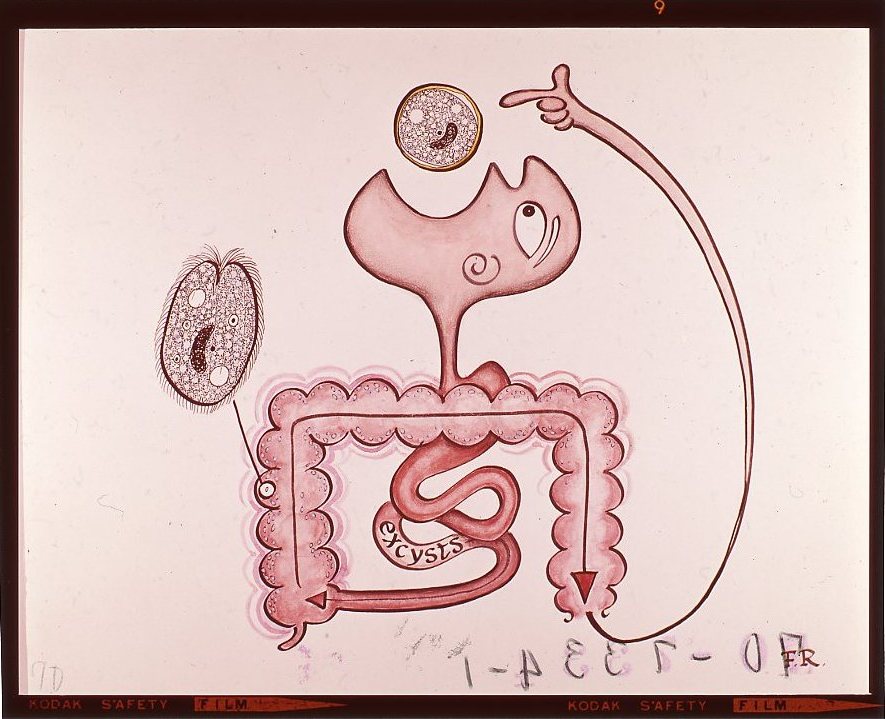
The parasite exists in two developmental stages: the trophozoite and the cyst. Trophozoites are oblong or spherical, measuring 30 to 150 μm in length and 25 to 120 μm in width. They have both a large, sausage-shaped macronucleus and a less prominent micronucleus. At this stage, the organism is not infective but can reproduce through transverse binary fission. The cyst stage is smaller and more spherical, about 40 to 60 μm in diameter, with a tough outer wall of one or more layers. Cysts are non-motile, do not reproduce, and must be ingested for infection to occur.
Transmission happens when humans consume food or water contaminated with feces from an infected host, typically a pig. Poor sanitation increases the risk. The first recorded case in the Philippines—where the disease is most common—was in 1904. An earlier attempt in 1896 by Cassagrandi and Barnagallo to induce balantidiasis in humans was unsuccessful, and it remains unclear whether *B. coli* was the actual parasite used. Today, the infection is found worldwide, but fewer than 1% of people are infected. Human infection is more frequent in areas where pigs and people live closely, such as the Philippines, Bolivia, and Papua New Guinea.
Most people with healthy immune systems show no symptoms. When symptoms do occur, they can include intermittent diarrhea, constipation, vomiting, abdominal pain, loss of appetite, weight loss, fever, fatigue, weakness, headache, colon inflammation, marked fluid loss, and prostate hyperplasia in males. The most common signs are intermittent diarrhea and constipation, or colon inflammation with abdominal cramps and bloody stools.
Quick Facts
- Field
- Infectious disease
Facts from the source article.
Lore & Background
Balantidiasis is caused by Balantidium coli, the only ciliated protozoan known to infect humans. The first study to generate balantidiasis in humans was undertaken by Cassagrandi and Barnagallo in 1896, but this experiment was not successful in creating an infection and it was unclear whether Balantidium coli was the actual parasite used. The first case of balantidiasis in the Philippines, where it is the most common, was reported in 1904. Currently, Balantidium coli is distributed worldwide but less than 1% of the human population is infected. Pigs are a major reservoir, and infection occurs more frequently in areas where pigs commingle with people, including the Philippines, Bolivia, and Papua New Guinea. The parasite also has a high rate of occurrence in rats, and in a Japanese study it was found in wild boars and five species of non-human primate: Chimpanzee, White-handed gibbon, Squirrel monkey, Sacred baboon, and Japanese macaque. It has also been found in species from the order Carnivora.
Reader's Guide
Balantidiasis is significant as the only ciliated protozoan infection in humans, with pigs as the primary reservoir. It is usually asymptomatic in immunocompetent individuals, but symptoms can include intermittent diarrhea, constipation, abdominal pain, and colon inflammation. Diagnosis involves microscopic examination of stools for trophozoites or cysts, or colonoscopy/sigmoidoscopy biopsy. Prevention focuses on water treatment (though chlorine is ineffective against cysts), food safety, separating pigs from living spaces, and proper manure management. Treatment includes tetracycline, metronidazole, or iodoquinol, with iodoquinol effective against both cyst and trophozoite stages but limited to gastrointestinal sites. The parasite exists as trophozoites (replicative, non-infective) and cysts (infective, non-motile). Its legacy lies in understanding zoonotic transmission and the importance of sanitation in agricultural communities.
Did You Know?
- Balantidium coli is the largest protozoan parasite of humans, with trophozoites 30 to 150 μm in length.
- Chlorine at concentrations normally used for municipal water treatment is not effective against Balantidium cysts.
- Balantidium coli has been found in five species of non-human primate, including Chimpanzee and Japanese macaque.
Origins & Early Recognition
The earliest documented attempt to deliberately produce balantidiasis in a human subject was carried out by Cassagrandi and Barnagallo in 1896. That pioneering effort ultimately failed to establish an infection, and even the identity of the parasite used in the experiment remained uncertain. Decades of obscurity followed until 1904, when the first confirmed case surfaced in the Philippines, a country that would go on to become the region where the disease is most prevalent. Today, Balantidium coli circulates on every inhabited continent, yet fewer than one percent of the global human population carries the organism. The parasite's geographic footprint tracks closely with pig husbandry: wherever swine live in close proximity to people, as in the Philippines, Bolivia, and Papua New Guinea, human infections appear with greater frequency. This zoonotic pattern, combined with the organism's status as the sole ciliated protozoan known to colonize the human gut, makes balantidiasis a uniquely positioned chapter in the history of parasitology.
A Parasite with a Wide Appetite: Host Range
Although domestic pigs are the principal reservoir for Balantidium coli and serve as the typical source of human infection, the organism's ecological reach extends far beyond a single species. Rats harbor the parasite at notably high rates, and a comprehensive Japanese survey that screened fecal samples from fifty-six mammalian species revealed an astonishing breadth of hosts. Every wild boar tested, considered the same species as the domestic pig, carried the organism, and it was additionally detected in five distinct non-human primate species: the chimpanzee, the white-handed gibbon, the squirrel monkey, the sacred baboon, and the Japanese macaque. Members of the order Carnivora have likewise been shown to host B. coli in separate investigations. This cross-species distribution underscores that balantidiasis is not a narrowly pig-to-human affair but a broader zoonotic phenomenon. In its natural pig hosts, the parasite remains entirely asymptomatic, making pigs efficient and silent vectors that can shed infectious cysts into the environment without any outward sign of illness.
Two Faces of the Organism: Morphology & Reproduction
Balantidium coli alternates between two morphologically distinct developmental stages, each serving a different biological purpose. The trophozoite, the active feeding form, ranges from oblong to roughly spherical and measures between thirty and one hundred fifty micrometers in length and twenty-five to one hundred twenty micrometers in width. These dimensions make it the largest protozoan parasite that infects humans. Under the microscope, a trophozoite displays two nuclei: a conspicuously large, sausage-shaped macronucleus and a smaller, less prominent micronucleus. The surface is studded with cilia, and the organism reproduces by transverse binary fission. Crucially, however, the trophozoite is not the infective stage. That role belongs to the cyst, a smaller, more perfectly spherical body roughly forty to sixty micrometers across. The cyst is encased in a tough wall composed of one or more layers, is completely non-motile, and does not divide. Only when a person ingests a cyst does the infection cycle begin, making this dormant, armored form the critical gateway for transmission.
From Symptoms to Cure: Clinical Picture & Therapeutic Options
In immunocompetent individuals, balantidiasis most often passes without notice. When symptoms do emerge, they tend to cluster around the gastrointestinal tract: intermittent diarrhea alternating with constipation, abdominal cramping, vomiting, anorexia, and bloody stools. More severe presentations can include fever, marked fluid loss, fatigue, headache, and inflammation of the colon. In adult males, prostate hyperplasia has been noted as an unusual but documented manifestation. Because the symptom profile is variable and may present incompletely, diagnosis often hinges on a probable exposure history, such as recent contact with pigs or infected individuals, combined with microscopic identification of trophozoites or cysts in stool samples, or histological evidence obtained through colonoscopy or sigmoidoscopy biopsy. Treatment follows three well-established regimens: tetracycline at five hundred milligrams four times daily for ten days, metronidazole at seven hundred fifty milligrams three times daily for five days, or iodoquinol at six hundred fifty milligrams three times daily for twenty days. Iodoquinol targets both life stages but is confined to the gastrointestinal lumen because it is poorly absorbed into the bloodstream. Nitazoxanide, paromomycin, and chloroquine represent additional therapeutic options.
Gallery
Frequently Asked Questions
Who is Balantidiasis?
Balantidiasis is a zoonotic intestinal infection caused by the ciliated protozoan Balantidium coli. It is the only ciliated protozoan species known to parasitize humans and is the largest protozoan parasite to do so, with trophozoites measuring 30 to 150 micrometers.
What are Balantidiasis's powers/role?
The parasite typically causes mild or completely asymptomatic gastrointestinal illness, though it can produce dysentery-like symptoms in vulnerable hosts. It spreads via the fecal-oral route, with pigs as the principal animal reservoir and the organism also documented in rats and several primate species.
Why is Balantidiasis important?
It occupies a unique niche in parasitology as the sole ciliated protozoan to infect humans, making it a valuable model for studying ciliate biology in a host-parasite relationship. Despite a global prevalence of less than one percent of the human population, it remains a recognized zoonotic concern wherever close human–pig contact persists.
Where does Balantidiasis come from?
The parasite's primary natural reservoir is the pig, though it has also been recorded in rats and multiple non-human primates including chimpanzees, gibbons, and macaques. The first documented human case surfaced in the Philippines in 1904, following an unsuccessful 1896 investigation by Cassagrandi and Barnagallo.
More in Zoonoses 1-24
Spotted an error? Know more?
Reader corrections go straight into our review queue. Suggest an edit · How this site is sourced