
Albi Cathedral
Fortress-like exterior, richly decorated interior, largest brick building.

Didier Descouens · CC BY-SA 4.0
Albi Cathedral, also called the Cathedral of Saint Cecilia of Albi, serves as the home church for the Catholic Archbishop of Albi. Its construction began shortly after the Albigensian Crusade, and from the outside it looks more like a fortress than a place of worship, with a severe, defensive appearance. Inside, however, the decoration is rich and colorful: bright blues and golds cover the walls, and the space is filled with intricate sculpture and artwork, including an elaborate choir screen. The building is built in the Southern French Gothic style, also known as Toulousian Gothic. It is often described as the largest brick structure anywhere in the world. Work started in 1282 and continued for two centuries. In 2010, UNESCO added the cathedral and its associated bishop’s buildings to its World Heritage list, citing the building’s distinctive architecture and the unusual coherence of its design.
- Location
- Albi, France
- Type
- Cathedral
- Architectural style
- Toulousian or Southern French Gothic
- Construction started
- 1282
- Construction duration
- 200 years
- Height of tower
- 78 meters
- Unesco designation
- 2010
Lore & Background
The first recorded church on the site was built at the end of the 4th century and is believed to have burned in about 666. A second church, named for Saint Cecilia, is mentioned in 920. A third Romanesque church was built of stone at the end of the 12th century. In the 12th century, Albi was part of the Province of Languedoc, and the region became a battleground between the established church and the Cathars. The Albigensian Crusade, launched in 1208, ended in 1229 with the defeat of the Cathars. Bernard de Castanet, who became Bishop of Albi in 1276, was the key figure behind the construction of the Gothic cathedral. He raised funds by setting aside one-twentieth of the revenue of the chapter and offering spiritual incentives to donors. He economised by using brick rather than stone. Construction began with the apse between 1282 and 1300. The nave walls were built between about 1310 and 1340, followed by the base of the bell tower between 1355 and 1366. The cathedral was finally consecrated on 23 April 1480.
Reader's Guide
Albi Cathedral is significant as a monumental expression of the power of the Catholic Church after the Albigensian Crusade. Its fortress-like appearance was intended to illustrate the power of the bishop, his unity with the king, and his fierce resistance against heresy. The use of brick made it economical to build on a massive scale, and it is claimed to be the largest brick building in the world. The interior contrasts sharply with the exterior, featuring a lavishly decorated choir screen, a large mural of the Last Judgement, and bright blues and golds. The cathedral's construction spanned 200 years, with major decorative projects continuing into the 16th century. During the French Revolution, the rood screen was threatened with destruction but was spared due to the intervention of an engineer. The first major restoration took place between 1849 and 1876, led by architect César Daly, who added a balustrade and small towers that were not original. The cathedral's UNESCO World Heritage designation in 2010 recognizes its unique architecture and design consistency.
Did You Know?
- The cathedral was built in the aftermath of the Albigensian Crusade, which was named for Albi.
- The rood screen was saved from destruction during the French Revolution by an engineer of the Ministry of Bridges and Highways.
A Fortress of Faith Born from Heresy
The cathedral of Sainte-Cécile did not emerge from a peaceful era. In 1208, the Pope and the French king united their forces against the Cathars, a group whose ascetic Christian dualism the dominant Catholic Church deemed a dangerous heresy. The repression that followed was brutal—Cathars were burned at the stake across the region, and the once-virtually independent territory was crushed and annexed by the French Crown. It was into this wounded landscape that Bishop Bernard de Castanet set his vision. After completing the Palais de la Berbie, a fortress-like episcopal palace at the close of the thirteenth century, Castanet ordered the construction of Sainte-Cécile in 1282. The cathedral was conceived as a monumental declaration of the Christian faith, a brick answer to the upheavals of the Albigensian Crusade. Its very existence was an act of theological and political assertion, raising a structure that would dominate the skyline of Albi for seven centuries and anchor the identity of the episcopal city that grew around it.
Brick, Light, and the Southern Gothic Vision
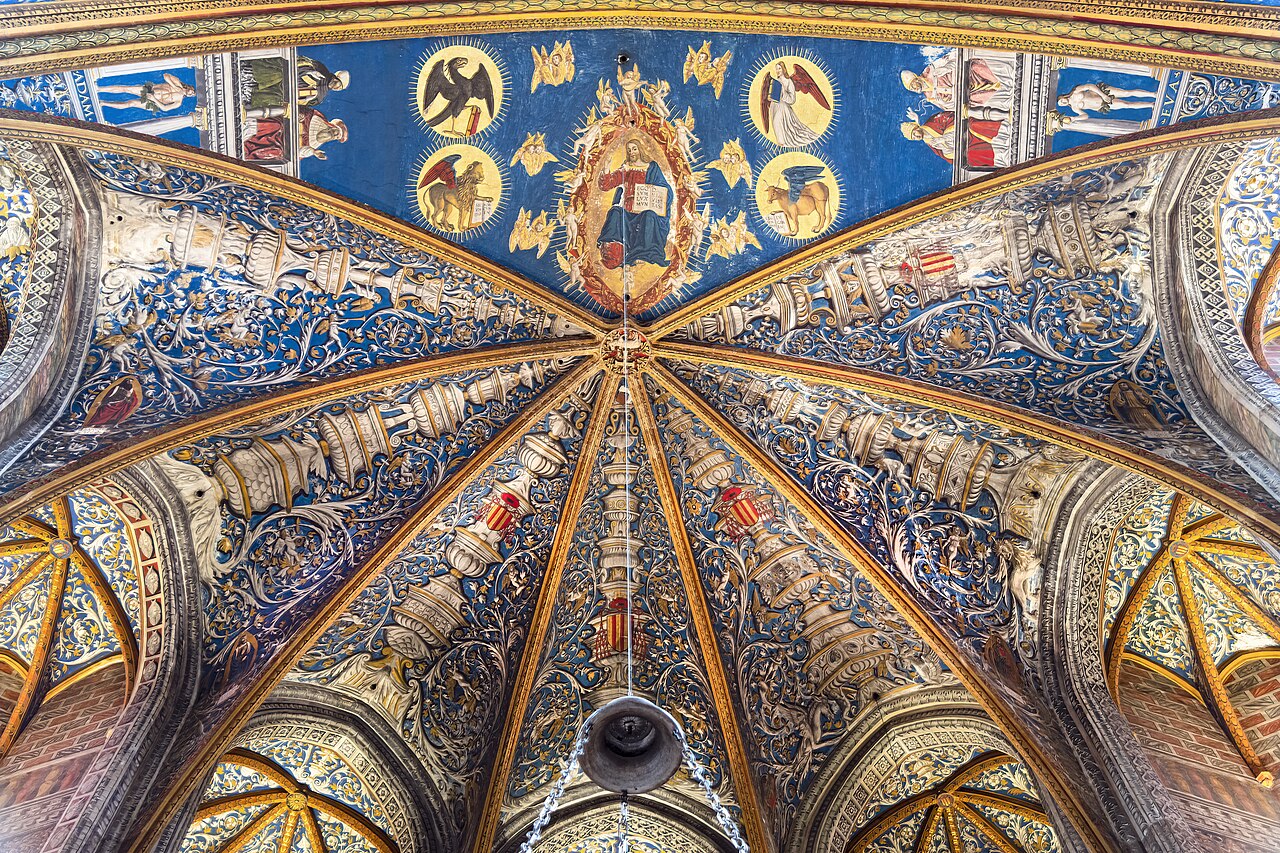
Sainte-Cécile stands as a landmark of the Southern Gothic tradition, its construction spanning the thirteenth through fifteenth centuries. What strikes any visitor first is the dramatic tension between outside and within. The exterior presents an austere, almost military profile—thick walls of local red brick that speak of defense and permanence. Step inside, however, and the space transforms into sumptuous, layered decoration. Over the centuries the cathedral accumulated embellishments that give it a rich palimpsest quality: the Dominique de Florence Doorway, a bell tower rising to seventy-eight metres, and the Baldaquin over the entrance, crafted between 1515 and 1540. Perhaps the most breathtaking interior feature is the rood screen, a delicate filigree work in stone executed in the Flamboyant Gothic idiom. It carries a magnificent group of polychrome statuary carved by artists from the Burgundian workshops of Cluny, numbering over two hundred figures that have remarkably retained their original colours to this day.
The Episcopal City and World Heritage Status
The cathedral does not stand alone. It is the gravitational centre of a sixty-three-hectare historic area that UNESCO inscribed on its World Heritage list in 2010, recognising the Episcopal City of Albi for its unique architecture. In its assessment, UNESCO described the ensemble—comprising the fortified late-thirteenth-century cathedral in its distinctive southern French Gothic brick style, the bishop's Palais de la Berbie, the Old Bridge, the Saint-Salvi quarter and its church, and the surrounding residential areas—as a coherent and largely unchanged collection of monuments and neighbourhoods stretching back through the centuries. The body of UNESCO text further calls it a complete built ensemble representative of a type of urban development in Europe running from the Middle Ages to the present day. Red brick and tiles define the visual language of most edifices in this zone, placing Albi alongside Toulouse and Montauban as one of the principal cities of Languedoc-style brick construction.
The Bishop's Fortress and a Painter's Legacy
Adjacent to the cathedral stands the Palais de la Berbie, a name drawn from the Occitan word Bisbia, meaning Bishops' Palace. Completed at the end of the thirteenth century under Bishop Castanet, this imposing fortress is older than the Palais des Papes in Avignon and ranks among the oldest and best-preserved castles in France. Today it houses the Musée Toulouse-Lautrec, a connection that might seem unexpected until one learns that Henri de Toulouse-Lautrec was born in Albi in 1864. The museum holds more than a thousand works by the artist, including thirty-one of his famous posters, forming the largest public collection in the world devoted to his career. The pairing of a medieval episcopal fortress with the vibrant, modernist art of a local son creates a striking dialogue across centuries. Together with the cathedral, the palace anchors the episcopal city that gave Albi its identity as the seat of the Archbishop of Albi and a place where medieval power and artistic legacy coexist under the same brick sky.
Gallery
Frequently Asked Questions
What is Albi Cathedral?
Albi Cathedral, formally the Cathedral of Saint Cecilia of Albi, is the seat church of the Catholic Archbishop of Albi in southern France. It is a UNESCO World Heritage Site and one of the most distinctive medieval buildings in the country.
Why does Albi Cathedral look like a fortress?
Its severe, defensive exterior reflects the turbulent aftermath of the Albigensian Crusade, when the local Catholic leadership wanted a structure that could double as a stronghold. Thick, unadorned brick walls and a heavy silhouette give it a distinctly military character rather than a typical ecclesiastical one.
What does the interior of Albi Cathedral look like?
In sharp contrast to the austere outside, the nave is lavishly covered in vivid blues and golds, with dense sculptural programs lining the walls. A particularly eye-catching feature is the elaborate choir screen that separates the nave from the sanctuary.
What architectural style is Albi Cathedral built in?
It is a textbook example of Southern French Gothic, a regional variant commonly called Toulousian Gothic. This style favors brick over cut stone while still employing pointed arches and ribbed vaulting typical of the broader Gothic tradition.
What makes Albi Cathedral unique among French cathedrals?
It is widely cited as the largest brick-built structure in the world, a distinction few other medieval cathedrals can claim. Construction began in 1282 and stretched over roughly two centuries, culminating in a 78-meter tower that still dominates the Albi skyline.
More in World Heritage Sites in France 1-24
Spotted an error? Know more?
Reader corrections go straight into our review queue. Suggest an edit · How this site is sourced