Lupercalia
Ancient Roman pastoral festival of purification and fertility.
The ancient Roman festival Lupercalia, or Lupercal, took place each year on February 15. It was a pastoral celebration meant to cleanse the city and encourage health and fertility. People also called it dies Februatus, a name derived from the cleansing tools known as februa, which in turn gave the month Februarius its name.
Quick Facts
- Longtype
- Classical Roman religion
- Observedby
- Roman Kingdom
- Roman Republic
- Roman Empire
- Date
- February 15
- Celebrations
- feasting
Facts from the source article.
Rites
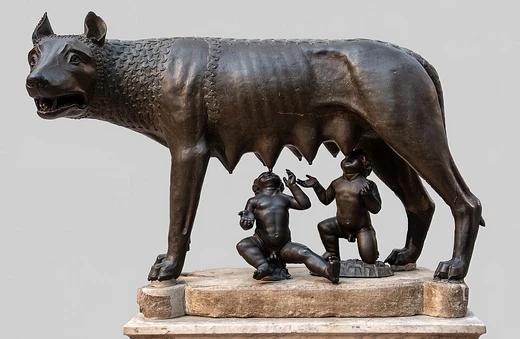
The Lupercalia took place in the Lupercal cave, the Palatine Hill, and the Forum, all key spots in Rome's founding stories. Next to the cave was a shrine to Rumina, the goddess of breastfeeding, and a wild fig tree called the Ficus Ruminalis. Some Roman writers called it caprificus, meaning 'goat fig'. The river god Tiberinus brought Romulus and Remus to this tree. Its hanging fruit and milky sap when cut made it a natural fit for a cult focused on breastfeeding. The festival had its own priests, the Luperci, or 'brothers of the wolf'. People said either the Arcadian hero Evander or Romulus and Remus started their rites. The Luperci were young men, usually between twenty and forty years old. They belonged to two religious groups based on family lines: the Quinctiliani, named after the Quinctia clan, and the Fabiani, named after the Fabia clan. Each group had a leader called a magister. In 44 BC, a third group, the Juliani, was created to honor Julius Caesar, with Mark Antony as its first magister. This group broke up or faded away after Caesar was killed, and Augustus did not bring it back. During the imperial period, the two older groups let in young men of equestrian rank. At the Lupercal altar, one or more Luperci sacrificed a male goat or goats and a dog, watched over by the Flamen dialis, Jupiter's high priest. The Vestal Virgins made salted mealcakes as an offering. After the blood sacrifice, two Luperci went to the altar. Their foreheads were smeared with blood from the sacrificial knife, then wiped clean with wool soaked in milk, and they had to laugh. Then came the sacrificial feast. After that, the Luperci cut strips called februa from the goat's skin and ran, mostly naked, counterclockwise along the old Palatine boundary. Plutarch wrote that they finished their run around the Palatine and went back to the Lupercal cave.
History
The Februa was a very old festival, possibly originating with the Sabines. Once the month of February was added to the Roman calendar, the Februa fell on the fifteenth day of that month. Over time, the rituals of the Lupercalia became the most important part of the Februa. The Romans believed the Lupercalia was started by Evander, a Greek hero from Arcadia who, according to legend, brought the Greek gods, laws, and alphabet to Italy and founded a city called Pallantium on the spot where Rome would later stand, sixty years before the Trojan War. The festival was observed in various parts of Italy; inscriptions mentioning the Luperci, the festival's priests, have been found in Velitrae, Praeneste, and Nemausus (now Nîmes). The Hirpi Sorani, or "wolves of Soranus," a cult from Mount Soracte about 45 kilometers north of Rome, practiced rites that had similarities to the Roman Lupercalia. Records of the festival in 44 BC show it was still going strong; during that celebration, Mark Antony offered Julius Caesar a golden crown, which Caesar publicly refused. The cave of the Lupercal was either restored or rebuilt by the emperor Augustus, and some have guessed it might be the same as a grotto discovered in 2007, buried 50 feet under the remains of Augustus's house. Most scholars, however, think that grotto was a nymphaeum, not the Lupercal. The Lupercalia appears on a calendar from the year 354 alongside both traditional Roman and Christian holidays. Even after all non-Christian cults and festivals were banned in 391, the nominally Christian population kept celebrating the Lupercalia regularly into the reign of Emperor Anastasius. Pope Gelasius I, who was pope from 494 to 496, complained that only the "vile rabble" took part and tried to forcefully end the festival. The Roman Senate objected, saying the Lupercalia was vital to Rome's safety. Gelasius sarcastically replied that if they believed the rite had healing power, they should celebrate it themselves in the old way and run around naked. There is no proof from the time that Gelasius actually abolished the Lupercalia or that he or any other church leader replaced it with the Feast of the Purification of the Blessed Virgin Mary. The connection between the Lupercalia and the romantic side of Saint Valentine's Day comes from the writings of Chaucer and the poetic tradition of courtly love.
Legacy
The Lupercalia festival is referenced in Horace’s Ode III, 18. Its rituals gave the name February (mensis Februarius) to the Roman month, which carried into the modern calendar. The god Februus, who represented both the month and purification, likely appeared after both. William Shakespeare’s Julius Caesar opens during Lupercalia, where Caesar orders Mark Antony to strike his wife Calpurnia to help her conceive. A 2019 study proposed that the word Leprechaun comes from Lupercus. Musician Patrick Wolf named his fifth album Lupercalia after the festival.
More in Wolves in Folklore, Religion and Mythology
Spotted an error? Know more?
Reader corrections go straight into our review queue. Suggest an edit · How this site is sourced