Wolves in folklore, religion and mythology
The wolf appears across Eurasian and North American mythologies as symbol, ancestor, and guardian.
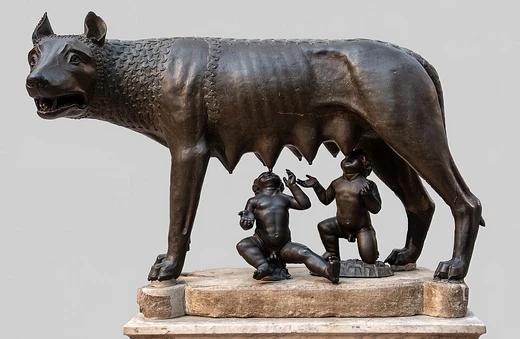
The wolf appears as a significant motif in the foundational myths and cosmologies of peoples across Eurasia and North America, corresponding to the historical range of the gray wolf. It holds particular importance among nomadic cultures of the Eurasian steppe and North American Plains. The modern trope of the Big Bad Wolf originates in European folklore, while wolves have also been associated with witchcraft in northern European and some Native American traditions.
Quick Facts
- Genesis reference
- Genesis 49:27
- Book of isaiah reference
- Isaiah 11:6
- Book of jeremiah reference
- Jeremiah 5:6
- New testament references
- Matthew 10:16
- Acts 20:29
- Matthew 7:15
- Chechen national symbol
- Wolf
Facts from the source article.
Did You Know?
- In the Babylonian epic Gilgamesh, the goddess Ishtar transformed a shepherd into a wolf after he rejected her.
- The name Georgia derives from an Old Persian term meaning 'land of the wolves'.
- The Turkic myth of Ashina tells of a she-wolf with a sky-blue mane who nursed a baby and later gave birth to half-wolf, half-human cubs from whom the Turkic people were born.
Indo-European
In Proto-Indo-European mythology, the wolf was likely linked to the warrior class known as the kóryos, whose initiation involved a symbolic transformation into wolves or dogs. This tradition appears in Iron Age Europe through Tierkrieger depictions from the Germanic sphere. Lithuanian legend holds that Grand Duke Gediminas dreamed of an iron wolf howling on a hill, leading to the founding of Vilnius. The Lithuanian goddess Medeina, a huntress who refused marriage, was portrayed as a she-wolf accompanied by wolves. Mircea Eliade proposed that the Dacians may have called themselves wolves or beings identical to wolves, suggesting religious significance. Their name may derive from a wolf-like god or legendary ancestor, or from young outlaws who lived like wolves during initiation. Hittite laws similarly referred to fugitive outlaws as wolves.
Arctic and North America
Across many Native American cultures, wolves are regarded as medicine beings, embodying courage, strength, loyalty, and hunting prowess. Among Aboriginal Canadians, those who lived by hunting typically held wolves in high esteem, while agricultural communities often thought little of them. Alaska Natives like the Nunamiut admired the wolf’s hunting abilities and tried to imitate them. The Naskapi, Squamish, and Lil’wat see the wolf as a guide for daytime hunting; the Naskapi also tell of giant wolves guarding the caribou afterlife and punishing careless hunters. The Netsilik Inuit and Takanaluk-arnaluk believed wolves protected the home of the seawoman Nuliayuk. The Tsilhqot’in feared wolves, thinking contact could bring nervous illness or death, while the Dena’ina considered wolves former humans and treated them as brothers. The Tsitsista, Lakota, Dakota, Siksikaitsitapi, Assiniboine, Arikara, Arapaho, Osage, Shoshone, and Pawnee share stories of wolves as hunting teachers. The Tsitsista call wolves masters of the grasslands and protectors of all animals. The Siksikaitsitapi view wolves as friends and forbid shooting them. In Pawnee spiritual tradition, the wolf was the first being to experience death. The Lenape include a Wolf clan among their three main clans. Mexican wolves and related subspecies hold importance for the Apache, Akimel O’odham, Diné, Hopi, and Havasupai, and were symbolically linked to the Sun, war, and the god Xolotl in Teotihuacan and other Pre-Columbian Mexican cultures.
Abrahamic traditions
In the Tanakh, the wolf symbolizes the Tribe of Benjamin, originating from Jacob's blessing in Genesis 49:27: Benjamin is a ravenous wolf who consumes the foe in the morning and divides the spoil in the evening. This has been interpreted as referencing the tribe's warlike nature and victorious members such as King Saul and Mordecai. The Temple in Jerusalem was partly in Benjamin's territory, and some interpretations see the ravenous wolf as the altar devouring sacrifices. The wolf appears as a symbol for Benjamin across Jewish, Samaritan, and Christian artwork. Isaiah 11:6 predicts that in the Messianic Age the wolf shall dwell with the lamb. Jeremiah 5:6 warns that the wolf of the desert ravages as divine punishment; Rashi interpreted this wolf as representing the Kingdom of Media. Medieval Jewish folklorist Berechiah ha-Nakdan wrote extensively about wolves in his Mishlè Shu'alim. Late Victorian Anglo-Jewish authors likened the Jewish community to Europe's wolves, focusing on pack dedication and brotherhood. The Bible contains 13 references to wolves, often as metaphors for greed and destructiveness. In the New Testament, Jesus used wolves as illustrations of dangers his followers would face.
Modern folklore, literature and pop culture
The popular image of the wolf is heavily shaped by the Big Bad Wolf from Aesop's Fables and Grimm's Fairy Tales. Christian symbolism portraying the wolf as the devil or evil, preying on the faithful as sheep, appears frequently in Western literature, as in Milton's Lycidas. In Scandinavian tradition, the wolf as warrior or protector sometimes combined with Christian symbolism of evil, becoming a popular attribute in heavy metal music, used by bands such as Powerwolf, Sonata Arctica, Marduk, Watain, Wintersun, and Wolf. Recent animated films including Balto, Princess Mononoke, The Secret of Kells, and Wolfwalkers portray wolves sympathetically, often as spiritual guardians protecting forests from human encroachment. In Walt Disney's The Jungle Book, the wolf pack are dedicated and protective parents to the protagonist Mowgli.
More in Wolves in Folklore, Religion and Mythology
Spotted an error? Know more?
Reader corrections go straight into our review queue. Suggest an edit · How this site is sourced