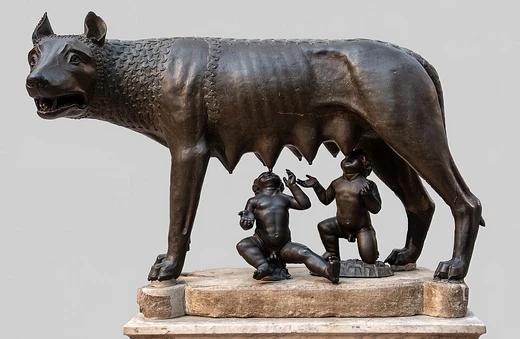
She-wolf (Roman mythology)
She-wolf who nursed Romulus and Remus in Roman myth.
In Roman foundation myth, the she-wolf (lupa in Latin) was an Italian wolf who nursed and sheltered the abandoned twins Romulus and Remus at her den, the Lupercal. She cared for them until a shepherd discovered them, and Romulus later became Rome's founder and first king. The image of the she-wolf suckling the twins is one of the most recognizable icons of ancient mythology and has been a symbol of Rome since ancient times.
Quick Facts
- Key figures
- Romulus
- Remus
- King Amulius of Alba Longa
- shepherd Faustulus
- Location of den
- Lupercal (cave)
- Associated deity
- Mars (wolf is his sacred animal)
- Earliest coin depiction
- 269 BC silver didrachm
Facts from the source article.
Did You Know?
- The Lupercalia was a very ancient festival even during Roman times, possibly associated with the god Lupercus, god of shepherds and protector of flocks.
- Some historians link the Lupercalia to the she-wolf and the Lupercal.
Origins
The she-wolf myth may have come from early Etrusco-Italic traditions as well as Greek ones. Since wolves were the main danger in the northern Mediterranean, people turned fear into awe and respect for them. The Hirpini people supposedly got their name from an Osco-Umbrian word for wolf, after a wolf led them to their first colony. The Lupercal legend likely existed before the story of Romulus and Remus. In Greek myth, Apollo's mother Leto became a she-wolf to give birth and escape Hera.
Literary sources
The three canonical versions of the myth—those of Livy, Plutarch, and Dionysius of Halicarnassus—all draw heavily on Quintus Fabius Pictor, one of Rome's earliest historians, whose now-lost work describes the she-wolf and the twins. The twins were abandoned at Amulius's order; some tales say they were to be left along the riverbank, others cast into the water. The servant either thought better of it or could not get close enough due to flooding, leaving them in standing water at the foot of Palatine Hill. The twins were found after their basket was left at a fig tree or came to rest there. In each account, the she-wolf rescued them and cared for them in or near the Lupercal until local shepherds discovered them. Dionysius reports that raised waters forced the servant to abandon the twins before the intended spot; the basket struck a stone, flipping the twins into mud, and the she-wolf lowered her teats to the crying babes and licked them clean. A shepherd witnessed this and gathered companions; the she-wolf withdrew into a cave sacred to Greek colonists with an altar to Pan. Livy claims the servants dropped the twins in standing water out of laziness, and the fig tree was the first spot they reached; the twins cried until waters receded, and the she-wolf arrived from the hills seeking water. Plutarch says the servant feared the torrential waters; after being left on the bank, waters rose and swept the twins to the fig tree.
Iconography
The famous Capitoline Wolf may be of Etruscan or Old Latin origin, but restoration in 2000 and radiocarbon dating cast doubt on an ancient origin. An Etruscan stele from Bologna (350–400 BC) shows an animal, possibly a wolf, nursing one infant. By 269 BC, the silver didrachm is the earliest complete icon, with the she-wolf's head turned backward and downward at the twins. The imagery became more recognizable than other Roman symbols, useful as the empire expanded; by the 1st century AD, it was common in Rome and provinces, appearing on the Ara Pacis. Coins were minted widely and in Roman colonies to express Roman-ness; the image appears on personal items, monuments, mosaic floors, and funerary stones from the 1st–3rd centuries AD. The Franks Casket, an 8th–9th-century Anglo-Saxon chest, features the she-wolf and twins with a Runic account; other Anglo-Saxon artifacts and coins also show them. Byzantines continued the image, with coins found in central Asia (modern Tajikistan and Uzbekistan) and an 8th-century Sogdian mural of a she-wolf suckling two infants. Italian football clubs A.S. Roma and S.S. Robur Siena use the imagery in logos; Mussolini's Fascist government also used it.
More in Wolves in Folklore, Religion and Mythology
Spotted an error? Know more?
Reader corrections go straight into our review queue. Suggest an edit · How this site is sourced