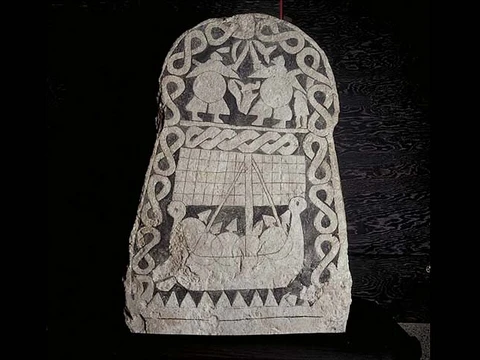
Norse colonization of North America
Norse explorers settled Greenland and briefly reached North America.
Last updated
Norse Greenlanders established settlements on the southwestern coast of Greenland and later voyaged to parts of North America.[1][2] The only confirmed Norse settlement in North America outside Greenland is at L'Anse aux Meadows in Newfoundland, occupied around 1021.[3][4]
Last updated 2026-10-05 from the source article.
Quick Facts
- Start date
- Late 10th century AD
- End date
- 15th century (Greenland colonies abandoned)
- Peak population
- 2,000–3,000 (Greenland western coast)
- Confirmed settlements
- L'Anse aux Meadows (Newfoundland) and Greenland settlements
- Primary exports
- Walrus ivory
- hides
- polar bear skins
- narwhal tusks
- Key sources
- Vinland sagas (13th–14th century Icelandic sagas)
Facts from the source article.
What happened
Erik the Red, banished from Iceland, sailed westward and founded a settlement in Greenland in the late 10th century.[5] Norse Greenland consisted of an Eastern Settlement, a Western Settlement, and a smaller Middle Settlement.[1] A Norse site at L'Anse aux Meadows was excavated in the 1960s by Anne Stine Ingstad and Helge Ingstad.[3] The site was used for boat repair and as a staging area for further voyages, not as a permanent settlement.[6][7]
After being banished from Iceland, Erik the Red sailed west, explored the coastline, and upon returning to Iceland, he gave the region the name Greenland and persuaded people to join him there.[5] The total number of inhabitants in the Norse Greenland settlements is estimated to have been between 2,000 and 3,000 at its maximum.[1] Using a carbon-14 spike from the year 993–994 and tree-ring analysis, wood from L'Anse aux Meadows was determined to have been cut by Norse people in the year 1021.[4] The Western Settlement was deserted by about 1350, and evidence suggests the Eastern Settlement was no longer occupied by the end of the 15th century.[8]
What the cited sources add
A 2023 study by Borreggine et al. concluded that sea-level rise in Southwest Greenland contributed to the Norse abandonment.[9][10] Icelandic archaeologist Lísabet Guðmundsdóttir studied over 8,500 wood remains from five Norse sites in Greenland.[11][12] She determined that eight pieces had been clearly imported from North America, including hemlock and jack pine.[11][12] A 2010 study of Icelanders' mitochondrial DNA concluded a lineage likely came from an Indigenous eastern Canadian woman brought to Iceland around the year 1000.[13]
The Kensington Runestone, a purported Norse artifact found in Minnesota, has been dismissed as a forgery by linguists and scholars.[14][15] Out of a sample of 8,552 wood fragments from five Greenlandic sites, 26 pieces (0.26%) could not be traced to local Greenlandic plants or driftwood.[11][12]
References
- Wikipedia, "Norse settlement of North America" (CC BY-SA 4.0), which cites: "Abandonment of Norse Settlements in Greenland (c. 1450s) – Climate in Arts and History", Climate in Arts and History; Edwards, "Towards a First Chronology for the Middle Settlement of Norse Greenland: 14 C and Related Studies of Animal Bone and Environmental Material", Radiocarbon, 2013, p. 13–29; Lynnerup, "Endperiod Demographics of the Greenland Norse", Journal of the North Atlantic, 2014, p. 18–24; Shea, "The Vikings who vanished", National Geographic, 3 February 2026 (original not read by us) en.wikipedia.org
- Wikipedia, "Norse settlement of North America" (CC BY-SA 4.0), which cites: Schlederman, "Vikings: the North Atlantic Saga", Smithsonian Institution Press, 2000, p. 189–192; Seaver, "Vikings: the North Atlantic Saga", Smithsonian Institution Press, 2000, p. 270–279; Barnes, "Viking America: The First Millennium", Boydell & Brewer, 2001, p. xiii; Jones, "The Norse Atlantic saga: being the Norse voyages of discovery and settlement to Iceland, Greenland, and North America", Oxford University Press, 1986, p. 184–185, 229; Bartusik, "Adam of Bremen's Gesta Hammaburgensis Ecclesiae Pontificum: Origi en.wikipedia.org
- Wikipedia, "Norse settlement of North America" (CC BY-SA 4.0), which cites: Mueller-Vollmer, "Vikings: An Encyclopedia of Conflict, Invasions, and Raids", ABC-CLIO, 2022, p. 29–30; Wallace, "L'Anse aux Meadows", The Canadian Encyclopedia, 2025; Mueller-Vollmer, "Vikings: An Encyclopedia of Conflict, Invasions, and Raids", ABC-CLIO, 2022, p. 29–30 (we also read that source) en.wikipedia.org
- Wikipedia, "Norse settlement of North America" (CC BY-SA 4.0), which cites: Handwerk, "New Dating Method Shows Vikings Occupied Newfoundland in 1021 C.E."; Kuitems, "Evidence for European presence in the Americas in AD 1021", Nature, 20 October 2021, p. 388–391; Price, "First Viking settlement in North America dated to exactly 1000 years ago", Science, 20 October 2021; Ledger, "New horizons at L'Anse aux Meadows", Proceedings of the National Academy of Sciences, 30 July 2019, p. 15341–15343; Richards, "The Vikings: A Very Short Introduction", Oxford University Press, 2005, p. 112–113 (original en.wikipedia.org
- Wikipedia, "Norse settlement of North America" (CC BY-SA 4.0), which cites: Luft, "Science and Its Times: 700–1449", Gale, 2001, p. 79–80; Anderson, "Norse voyages in the tenth and following centuries", The Norse Discovery of America, 18 February 2004; Reeves, "Discovery and colonization of Greenland", Saga of Erik the Red, 1906 (we also read that source) en.wikipedia.org
- Wikipedia, "Norse settlement of North America" (CC BY-SA 4.0), which cites: Ledger, "New horizons at L'Anse aux Meadows", Proceedings of the National Academy of Sciences, 30 July 2019, p. 15341–15343; Barraclough, "Beyond the Northlands: Viking Voyages and the Old Norse Sagas", Oxford University Press, 2016, p. 99, 129; Barraclough, "Beyond the Northlands: Viking Voyages and the Old Norse Sagas", Oxford University Press, 2016, p. 99, 129; Ledger, "New horizons at L'Anse aux Meadows", Proceedings of the National Academy of Sciences, 30 July 2019, p. 15341–15343 (original not read by us) en.wikipedia.org
- Wikipedia, "Norse settlement of North America" (CC BY-SA 4.0), which cites: Wallace, "The Norse in Newfoundland: L'Anse aux Meadows and Vinland", Newfoundland Studies, 2003, p. 5–43; Wallace, "The Norse in Newfoundland: L'Anse aux Meadows and Vinland", Newfoundland Studies, 2003, p. 5–43; "L'Anse aux Meadows National Historic Site", Parks Canada, 30 March 2017; Ingstad, "The Viking Discovery of America: The Excavation of a Norse Settlement in L'Anse Aux Meadows, Newfoundland", Breakwater Books, 2000, p. 135; Wallace, "The Norse in Newfoundland: L'Anse aux Meadows and Vinland", Newfoundland Stu en.wikipedia.org
- Wikipedia, "Norse settlement of North America" (CC BY-SA 4.0), which cites: Wahlgren, "The Vikings and America", Thames and Hudson, 1986, p. 18–22, 66, 97; Edwards, "Towards a First Chronology for the Middle Settlement of Norse Greenland: 14 C and Related Studies of Animal Bone and Environmental Material", Radiocarbon, 2013, p. 13–29 (we also read that source) en.wikipedia.org
- Marisa Borreggine, "Sea-level rise in Southwest Greenland as a contributor to Viking abandonment", Proceedings of the National Academy of Sciences (2023), doi:10.1073/pnas.2209615120. OpenAlex metadata CC0; paper not read. doi.org
- Wikipedia, "Norse settlement of North America" (CC BY-SA 4.0), which cites: Borreggine, "Sea-level rise in Southwest Greenland as a contributor to Viking abandonment", Proceedings of the National Academy of Sciences, April 25, 2023 (we also read that source) en.wikipedia.org
- Wikipedia, "Norse settlement of North America" (CC BY-SA 4.0), which cites: Schlederman, "Vikings: the North Atlantic Saga", Smithsonian Institution Press, 2000, p. 189–192; Seaver, "Vikings: the North Atlantic Saga", Smithsonian Institution Press, 2000, p. 270–279; Guðmundsdóttir, "Timber imports to Norse Greenland: lifeline or luxury?", Antiquity, April 2023, p. 454–471; "Ancient Norse on Greenland imported wood from distant shores", Nature, 4 May 2023, p. 11–11; Guðmundsdóttir, "Timber imports to Norse Greenland: lifeline or luxury?", Antiquity, April 2023, p. 454–471 (we also read that sou en.wikipedia.org
- Lísabet Guðmundsdóttir, "Timber imports to Norse Greenland: lifeline or luxury?", Antiquity (2023), doi:10.15184/aqy.2023.13. OpenAlex metadata CC0; paper not read. doi.org
- Wikipedia, "Norse settlement of North America" (CC BY-SA 4.0), which cites: Ebenesersdóttir, "A new subclade of mtDNA haplogroup C1 found in icelanders: Evidence of pre-columbian contact?", American Journal of Physical Anthropology, January 2011, p. 92–99 (original not read by us) en.wikipedia.org
- Wikipedia, "Norse settlement of North America" (CC BY-SA 4.0), which cites: Edwards, "The Kensington Runestone: Geological Evidence of a Hoax", The Minnesota Archaeologist, 1 January 2020, p. 6–40; Edwards, "The Kensington Runestone: Geological Evidence of a Hoax", The Minnesota Archaeologist, 1 January 2020, p. 6–40; Campbell, "Norse America: The Story of a Founding Myth", Oxford University Press, 2021, p. 173; Wilkes, "The most infamous archaeological hoaxes in history", Yahoo News, 21 September 2025; Breda, "Kensington-stenen", Symra, 1910, p. 65–80 (original not read by us) en.wikipedia.org
- Wikipedia, "Norse settlement of North America" (CC BY-SA 4.0), which cites: Blegen, "The Kensington Rune Stone; New Light on an Old Riddle", Minnesota Historical Society, 1968, p. 87 (original not read by us) en.wikipedia.org
Each numbered sentence above was checked against the source it cites before publication. Sentences citing Wikipedia adapt text from the English Wikipedia article Norse settlement of North America (contributors), used under CC BY-SA 4.0; this entry is available under the same licence. Other sources were used for facts only; no text or images are copied from them.
More in The Viking Age
Related in The Viking Age
Links follow this subject's own source article.
Sources
Compiled from Wikipedia and the sources listed below. Text from Wikipedia is available under CC BY-SA 4.0; this entry is adapted from it.
- Wikipedia: Norse settlement of North America (CC BY-SA 4.0).
- Word definitions: the Codexery glossary, each quoted from its Wikipedia article.
Spotted an error? Know more?
Reader corrections go straight into our review queue. Suggest an edit · How this site is sourced