Indigenous peoples in Canada
Indigenous peoples in Canada: First Nations, Inuit, and Métis.
Last updated
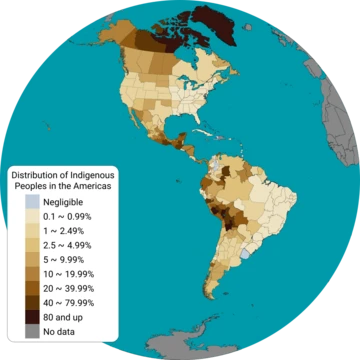
About 5% of Canada’s population is made up of Indigenous peoples, also called Aboriginal Canadians. This group includes three distinct peoples: First Nations, Inuit, and Métis. There are more than 600 recognized First Nations governments or bands, each with its own unique culture, language, music, and art. Some of the oldest known human settlements in Canada are at Old Crow Flats and Bluefish Caves.
Post-Archaic periods
Before European colonization, Indigenous cultures had permanent villages, farms, public and ceremonial buildings, complex social hierarchies, and trade networks. The Métis, who are of mixed ancestry, emerged in the mid-1600s when First Nations and Inuit people married European settlers, mostly French. First Nations and Métis were crucial to the growth of European colonies in Canada, especially by helping Europeans with the fur trade. Many laws, treaties, and other legal measures have been created between European settlers and Indigenous groups.
Forced assimilation
The effects of settler colonialism are visible in Canada’s culture, history, politics, laws, and legislatures. In the past, this included policies aimed at assimilating Indigenous peoples, which harmed their languages, traditions, and religions. Some academics and politicians have described these actions as cultural genocide or genocide.
Today, Indigenous peoples have a constitutional right to self-government, which lets them manage their own cultural, political, health, and economic affairs. National Indigenous Peoples Day celebrates the many cultures and contributions of Indigenous peoples to Canada’s history. People from First Nations, Inuit, and Métis backgrounds have become well-known figures and have helped shape Canada’s cultural identity. Under Section 35 of the Constitution Act, 1982, “Aboriginal peoples of Canada” includes Indian, Inuit, and Métis peoples.
Terminology
“Aboriginal” is a legal term that covers all Indigenous peoples in Canada. The word “Indian” is still used in legal documents for First Nations, but “Indian” and “Eskimo” are now seen as offensive and are rarely used in everyday speech. “Indian” remains the legal term in the Constitution. “Aboriginal” is starting to feel outdated and is slowly being replaced by “Indigenous peoples.” There is also a push to recognize each Indigenous group as a distinct nation, similar to how European, African, and Asian cultures are seen as separate.
“First Nations” (usually plural) has been common since the 1970s, replacing “Indians” and “Indian bands” in daily language. On reserves, many people now refer to themselves by their specific nation or ethnic identity—for example, “I am Haida” or “we are Kwantlens.” Since the 1970s, “First Peoples” has also been used to refer to all Indigenous groups: First Nations, Inuit, and Métis. Even though Canada is in the Americas, the term “Native American” is rarely used here because “American” can be confusing. It is mostly used only for Indigenous peoples in the United States.
“Native Canadians” was common until the 1980s to avoid this confusion. One problem with the word “Aboriginal” is that it can be too general. In some contexts, it could refer to non-Indigenous people born in a certain place—for example, someone born in Calgary might call themselves a “Calgary native.” Similarly, “Native American” could mean someone born in America, not necessarily an Indigenous person.
Because of this, “native” is not recommended, though it is not usually considered offensive. The Indian Act (R.S.C., 1985, c. I-5) defines “Indian” legally as “a person who pursuant to this Act is registered as an Indian or is entitled to be registered as an Indian.” Section 5 of the Act says a registry must be kept of everyone entitled to be registered. No other term is legally recognized for registration, and the Act specifically excludes Inuit (section 4). The term “Eskimo” is seen as offensive in Canada and Greenland.
Indigenous people there now use “Inuit,” though the Yupik of Alaska and Siberia do not consider themselves Inuit—ethnographers agree they are a separate people. They prefer “Yupik,” “Yupiit,” or “Eskimo.” Yupik languages are related to but distinct from Inuit languages. There is no single replacement term for “Eskimo” that covers all Inuit and Yupik across the Arctic. Beyond these ethnic labels, Indigenous peoples are also grouped into legal categories based on their relationship with the Crown (the state).
Lore & Background
Métis nations of mixed ancestry originated in the mid-17th century when First Nations and Inuit married Europeans, primarily French settlers. Old Crow Flats and Bluefish Caves are some of the earliest known sites of human habitation in Canada. The characteristics of Indigenous cultures in Canada prior to European colonization included permanent settlements, agriculture, civic and ceremonial architecture, complex societal hierarchies, and trading networks.
Reader's Guide
In Section 35 of the Constitution Act, 1982, 'Aboriginal peoples of Canada' includes Indian, Inuit, and Métis peoples. 'Aboriginal' as a collective noun is a specific term of art used as a legal term encompassing all Indigenous peoples living in Canada. Although 'Indian' is a term still commonly used in legal documents for First Nations, the descriptors 'Indian' and 'Eskimo' have fallen into disuse in Canada; most consider them to be pejorative. Indian remains in place as the legal term used in the Canadian Constitution.
Aboriginal peoples has begun to be considered outdated and is slowly being replaced by the term Indigenous peoples. The term Eskimo has pejorative connotations in Canada and Greenland. Indigenous peoples in those areas have replaced the term Eskimo with Inuit, though the Yupik of Alaska and Siberia do not consider themselves Inuit, and ethnographers agree they are a distinct people.
They prefer the terminology Yupik, Yupiit, or Eskimo. The Yupik languages are linguistically distinct from the Inuit languages, but are related to each other. Linguistic groups of Arctic people have no universal replacement term for Eskimo, inclusive of all Inuit and Yupik across the geographical area inhabited by them.
Frequently Asked Questions
Who are Indigenous peoples in Canada?
Indigenous peoples in Canada—also called Aboriginal Canadians—are the original inhabitants of the land, encompassing three distinct groups: the Inuit, the Métis, and the First Nations. Together they make up roughly 5% of the country's total population.
How many First Nations governments or bands are recognized in Canada?
There are more than 600 recognized First Nations governments or bands across the country. Each carries its own distinctive culture, language, music, and artistic traditions.
What is the constitutional legal term used for Indigenous peoples in Canada?
The Canadian Constitution uses the term 'Aboriginal peoples of Canada,' which explicitly includes Indian (First Nations), Inuit, and Métis peoples. This legal framing underpins their recognized rights and distinct status within the country.
Why are Indigenous peoples considered foundational to Canada's identity?
Indigenous peoples shaped the land, its trade networks, and its societal structures long before colonization, and their cultures remain a living, central part of Canadian identity. Their history and ongoing contributions are woven into the very fabric of what it means to be Canadian.
More in Indigenous Peoples Of The World
Sources
Compiled from Wikipedia and the sources listed below. Text from Wikipedia is available under CC BY-SA 4.0; this entry is adapted from it.
- Wikipedia: Indigenous peoples in Canada (CC BY-SA 4.0).
Spotted an error? Know more?
Reader corrections go straight into our review queue. Suggest an edit · How this site is sourced