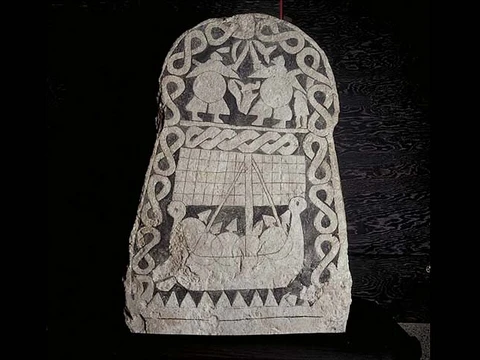
L'Anse aux Meadows
The only undisputed Norse site in North America outside Greenland.
Last updated
Where it is
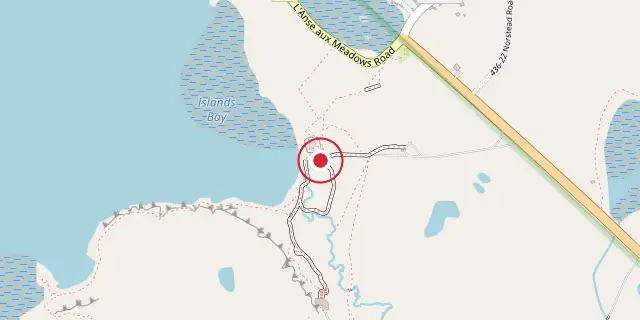
Coordinates: 51°35′46″N 55°31′59″W (51.5960, -55.5330) · Open in OpenStreetMap
Coordinates and connected clubs: the infobox of Wikipedia: L'Anse aux Meadows (CC BY-SA 4.0). Map: drawn by Codexery from OpenStreetMap tiles.
L'Anse aux Meadows is the only undisputed pre-Columbian European site in the Americas outside Greenland, with Norse activity dated to 1021 CE.[1][2] The site contains remains of eight sod-and-wood buildings and over 800 Norse artifacts, spanning 8000 hectares of land and sea.[3]
Last updated 2026-10-05 from the source article.
What happened
The Norse settlement at L'Anse aux Meadows has been dated to approximately 1000 CE by carbon dating, with estimates ranging from 990 to 1050.[4] A 2021 study using tree-ring analysis of three wood samples pinpointed 1021 as a year of Norse activity at the site.[4][2] The Ingstads were led to the mounds by local resident George Decker in 1960.[5] The dwellings could accommodate 30 to 160 people, though the site's population at any given time is unknown.[6]
From the Norse settlement at L'Anse aux Meadows, groups ventured southward to explore other parts of North America, using the site as a staging point.[1] The Norse building ruins at L'Anse aux Meadows were uncovered through excavations directed by Helge Ingstad and Anne Stine Ingstad between 1961 and 1968.[7] Butternuts discovered among the food debris at the site do not grow wild north of New Brunswick, indicating that Norse explorers traveled to more southerly areas to collect them.[8] In 1968, Canada designated L'Anse aux Meadows a National Historic Site, and UNESCO added it to the World Heritage list in 1978.[3]
What the cited sources add
The UNESCO description confirms the site contains excavated remains of a complete 11th-century Viking settlement, the earliest evidence of Europeans in North America.[9] The UNESCO description also states that artifacts show evidence of iron production and woodworking likely used for ship repair.[9] The Handwerk article describes L'Anse aux Meadows as a base where Norse might overwinter, repair ships, or stockpile provisions.[2]
References
- Wikipedia, "L'Anse aux Meadows" (CC BY-SA 4.0), which cites: Nydal, "A Critical Review of Radiocarbon Dating of a Norse Settlement at L'Anse Aux Meadows, Newfoundland Canada", Radiocarbon, 1989, p. 976–985; Cordell, "L'Anse aux Meadows National Historic Site", ABC-CLIO, 2009, p. 82; Ledger, "New horizons at L'Anse aux Meadows", Proceedings of the National Academy of Sciences, 15 July 2019, p. 15341–15343; Andrei, "Vikings did reach North America a thousand years ago – and now we know exactly when", ZME Science, 11 September 2023; Kuitems, "Evidence for European presence in the Americas in AD 1 en.wikipedia.org
- Handwerk, "New Dating Method Shows Vikings Occupied Newfoundland in 1021 C.E.", Smithsonian Magazine. facts only, no text reused. smithsonianmag.com
- Wikipedia, "L'Anse aux Meadows" (CC BY-SA 4.0), which cites: "The Ancient World, Volumes 1–5", Routledge, 17 July 2015, p. 272–; Kirsten Wolf, "Daily Life of the Vikings", Greenwood Publishing Group, 2004, p. 139–; "L'Anse aux Meadows National Historic Site", UNESCO World Heritage Center; "ENVIRONMENT", www.ourcommons.ca (we also read that source) en.wikipedia.org
- Wikipedia, "L'Anse aux Meadows" (CC BY-SA 4.0), which cites: Ledger, "New horizons at L'Anse aux Meadows", Proceedings of the National Academy of Sciences, 15 July 2019, p. 15341–15343; Cordell, "L'Anse aux Meadows National Historic Site", ABC-CLIO, 2009, p. 82; Cordell, "L'Anse aux Meadows National Historic Site", ABC-CLIO, 2009, p. 82; Nydal, "A Critical Review of Radiocarbon Dating of a Norse Settlement at L'Anse Aux Meadows, Newfoundland Canada", Radiocarbon, 1989, p. 976–985; Kuitems, "Evidence for European presence in the Americas in AD 1021", Nature, 20 October 2021, p. 388–391; Handwer en.wikipedia.org
- Wikipedia, "L'Anse aux Meadows" (CC BY-SA 4.0), which cites: "History – Discovery of the Site and Initial Excavations (1960–1968)", L'Anse aux Meadows National Historic Site of Canada, 4 April 2019; Ingstad, "The Viking Discovery of America: The Excavation of a Norse Settlement in L'Anse Aux Meadows, Newfoundland", Breakwater Books, 2000 (we also read that source) en.wikipedia.org
- Wikipedia, "L'Anse aux Meadows" (CC BY-SA 4.0), which cites: Kolodny, "In Search of First Contact: The Vikings of Vinland, the Peoples of the Dawnland, and the Anglo-American Anxiety of Discovery", Duke University Press, 2012, p. 95; Richards, "The Vikings: A Very Short Introduction", Oxford University Press, 2005, p. 112; Richards, "The Vikings: A Very Short Introduction", Oxford University Press, 2005, p. 112 (we also read that source) en.wikipedia.org
- Wikipedia, "L'Anse aux Meadows" (CC BY-SA 4.0), which cites: Boissoneault, "L'Anse Aux Meadows & the Viking Discovery of North America", JSTOR Daily, 23 July 2015; Boissoneault, "L'Anse Aux Meadows & the Viking Discovery of North America", JSTOR Daily, 23 July 2015; Wallace, Birgitta Linderoth (2006). The Saga of L'Anse aux Meadows. Historic Sites Association of Newfoundland and Labrador. pp. 98–99. (original not read by us) en.wikipedia.org
- Wikipedia, "L'Anse aux Meadows" (CC BY-SA 4.0), which cites: "History – Is L'Anse aux Meadows Vinland?", L'Anse aux Meadows National Historic Site of Canada (original not read by us) en.wikipedia.org
- "L'Anse aux Meadows National Historic Site", UNESCO World Heritage Center. facts only, no text reused. whc.unesco.org
Each numbered sentence above was checked against the source it cites before publication. Sentences citing Wikipedia adapt text from the English Wikipedia article L'Anse aux Meadows (contributors), used under CC BY-SA 4.0; this entry is available under the same licence. Other sources were used for facts only; no text or images are copied from them.
More in The Viking Age
Sources
Compiled from Wikipedia and the sources listed below. Text from Wikipedia is available under CC BY-SA 4.0; this entry is adapted from it.
- Wikipedia: L'Anse aux Meadows (CC BY-SA 4.0).
Spotted an error? Know more?
Reader corrections go straight into our review queue. Suggest an edit · How this site is sourced