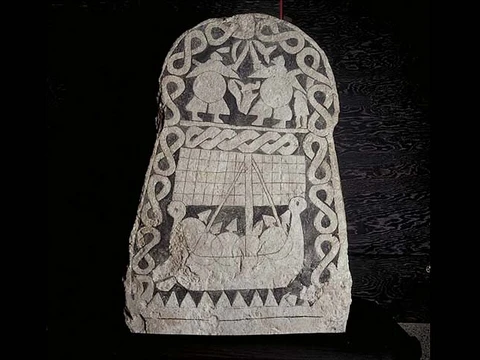
Runestones
Raised stones with runic inscriptions, mostly from the late Viking Age.
Last updated
Runestones are raised stones with runic inscriptions, first appearing in Norway and Sweden during the 4th and 5th centuries.[1] Most runestones were erected between 950 and 1100 CE, primarily in Sweden.[1] Scandinavia's roughly 6,000 runic inscriptions include about 3,000 runestones.[2]
Quick Facts
- Earliest appearance
- 4th–5th century
- Highest concentration
- Uppland, Sweden (1,196 inscriptions)
- Primary purpose
- Mark territory
- explain inheritance
- boast about constructions
- bring glory to dead kinsmen
- tell of important events
Facts from the source article.
What happened
The tradition of raising runestones began in the 4th and 5th centuries in Norway and Sweden, where early stones were usually placed next to graves.[1] An event in Denmark in the 960s may have increased the spread of runestones.[3] King Harald Bluetooth, after his baptism, commanded the construction of a runestone to mark a new order and age.[3] This stone featured Denmark's oldest depiction of Jesus and a prototype of common runic animals.[3]
Danish runestones first emerged during the 8th and 9th centuries.[1] Many chieftains and Norse clans copied King Harald's example, causing a runestone fashion to spread north from Denmark into Sweden.[3] While the trend typically ended after one generation in most areas, it continued into the 12th century within Uppland and Södermanland.[3] Runestones served to delineate territory, clarify inheritance, celebrate constructions, honor deceased relatives, and record significant events.[4]
Men raised the majority of runestones; only one out of every eight was erected by a woman acting alone.[5]
What the cited sources add
Koesling's 2021 work discusses early Scandinavian rune-stones and remarks on the banalities of "burial-stones"[6] The same source also examines the Rök Runestone and the end of the world.[6] Koesling's research addresses the emergence of memory in historical discourse.[6]
References
- Wikipedia, "Runestone" (CC BY-SA 4.0), which cites: "Runsten", (1995), volume 16, pp. 91-92.; Zilmer 2005:38; Koesling, Jonas. 2021. “Memories Carved in Stones? Collective Memory Studies and Early Scandinavian Rune-Stones, or Remarks on the Banalities of ‘Burial-Stones’; Olstad, "Ein minnestein for å hedre seg sjølv", forskning.no, 2002-12-16; "Runsten", (1995), volume 16, pp. 91-92. (we also read that source) en.wikipedia.org
- Wikipedia, "Runestone" (CC BY-SA 4.0), which cites: Zilmer 2005:38; "Runsten", (1995), volume 16, pp. 91-92. (original not read by us) en.wikipedia.org
- Wikipedia, "Runestone" (CC BY-SA 4.0), which cites: Harrison & Svensson 2007:192 (original not read by us) en.wikipedia.org
- Wikipedia, "Runestone" (CC BY-SA 4.0), which cites: Harrison & Svensson 2007:195 (original not read by us) en.wikipedia.org
- Wikipedia, "Runestone" (CC BY-SA 4.0), which cites: Harrison & Svensson 2007:196 (original not read by us) en.wikipedia.org
- Koesling, Jonas. 2021. “Memories Carved in Stones? Collective Memory Studies and Early Scandinavian Rune-Stones, or Remarks on the Banalities of ‘Burial-Stones’. facts only, no text reused. scancan.net
Each numbered sentence above was checked against the source it cites before publication. Sentences citing Wikipedia adapt text from the English Wikipedia article Runestone (contributors), used under CC BY-SA 4.0; this entry is available under the same licence. Other sources were used for facts only; no text or images are copied from them.
More in The Viking Age
Sources
Compiled from Wikipedia and the sources listed below. Text from Wikipedia is available under CC BY-SA 4.0; this entry is adapted from it.
- Wikipedia: Runestone (CC BY-SA 4.0).
Spotted an error? Know more?
Reader corrections go straight into our review queue. Suggest an edit · How this site is sourced