National Autonomous University of Mexico
A secular public university founded in 1910, central to Mexican education and culture.

Régis Lachaume · Public domain
The National Autonomous University of Mexico (UNAM) is a public research university in Mexico, founded in its modern form on 22 September 1910 by Justo Sierra as a secular alternative to its predecessor, the Royal and Pontifical University of Mexico. It is one of the world's largest universities, with more than 324,413 students, multiple campuses in Mexico City and across the country, and a presence in nine countries. Its main campus, Ciudad Universitaria, is a UNESCO World Heritage site and hosted the main events of the 1968 Summer Olympics.
Quick Facts
- Native Name
- Universidad Nacional Autónoma de México
- Latin Name
- Universitas Mexicana
- Former Names
- National University of Mexico (1910–1929)
- Motto
- es · Por mi raza hablará el espíritu
- Motto Eng
- "For my race, shall the spirit speak"
- Established
- 22 September 1910
- Founders
- Justo Sierra / Porfirio Díaz
- Rector
- Leonardo Lomelí Vanegas · es
- Budget
- US$3.1 billion (2025)
- City
- Mexico City
- Country
- Mexico
Facts from the source article.
Lore & Background
The university was founded on 22 September 1910 by Justo Sierra, then minister of education, who sought to create a secular, national institution distinct from the Royal and Pontifical University of Mexico (founded in 1551). The project initially unified several schools, including Fine Arts, Business, Engineering, and Medicine. Its first rector was Joaquin Eguía y Lis. The early years were marked by political challenges due to the Mexican Revolution and government control, leading to a student strike in 1912 over examination methods.
Efforts to gain autonomy began in 1914 but failed; autonomy was eventually achieved in the mid-1920s after student strikes and negotiations. In the early 1930s, rector Manuel Gómez Morín opposed government attempts to implement socialist education, successfully defending academic freedom. In 1943, decisions were made to move the university to a new consolidated campus, Ciudad Universitaria, which opened in 1952. The campus hosted the 1968 Summer Olympics and was the birthplace of the student movement of 1968, which culminated in the Tlatelolco massacre.
The last major student strike occurred in 1999–2000, protesting a proposed tuition fee, and ended when police stormed the buildings on 6 February 2000. In 2009, UNAM received the Prince of Asturias Award for Communication and Humanities.
Reader's Guide
The National Autonomous University of Mexico is a cornerstone of Mexican higher education and research. Founded in 1910 as a secular alternative to the colonial-era Royal and Pontifical University, it has grown into one of the world's largest universities, with over 324,000 students and a network of campuses, research institutes, museums, and historic sites. Its main campus, Ciudad Universitaria, is a UNESCO World Heritage site, reflecting its architectural and cultural significance. UNAM has produced all of Mexico's Nobel laureates and accounts for more than 25% of scientific papers published by Mexican academics, underscoring its role as a leading research institution. The university has been a site of major social and political movements, including the 1968 student protests and the 1999–2000 strike over tuition. Its autonomy, won in the 1920s, has allowed it to maintain academic freedom and secular principles. UNAM's influence extends beyond Mexico, with a presence in nine countries and recognition through the Prince of Asturias Award.
Did You Know?
- UNAM has 34 research institutes, 26 museums, and 18 historic sites.
- Many Mexican Nobel laureates have been alumni of UNAM.
- More than 25% of total scientific papers published by Mexican academics come from UNAM researchers.
- The university was awarded the Prince of Asturias Award for Communication and Humanities in 2009.
A Secular Rebirth: The 1910 Founding
When Justo Sierra, serving as education minister under the Porfirio Díaz regime, signed the charter for a new national university on 22 September 1910, he was deliberately rejecting the legacy of the Royal and Pontifical University of Mexico. That older institution, established by a 1551 royal decree issued by Crown Prince Phillip II on behalf of Charles I of Spain, had been the first Western-style university in North America but was shut down permanently in 1865 by Emperor Maximilian I. Rather than resurrect what Sierra considered an anachronistic, church-entangled body, he chose to consolidate Mexico City's scattered higher-education colleges—spanning Fine Arts, Business, Political Science, Jurisprudence, Engineering, Medicine, Normal, and the National Preparatory schools—into a single secular, nationally scoped university. The guiding philosophy was positivism intertwined with the liberal ideals that had shaped nineteenth-century Mexican politics. Joaquín Eguía y Lis took the helm as the first rector. From the outset, however, the new institution faced turbulence: the Mexican Revolution roiled the political landscape, the federal government retained direct control over curriculum and policy, and philosophical opponents questioned the very premise of the project.
Student Power and the Struggle for Autonomy
The university's early decades were defined by recurring confrontations between students, faculty, and the state. In 1912, a student strike erupted when Jurisprudence students protested examination methods imposed by director Luis Cabrera Lobato; by July, a majority of law students had departed to form the Free School of Law. Autonomy efforts in 1914 stalled, but momentum resumed in the early 1920s. Under rector José Vasconcelos, who in 1921 designed the university's coat of arms—an eagle and a condor flanking a map of Latin America from Mexico's northern border to Tierra del Fuego, bearing the motto "The Spirit shall speak for my people"—the push for independence from the Secretariat of Public Education gained real traction. Mid-1920s strikes over grading rules, including walkouts at the law school and police confrontations at the medical school, were backed by sympathetic professors and ultimately secured full autonomy: the rector became the university's final authority. In the 1930s, rector Manuel Gómez Morín, supported by the Jesuit-founded Unión Nacional de Estudiantes Católicos, successfully resisted the government's attempt to impose socialist education. The pattern of student-led pressure peaked in 1966, when students stormed the rectorate, forced the rector's resignation, and triggered a professor strike that compelled the Board of Regents to comply.
Ciudad Universitaria: A Campus as Cultural Monument
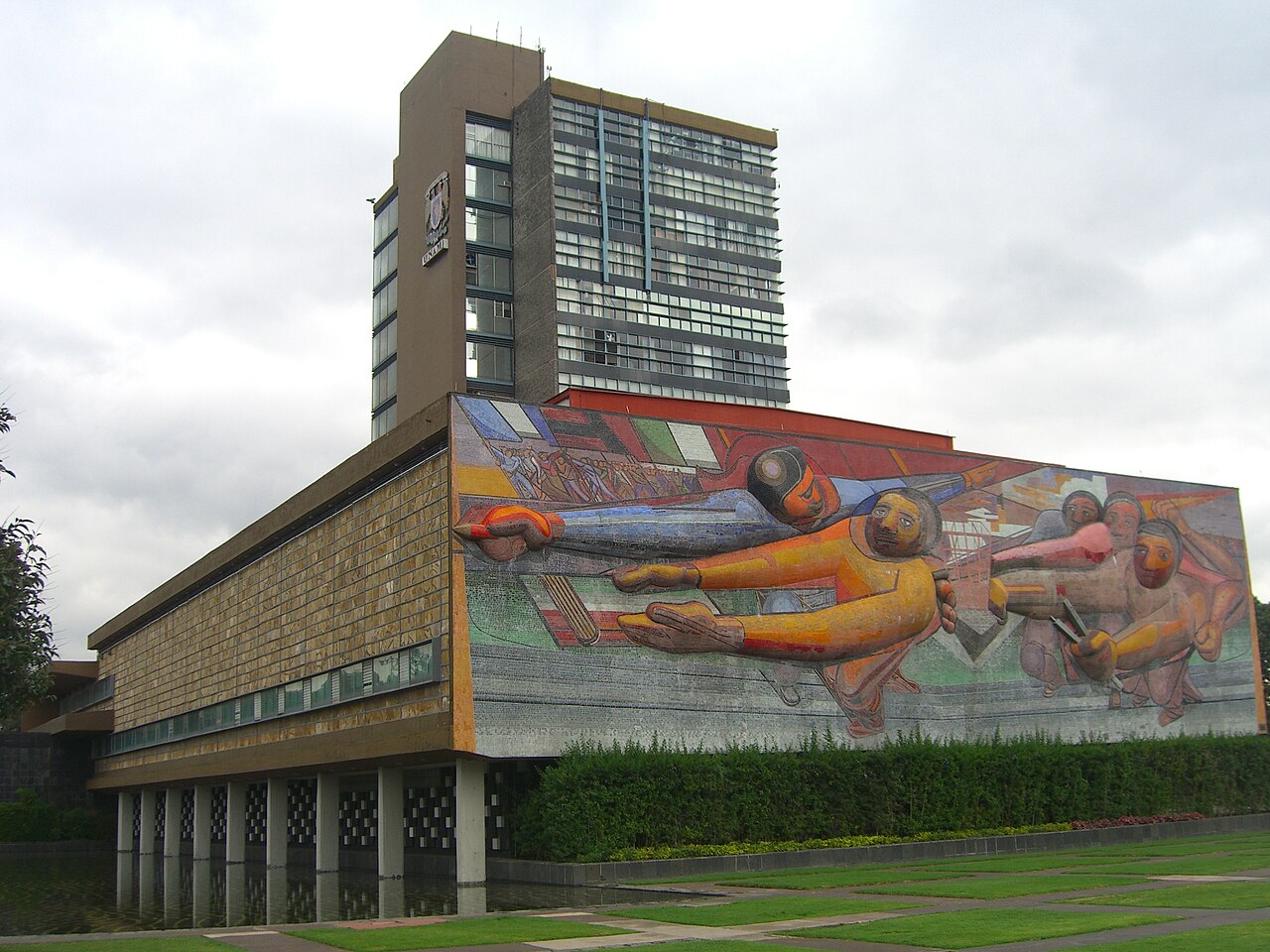
In 1943, university leaders made the pivotal decision to relocate from scattered buildings in Mexico City's center to a single, consolidated campus in San Ángel, south of the city. The first stone laid was that of the Faculty of Sciences, marking the beginning of what would become Ciudad Universitaria. On 20 November 1952, President Miguel Alemán Valdés attended the ceremony, and the University Olympic Stadium was inaugurated on the same day. The campus was designed and decorated by some of Mexico's most celebrated architects and painters, transforming it into a living gallery of national art and architectural ambition. A portion of Ciudad Universitaria has since been designated a UNESCO World Heritage site, a recognition of its extraordinary cultural and artistic significance. The campus also served as the primary venue for the main events of the 1968 Summer Olympics, placing it at the center of a global sporting spectacle. Yet the same grounds that hosted athletic competition also became the birthplace of the student movement of 1968, a defining political moment in Mexican history that would echo through decades of social and academic discourse.
A Global Academic Powerhouse
With more than 324,413 enrolled students, UNAM stands as one of the largest universities on the planet. Its physical and intellectual footprint extends far beyond Mexico City: the institution maintains multiple campuses throughout the country, a presence in nine countries, 34 dedicated research institutes, 26 museums, and 18 historic sites. In 1957, the creation of the Doctorate Council formalized and organized graduate-level scholarship, adding a new layer of academic depth. The university's research output is staggering—more than a quarter of all scientific papers published by Mexican academics originate from UNAM researchers. Its alumni include every Mexican Nobel laureate, a testament to the depth of talent the institution has cultivated over more than a century. In 2009, the university received the Prince of Asturias Award for Communication and Humanities, an international honor that underscored its influence well beyond the sciences. From its founding as a secular alternative to a church-dominated predecessor to its current role as a continental and global knowledge hub, UNAM has consistently positioned itself at the intersection of Mexican identity and universal scholarship.
Gallery

Frequently Asked Questions
What is the National Autonomous University of Mexico?
UNAM is a public research university in Mexico City that was re-established in its modern secular form in 1910. It is the largest university in Latin America and a central pillar of Mexican higher education and scientific research.
How many students attend UNAM?
The university enrolls more than 324,000 students across multiple campuses in Mexico City and other regions of the country. It also maintains academic presences in nine countries outside Mexico.
What is Ciudad Universitaria and why is it famous?
Ciudad Universitaria is UNAM's main campus in Mexico City and holds UNESCO World Heritage status. The sprawling complex also served as the primary venue for events during the 1968 Summer Olympics.
Why is UNAM considered so important to Mexico?
A large share of scientific publications by Mexican academics come from UNAM researchers, and many of the country's Nobel laureates are alumni. The university functions as a cultural and intellectual engine that shapes public discourse and national identity.
How did UNAM come to exist in its current form?
In 1910, educator Justo Sierra founded the institution as a secular public university, replacing the older Royal and Pontifical University of Mexico. This re-founding marked a deliberate break from religious control of higher education in the country.
More in Universities 1-24
Spotted an error? Know more?
Reader corrections go straight into our review queue. Suggest an edit · How this site is sourced