
KU Leuven
Largest university in Belgium and the Low Countries; Catholic research institution in Leuven, Belgium.

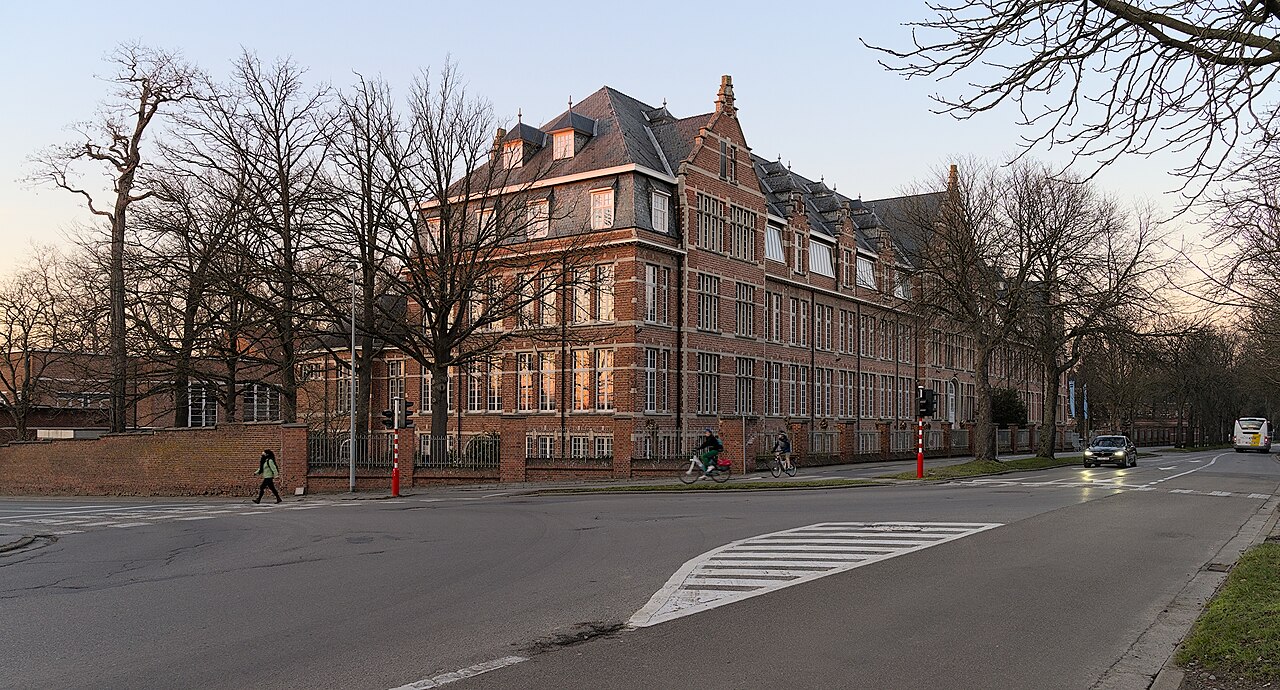
Ste.caneva · CC BY-SA 4.0
KU Leuven (Katholieke Universiteit Leuven) is a Catholic research university in Leuven, Belgium. It is the largest university in Belgium and the Low Countries, with over 65,000 students enrolled in 2021–22. The university traces its origins to the Old University of Leuven founded in 1425, though its modern form dates from a Catholic refoundation in 1834 in Mechelen, moving to Leuven in 1835. It split from its French-language sister university, Université catholique de Louvain (UCLouvain), in 1968–1970.
Quick Facts
- Latin Name
- Universitas catholica Lovaniensis
- Motto
- Sedes Sapientiae (Latin)
- Motto Eng
- Seat of Wisdom
- Established
- 1425 as Studium Generale Lovaniense (predecessor institution) / 1834 as Catholic University of Leuven (1834–1968) / 1970 (split)
- Academic Affiliations
- CESAER / CLUSTER / Coimbra Group / EASN Association / EUA / Europaeum / EQUIS / LERU / VIU / TPC / Una Europa / Universitas 21
- Budget
- 1.5 billion (operating revenue, FY 2024)
- Administrative Staff
- 11,534
- Chancellor
- Jozef De Kesel
- Chairman
- Marianne Thyssen
- Rector
- Severine Vermeire
- City
- Leuven
- Country
- Belgium
Facts from the source article.
Lore & Background
KU Leuven hosts the world's largest banana genebank, the Bioversity International Musa Germplasm Transit Centre, which celebrated its 30th anniversary in 2017. In 2018, a student died during a hazing ritual for the Reuzegom fraternity; 18 students were later fined and given community service. The university is a member of the Coimbra Group and LERU. Its Faculty of Economics and Business has been accredited by EQUIS since 2014. The university's electronic learning environment, TOLEDO, launched in 2001, integrates tools like Blackboard and Question Mark Perception.
Reader's Guide
KU Leuven stands as a major European research university with a complex institutional lineage. Its claim to continuity with the 1425 Studium Generale Lovaniense, while legally contested, anchors its identity in centuries of scholarship. The university's split in 1968–70 resolved linguistic tensions but created two separate institutions, each celebrating a shared 600th anniversary in 2025. As the largest Dutch-language university globally, it attracts a significant international student body (21% in 2021–22) and maintains extensive Erasmus contracts and bilateral agreements. Its Catholic character is balanced by financial independence from the Church, though the Archdiocese retains board influence. The 2018 hazing death highlighted issues of student culture and institutional accountability. KU Leuven's research impact is evident through its technology transfer arm, LRD, and its hosting of the world's largest banana genebank. The university's shift to the acronymic name KU Leuven in 2011 reflects a modern emphasis on academic freedom while preserving its Catholic heritage. Its membership in the Coimbra Group and LERU underscores its role in European research networks.
Did You Know?
- The university's legal name remains Katholieke Universiteit Leuven, but it uses the acronym KU Leuven in all official communications since 2011.
- The university first admitted female students in 1920, about 40 years after the universities of Brussels, Liège, and Ghent.
A University Forged by Revolution and Rebirth
The story of KU Leuven stretches back to 1425, when Duke John IV of Brabant, alongside civil authorities and the city's municipal government, established the Studium Generale Lovaniense despite resistance from the chapter of Sint-Pieter. For centuries, this institution attracted luminaries including Erasmus, Vesalius, Mercator, and even a future pope. Yet the French Revolution shattered that continuity: a 1793 law mandating the closure of all French universities took effect, and on October 25, 1797, the Département of the Dyle formally abolished the old university. After a brief secular successor under King William I (1817–1835), Belgian bishops refounded a Catholic university in Mechelen in 1834, relocating it to Leuven by December 1835. Today, KU Leuven officially claims descent from the 1425 institution in its statutes, a position it asserts against rulings by the Court of Cassation and the Cour d'Appel. Together with its French-language sister, UCLouvain, the university marks its 600th anniversary in 2025—a milestone that underscores a pattern shared by several European universities that survived the upheavals of the revolutionary era.
The Linguistic Split and Modern Independence
In 1968, deepening tensions between Dutch-speaking and French-speaking communities in Belgium forced the dissolution of the bilingual Catholic University of Leuven. The Dutch-language half became a fully independent institution in Leuven in 1970, with Pieter De Somer serving as its first rector after the separation. The French-language counterpart, UCLouvain, departed for a newly constructed greenfield campus in the francophone region. Though both share a common heritage, they now operate as distinct sister universities. The naming conventions reflect this duality: the legal name remains Katholieke Universiteit te Leuven, yet in practice only the acronym KU Leuven appears in official communications, never translated—unlike its French counterpart, which uses the full name Université catholique de Louvain. The split was not merely administrative; it cemented KU Leuven's identity as the largest Dutch-language university in the world and the largest university in the entire Low Countries, a position it has maintained ever since.
Scale, Campuses, and Global Footprint
KU Leuven operates on a scale that dwarfs most European institutions. With more than 65,000 enrolled students in the 2021–22 academic year, it stands as the largest university in Belgium and the Low Countries. Nearly a fifth of its student body—21 percent—comes from outside Belgium, reflecting a genuinely international character. The university's physical footprint extends well beyond the historic Leuven campus, with satellite locations in Kortrijk, Antwerp, Ghent, Bruges, Ostend, Geel, Diepenbeek, Genk, Aalst, Sint-Katelijne-Waver, and Brussels. While Dutch remains the primary language of instruction, a significant number of graduate and postgraduate programs are delivered in English, broadening access for non-Dutch speakers. The university's international engagement is further evidenced by Erasmus contracts with 434 European institutions and 22 central bilateral agreements spanning eight countries, including the United States, China, Japan, South Africa, Vietnam, Poland, the Netherlands, and the Democratic Republic of Congo.
From Cloistered Faith to Open Research Powerhouse
KU Leuven's evolution from a faith-bound institution to a broadly inclusive research university mirrors wider societal shifts. It once admitted only baptized Catholics, but today students of every faith or life-stance are welcome. The admission of women, which did not occur until 1920, lagged roughly four decades behind Belgian peers in Brussels, Liège, and Ghent—a gap that speaks to the conservative currents of the era. In the modern period, the university has invested heavily in translating academic research into commercial impact. In 1972 it created Leuven Research & Development (LRD), a dedicated entity that has spawned numerous spin-offs, including the technology firm Metris, and manages tens of millions of euros in venture capital. On the digital front, the TOLEDO electronic learning environment—launched in September 2001 and built around tools such as Blackboard and Question Mark Perception—has become the university's central platform for teaching and assessment. KU Leuven also holds membership in the Coimbra Group and the LERU League of European Research Universities, while its Faculty of Economics and Business earned European Quality Improvement System accreditation in November 2014.
Gallery

Frequently Asked Questions
What is KU Leuven?
KU Leuven is a Dutch-language Catholic research university headquartered in Leuven, Belgium, and it holds the title of the largest university in the Low Countries. It serves more than 65,000 students spread across its main campus and a network of satellite sites throughout Flanders.
How old is KU Leuven?
The institution traces its lineage to the Old University of Leuven, established in 1425, making it one of the oldest academic houses in the region. Its current legal identity, however, was born from a Catholic refoundation in Mechelen in 1834, with the campus relocating to Leuven the following year.
What happened in the 1968–1970 split?
During the late 1960s, the single bilingual Catholic university divided along linguistic lines, with the Dutch-speaking side becoming KU Leuven and the French-speaking side becoming Université catholique de Louvain (UCLouvain). The separation was driven by Belgium's broader language-community tensions.
How big is KU Leuven compared to other universities?
With over 65,000 enrolled students as of the 2021–22 academic year, KU Leuven is the largest university in Belgium and the entire Low Countries region. Roughly 21 percent of its student body comes from outside Belgium.
Is KU Leuven a religious institution?
KU Leuven carries a Catholic identity and maintains a formal link to the Archdiocese of Mechelen–Brussels, which holds board seats with veto powers. Nevertheless, the university is financially independent and operates as a self-governing research institution rather than a church-run school.
More in Universities 1-24
Spotted an error? Know more?
Reader corrections go straight into our review queue. Suggest an edit · How this site is sourced