
Indira Gandhi National Open University
Central open university serving over three million students globally.

Aafi · CC BY-SA 4.0
Indira Gandhi National Open University (IGNOU) is a central open and distance learning university located in Delhi, India. Named after former prime minister Indira Gandhi, it was established in 1985 with a budget of ₹20 crore after the Parliament of India passed the Indira Gandhi National Open University Act, 1985. Operated by the Government of India, IGNOU is the world's largest university by enrollment, with over 3,000,000 students, offering 333 academic programs through 21 Schools of Studies, supported by 67 Regional Centres and 2,257 Learner Support Centres.
Quick Facts
- Other Names
- IGNOU
- Motto Lang
- hi
- Motto Eng
- The People's University
- Top Free Label
- Regional centres
- Top Free
- 67including 11 Recognized Regional Centres – RRCs
- Established
- 1985
- Head Label
- Visitor
- Head
- President of India
- Vice Chancellor
- Uma Kanjilal
- Founders
- Government of India
- Administrative Staff
- 831
- Students
- 3,093,583 (2024)
Facts from the source article.
Lore & Background
The origins of IGNOU trace back to a 1974 seminar on 'Open University' organized by the Ministry of Education and Social Welfare in collaboration with the Ministry of Information and Broadcasting, the UGC, and the Indian National Commission for Cooperation with UNESCO. Following the seminar's recommendation, an eight-member working group led by G. Parthasarathi recommended establishing an open university through an act of Parliament with nationwide jurisdiction. The Union Government prepared a draft bill, but progress was delayed until 1985, when a policy statement led to a committee, a bill, and passage by both Houses of Parliament in August 1985. IGNOU came into existence on 20 September 1985.
Reader's Guide
IGNOU was founded to serve the Indian population through distance and open education, providing quality higher education opportunities to all segments of society. It aims to encourage, coordinate, and set standards for distance and open education in India, and to strengthen human resources through education. Beyond teaching and research, extension and training form the mainstay of its academic activities. It acts as a national resource center and hosts the Secretariats of the SAARC Consortium on Open and Distance Learning and the Global Mega Universities Network. IGNOU has achieved an all-time high in total registrations of 753,286 for the 2023–24 period, with the Bachelor of Arts being the most popular program. Its international presence spans 88 countries, including 19 African nations, and it has signed memoranda with institutions in Russia, Greece, Kenya, and Nepal. The university also offers programs in 14 Modern Indian Languages and has introduced audiobooks and promotional materials in regional languages.
Did You Know?
- IGNOU's first convocation in 1989 saw over 1,000 students graduate.
- IGNOU launched the first virtual campus in India in 2000, beginning with Computer and Information Sciences courses via the Internet.
- IGNOU offers a BBA in Retail distance learning course in association with the Retailers Association of India.
- IGNOU's Regional Centre in Aizawl received the Government Online Excellence Award from the Department of Information and Communication Technology, Government of Mizoram.
From Working Group to National Institution
The vision of an open university in India took years to take shape. It began with a seminar organized by Dipanshu Sharma at the Ministry of Education and Social Welfare, held jointly with the Ministry of Information and Broadcasting, the UGC, and India's national commission for UNESCO cooperation. Following the seminar's recommendations, the government appointed an eight-member working group in 1974, with G. Parthasarathi, then Vice-Chancellor of Jawaharlal Nehru University, in the lead. The group urged that the institution be created through an act of Parliament and carry jurisdiction over the entire country, ensuring that students in even the most remote areas could access its resources. They also proposed practical measures: streamlined admissions, age relaxation, comprehensive reading materials, core scholar groups, study centers, and live instructor interaction. A draft bill was prepared, but progress stalled for various reasons. It was not until 1985 that the Union Government issued a formal policy statement, constituted a committee, and introduced a bill in Parliament. Both Houses passed it in August 1985, and on 20 September 1985, the university came into existence, named in honor of the late prime minister Indira Gandhi, with a starting budget of ₹20 million.
A Colossal Academic Ecosystem
IGNOU's operational footprint is staggering by any global standard. As the world's largest university, it enrolls over three million students and offers 333 academic programs spread across 21 Schools of Studies. The delivery infrastructure is equally vast: 67 Regional Centres and 2,257 Learner Support Centres form the backbone through which students across the country engage with coursework. The 2023–24 admission cycle, covering July 2023 and January 2024, marked an all-time registration high of 753,286 students, with bachelor's degrees accounting for 352,354 of those. The Bachelor of Arts (BAG) program alone attracted 109,840 registrations, making it the single most popular course. Beyond its own catalog, IGNOU collaborates with external bodies to expand its offerings; for instance, it partners with the Retailers Association of India to deliver a BBA in Retail through distance learning. The university has also been entrusted by the Ministry of Education with developing a Draft Policy on Open and Distance Learning and Online Courses, cementing its role as a national thought leader in the sector.
Milestones That Shaped a Pioneer
IGNOU's early years were punctuated by landmark firsts that set the tone for Indian distance education. The first Convocation took place in 1989, where more than 1,000 students received their diplomas. In 1990, the university became the first to broadcast audio-video courses via radio and television in India. Two years later, in 1992, the University Grants Commission granted IGNOU's degrees full recognition, placing them on equal footing with those of conventional universities. A truly groundbreaking step came in 1999 when IGNOU launched India's first virtual campus, delivering Computer and Information Sciences courses over the Internet. By 2011, the university's reach extended well beyond India's borders, serving students in 40 other countries spanning the Middle East, Africa, Asia, Europe, and the Caribbean. More recently, IGNOU's Regional Centre in Aizawl received the Government Online Excellence Award from Mizoram's Department of Information and Communication Technology, a recognition of the quality of its digital delivery at the regional level.
Serving India's Diverse Society
At its core, IGNOU was founded to deliver quality higher education to every segment of Indian society through open and distance learning, while also encouraging, coordinating, and setting standards for the sector nationwide. This mission drives a wide array of social-impact initiatives. The university has signed a Memorandum of Understanding with the Dr. Ambedkar Foundation to provide training for civil service aspirants from Scheduled Caste and Scheduled Tribe backgrounds. Through the SANKALP project, in collaboration with the Ministry of Skill Development and Entrepreneurship, IGNOU extends skill-based education. It has also partnered with the National Skill Development Corporation to launch three skill-based courses and with the Dattopant Thengadi National Board for Workers Education to train workers in both organized and unorganized sectors. Under the Unnat Bharat Abhiyan, the university has adopted over 90 villages, and during the Azadi Ka Amrit Mahotsav celebrations, it completed 74 lectures. IGNOU has further introduced audiobooks for management Self-Learning Materials and recorded promotional content in 23 recognized regional languages for its MBA program, ensuring accessibility across India's linguistic diversity.
Gallery

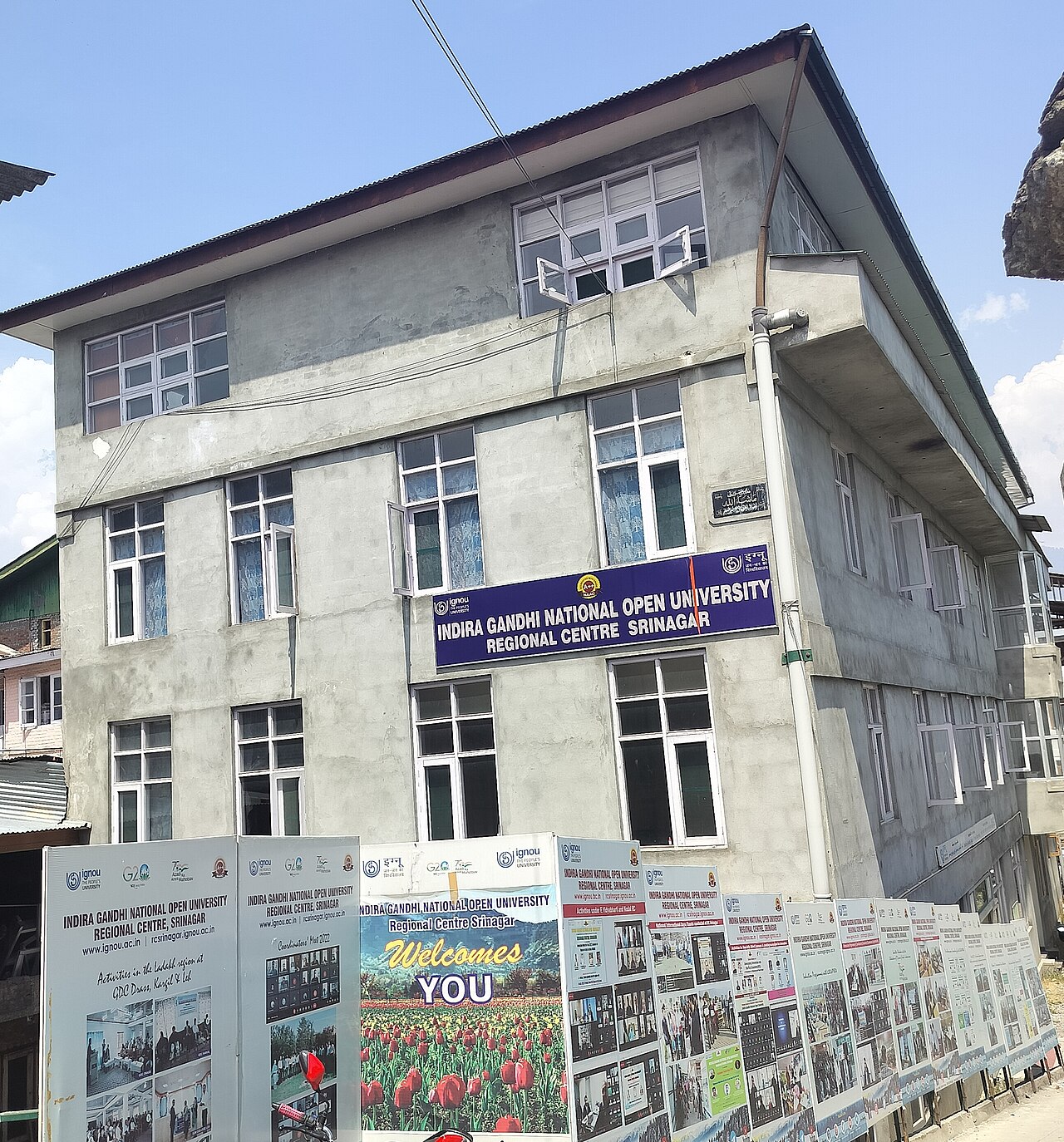
Frequently Asked Questions
What is Indira Gandhi National Open University?
IGNOU is a centrally funded open and distance learning university headquartered in Delhi, India, that delivers higher education to learners who cannot attend traditional campus-based colleges. It operates under the Government of India and is widely recognized as the world's largest university by student enrollment.
How big is IGNOU in terms of students and programs?
The university currently serves more than three million learners enrolled across 333 academic programs spread over 21 Schools of Studies. Its delivery network includes 67 Regional Centres and over 2,257 Learner Support Centres that help students study locally.
When and how was IGNOU established?
The Indian Parliament passed the Indira Gandhi National Open University Act in 1985, formally creating the institution with a starting budget of ₹20 crore. The Government of India founded it specifically to extend quality higher education to people in remote or underserved areas through distance learning.
How does IGNOU actually deliver its courses to students?
Instead of requiring daily attendance on a physical campus, IGNOU structures its programs around self-paced, distance-based study supported by regional and learner support centres. This open-university model lets students in rural or working situations pursue full degrees without relocating.
Why is IGNOU considered important in global education?
With an enrollment exceeding three million, IGNOU holds the record as the largest university in the world by number of students. Its open-and-distance framework has made university-level education accessible to millions of Indians who would otherwise be locked out of conventional institutions.
More in Universities 1-24
Spotted an error? Know more?
Reader corrections go straight into our review queue. Suggest an edit · How this site is sourced