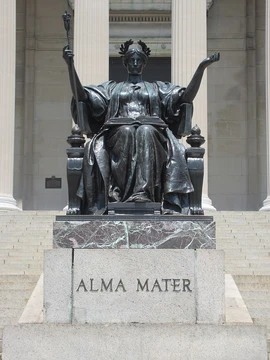
Johns Hopkins University
First U.S. research university, founded by a Quaker philanthropist.

Daderot · Public domain
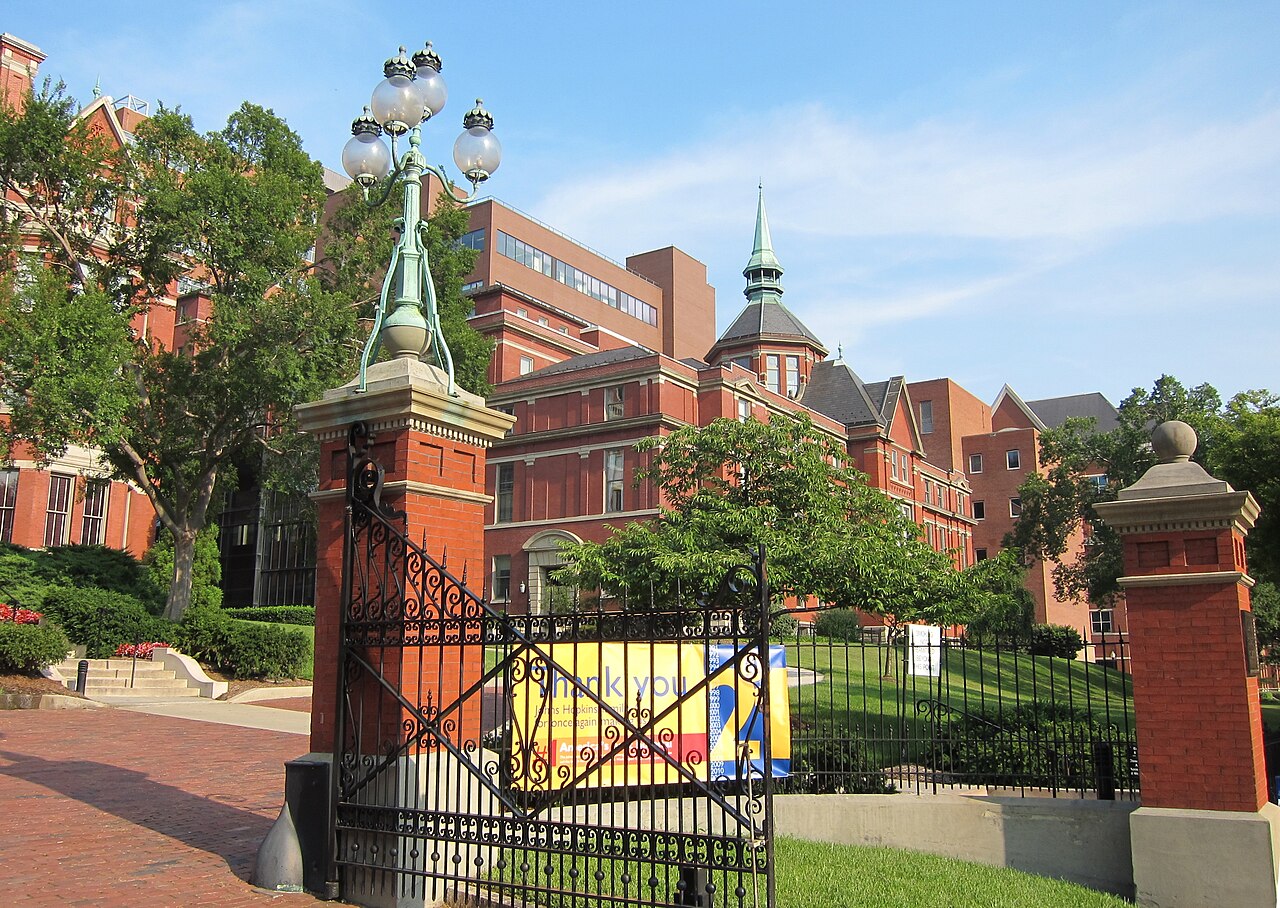
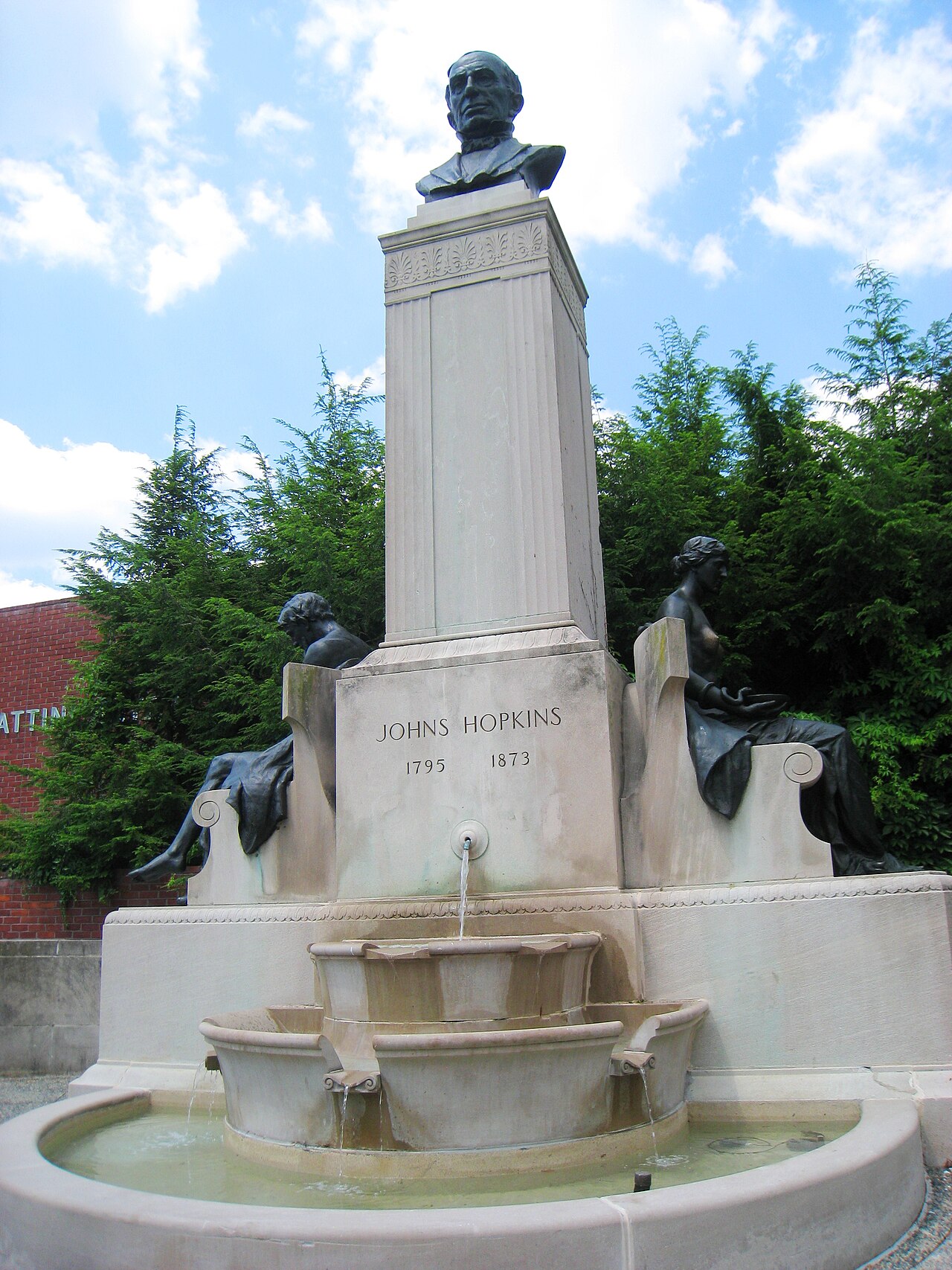
Johns Hopkins University, also called Johns Hopkins, Hopkins, or JHU, is a private research university based in Baltimore, Maryland. It was incorporated in 1867 and opened its doors in 1876, following the European research institution model, and is often described as the first research university in the United States, though this characterization is a matter of interpretation and not universally agreed upon. The institution takes its name from its first major donor, Johns Hopkins, an American businessman and Quaker philanthropist. His $7 million bequest—worth a substantial sum in its day—was the largest charitable gift in U.S. history at the time.
The university’s founding was shaped by a novel approach: a focus on advanced knowledge discovery, inspired by the German Humboldtian model, particularly Heidelberg University. This made Johns Hopkins a prototype for the modern U.S. research university, shifting higher education from teaching established knowledge to generating new scientific findings. The original board chose this path, and the university’s success eventually transformed American higher education.
Daniel Coit Gilman, the first president, was inaugurated on February 22, 1876. He had previously led the University of California (system) and studied German universities like Freiburg. Gilman merged teaching and research, arguing that the best teachers are those who conduct original research. He recruited internationally known scholars, including mathematician James Joseph Sylvester, biologist H. Newell Martin, physicist Henry Augustus Rowland, classicists Basil Gildersleeve and Charles D. Morris, economist Richard T. Ely, and chemist Ira Remsen, who later became the second president in 1901. Gilman’s emphasis on graduate education and faculty research helped revolutionize U.S. higher education.
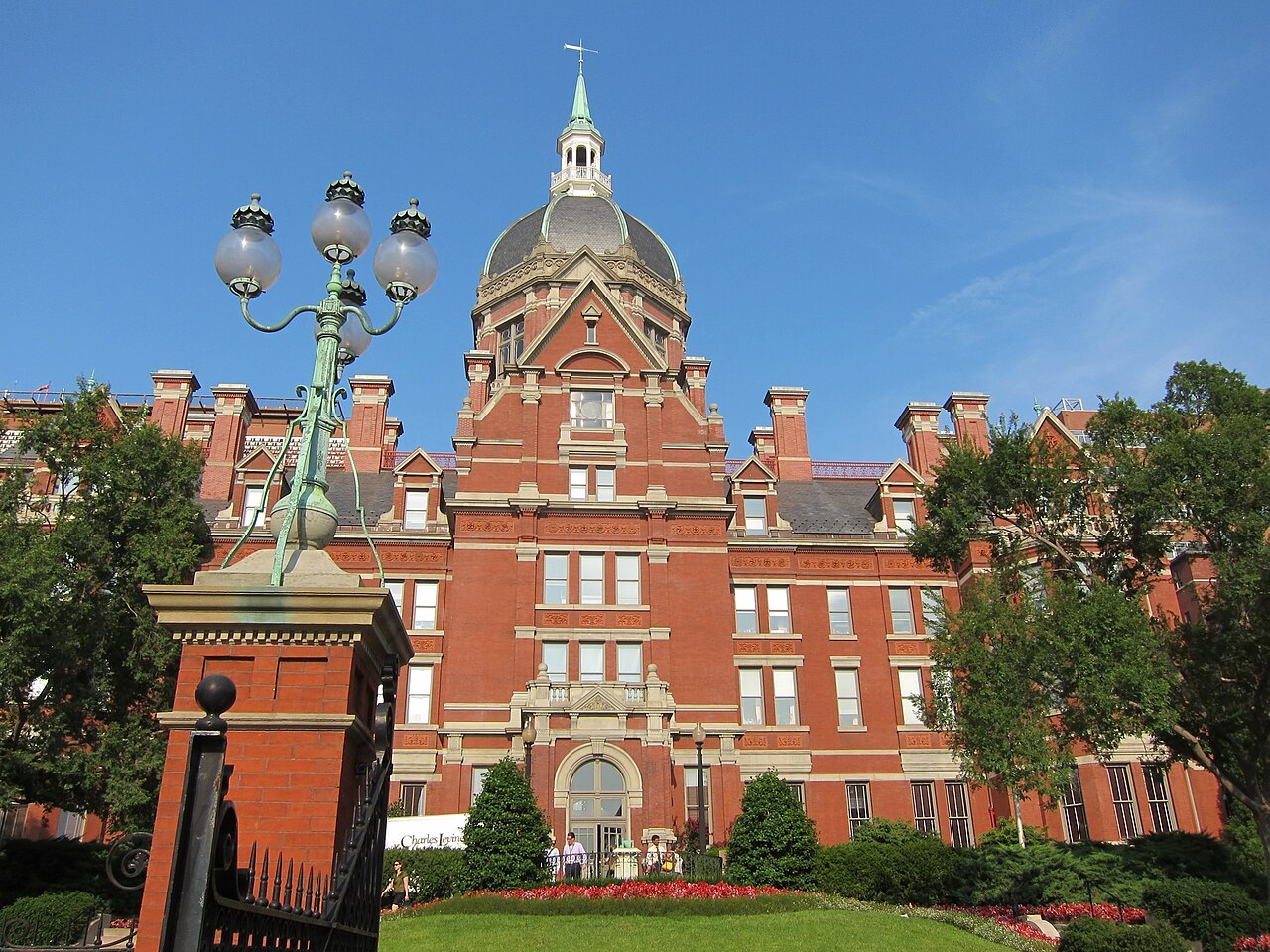
In 1900, Johns Hopkins became a founding member of the Association of American Universities. Its School of Medicine, established in 1893, gained international fame for pioneering biomedical research. The university now has ten academic divisions, mostly spread across four campuses in Baltimore, with additional graduate campuses in Italy, China, and Washington, D.C. The two undergraduate divisions—the Zanvyl Krieger School of Arts and Sciences and the Whiting School of Engineering—are on the Homewood campus near Baltimore’s Charles Village neighborhood.
Quick Facts
- Latin Name
- Universitas Hopkinsiensis
- Motto
- la · Veritas vos liberabit (Latin)
- Motto Eng
- "The truth will set you free"
- Established
- February 22, 1876
- Academic Affiliations
- AAU · COFHE · CUWMA · NAICU · ORAU · UARC · URA · Space-grant
- Endowment
- $13.06 billion (FY2024)
- President
- Ronald J. Daniels
- Provost
- Lainie Rutkow (interim)
- Undergrad
- 6,356 (fall 2024)
- Students
- 30,210 (fall 2024)
- Postgrad
- 23,854 (fall 2024)
- Total Staff
- 27,300
Facts from the source article.
Lore & Background
Johns Hopkins, a Quaker businessman and childless bachelor, bequeathed $7 million upon his death in 1873 to fund a hospital and university in Baltimore. The donation, generated primarily from the Baltimore and Ohio Railroad, was the largest philanthropic gift in U.S. history at the time. The university's first name comes from the surname of his great-grandmother, Margaret Johns. Hopkins's relationship to slavery has been debated; research commissioned by the university in 2020 cited census records as evidence that individuals recorded as enslaved were his property, and the university has accepted this finding. Subsequent scholarship has not substantially rebutted this conclusion.
Reader's Guide
Johns Hopkins University revolutionized higher education in the United States by integrating teaching and research, following the Humboldtian model of German universities. Under first president Daniel Coit Gilman, the university recruited internationally known researchers and focused on graduate education and faculty research. Its School of Medicine, established in 1893, became the first medical school in the U.S. to admit women on an equal basis with men and to require a bachelor's degree, setting a prototype for academic medicine. The university became a founding member of the Association of American Universities in 1900. Its success shifted American higher education from teaching revealed or applied knowledge to the scientific discovery of new knowledge. The Johns Hopkins University Press, founded in 1878, is the oldest American university press in continuous operation.
Did You Know?
- Johns Hopkins University was the first research university in the United States.
- The university's $7 million founding gift was the largest philanthropic gift in U.S. history up to that time.
- The Johns Hopkins Blue Jays men's lacrosse team has won 44 national titles.
Founding and Early Identity
The story of Johns Hopkins University Press begins in 1878, when Daniel Coit Gilman—then serving as the university's inaugural president—gave the new institution its publishing arm. What launched as a modest Publication Agency quickly found its footing: the American Journal of Mathematics appeared in the very first year, followed by the American Chemical Journal the next. The press's first standalone book came in 1881, a memorial tribute to Sidney Lanier, a poet who had counted among the university's earliest writers in residence. For over a decade the operation carried the simpler name Johns Hopkins Press before adopting its current title in 1972. What makes this lineage remarkable is continuity. Across more than a century and a quarter of operation, the press has never ceased publishing, earning its place as the oldest university press in the United States to have run without interruption since its founding.
A Remarkable Chain of Stewardship
Few publishing houses can boast such an unbroken chain of leadership. In over 125 years, the press has had just eight directors, a testament to the stability of its mission. The early leaders held their posts for remarkable stretches: Nicholas Murray guided the operation for three decades from 1878 to 1908, and Christian W. Dittus followed with a forty-year tenure through 1948. Harold E. Ingle and Jack G. Goellner each served for more than two decades, anchoring the mid-twentieth century. The later years saw shorter appointments—Willis G. Regier, James D. Jordan, and Kathleen Keane—before Barbara Pope took the helm in 2017. Keane, who directed the press from 2003 until her retirement, is widely credited with steering it through the digital transformation that reshaped scholarly publishing. Her successor inherited an institution already repositioned for the online era, continuing a tradition of long-term institutional thinking that distinguishes the press from more frequently restructured peers.
Project MUSE and the Digital Leap
The digital revolution in academic publishing found an early and committed champion in Johns Hopkins University Press. In 1993, the press launched Project MUSE, an online platform that has since grown to host more than 550 scholarly journals and over 20,000 electronic books—a vast digital library accessible to researchers worldwide. This initiative did not replace the press's print output; rather, it expanded its reach. Today, the press still produces more than 200 new books annually and publishes 90 scholarly journals, while Project MUSE simultaneously makes a far broader corpus available in electronic form. Kathleen Keane, who directed the press from 2003 until her 2017 retirement, is specifically credited with modernizing the organization for the digital age, ensuring that the century-old institution could compete and thrive in an era where readers increasingly turn to screens. The result is a hybrid model: a traditional book and journal publisher whose electronic arm now rivals the scale of dedicated digital platforms.
A Church-Turned-Office and Three Divisions
Since 1993, the press has called a distinctive building in Baltimore's Charles Village neighborhood its permanent home. The structure, originally built in 1897 as the church for the Saints Philip and James Roman Catholic parish, is a granite-and-brick edifice that the press renovated to house its offices across five floors. The move to this space followed years of shifting locations on and off the university's Homewood campus, finally giving the organization a fixed, identity-rich base. Operationally, the press is organized into three divisions. Book Publishing handles the full lifecycle of a title—from acquisitions and manuscript editing through design, production, and marketing. The Journals and Electronic Publishing division oversees the 90 periodicals and the Project MUSE platform. The third arm, Hopkins Fulfillment Services, manages order processing, information systems, and the distribution center that gets physical copies into readers' hands. Together, these units allow a single institution to function as both a content creator and a logistics operation.
Gallery
Frequently Asked Questions
What is Johns Hopkins University?
It is a private research university located in Baltimore, Maryland, that opened in 1876 and is widely credited as the first American institution built around the European graduate-research model.
Who is Johns Hopkins University named after?
The school takes its name from Johns Hopkins, a Quaker businessman whose $7 million estate bequest funded its creation. At the time, that gift was the largest charitable donation ever made in the United States.
When was Johns Hopkins University founded and who led it first?
The institution was legally incorporated in 1867 but did not open its doors to students until 1876. Daniel Coit Gilman served as its first president.
Why is Johns Hopkins University considered groundbreaking in U.S. higher education?
It was the first university in America to adopt the European research-university structure, prioritizing graduate-level scholarship and hands-on laboratory science over the older lecture-only format.
What is Johns Hopkins University known for in the medical field?
It established the first coeducational graduate-level medical school in the country and has long been a leading center for pioneering biomedical research.
More in Universities 1-24
Spotted an error? Know more?
Reader corrections go straight into our review queue. Suggest an edit · How this site is sourced