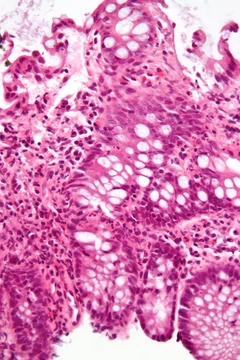
Polymyositis
Chronic inflammatory myopathy of proximal muscles with systemic complications.
Polymyositis is a chronic inflammatory myopathy primarily affecting the endomysial layer of skeletal muscle. It is related to dermatomyositis and inclusion body myositis, and its inflammation is mediated by cytotoxic T cells. The condition is notable for its association with an increased risk of cancer and systemic involvement such as interstitial lung disease and heart disease.
Quick Facts
- Field
- Rheumatology
Facts from the source article.
Signs and symptoms
The hallmark of polymyositis is weakness and loss of muscle mass in the proximal musculature, along with neck and torso flexion difficulties, often accompanied by marked pain. Hip extensors are frequently severely affected, causing trouble climbing stairs and rising from a seated position. Unlike dermatomyositis, skin involvement is absent. Dysphagia or other esophageal motility problems occur in up to one-third of patients. Low-grade fever and enlarged lymph nodes may be present. Advanced disease can include foot drop in one or both feet. Systemic involvement includes interstitial lung disease and heart disease such as heart failure and conduction abnormalities. The weakness is generally progressive and bilateral, often first noticed in the upper legs due to early fatigue while walking. It may present as inability to rise from a seated position or raise arms above the head. Lymphocytic inflammation, mainly cytotoxic T cells, accompanies the weakness. Polymyositis carries an increased risk of cancer; factors associated with higher risk include older age, age greater than 45, male sex, dysphagia, death of skin cells, cutaneous vasculitis, rapid onset under four weeks, elevated creatine kinase, higher erythrocyte sedimentation rate, and higher C-reactive protein levels. Lower risk is associated with interstitial lung disease, joint inflammation or pain, Raynaud's syndrome, or anti-Jo-1 antibody. Associated malignancies include nasopharyngeal cancer, lung cancer, non-Hodgkin's lymphoma, and bladder cancer. Cardiac involvement manifests as heart failure in up to 77% of patients. Interstitial lung disease is found in up to 65% of patients as defined by HRCT or restrictive ventilatory defects.
Causes
Polymyositis is a muscle inflammation driven by cytotoxic T cells targeting an unknown self-antigen, unlike dermatomyositis, which stems from antibody-mediated blood vessel damage. Its cause remains unclear, possibly involving viral triggers or autoimmunity. Cancer can provoke both conditions, likely when an immune response against a tumor mistakenly attacks muscle tissue. A possible link to celiac disease has been suggested.
Diagnosis
Diagnosis is fourfold: history and physical examination, elevation of creatine kinase, electromyograph alteration, and a positive muscle biopsy. The hallmark clinical feature is proximal muscle weakness, with muscle pain and dysphagia being less important findings. Cardiac and pulmonary findings occur in approximately 25% of cases. Sporadic inclusion body myositis is often misdiagnosed as polymyositis but can be differentiated by its lack of response to treatment and onset over months to years, whereas polymyositis comes on over weeks to months and tends to respond well initially. Clinical criteria are non-specific, and many disorders can present similarly, including dermatomyositis, inclusion body myositis, immune-mediated necrotizing myopathy, systemic lupus erythematosus, systemic sclerosis, and Sjögren syndrome. Other conditions that may be confused include amyotrophic lateral sclerosis, chronic spinal muscular atrophy, myasthenia gravis, inherited metabolic myopathies such as McArdle disease, endocrine conditions like thyroid disorders, Cushing syndrome, and acromegaly, as well as parasitic infections such as Trichinella and sarcocystosis, and viral infections like influenza.
Society and culture
Notable individuals who died from effects of polymyositis include abstract painter Dan Christensen, composer Robert Erickson, and wrestler Victor Manuel Resendiz Ruiz. Ana Estrada, the first person in Peru to die by euthanasia, had polymyositis. Film director David Lean, playwright Eric Samuelsen, Cardinal John Wright, and Puerto Rican actress and singer Rosita Velazquez are also listed as having the condition.
More in Steroid-responsive Inflammatory Conditions
Spotted an error? Know more?
Reader corrections go straight into our review queue. Suggest an edit · How this site is sourced