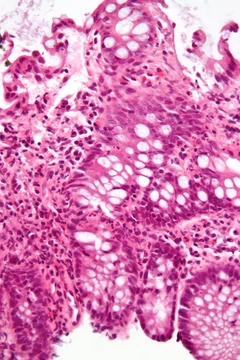
Rheumatoid arthritis
Chronic autoimmune disorder causing joint inflammation and systemic effects.
Rheumatoid arthritis is a long-term autoimmune disorder that primarily affects joints, typically resulting in warm, swollen, and painful joints. It often involves the same joints on both sides of the body, most commonly the wrist and hands, and can also affect other organs. The condition is notable for its chronic inflammation and potential to cause joint damage and disability.
Quick Facts
- Field
- Rheumatology, Immunology
- Symptoms
- Warm
- swollen
- painful joints
- Complications
- Low red blood cells
- inflammation around the lungs
- inflammation around the heart
- Onset
- Middle age
- Duration
- Lifelong
- Diagnosis
- Based on symptoms
- medical imaging
- blood tests
- Differential
- Systemic lupus erythematosus
- psoriatic arthritis
- fibromyalgia
- Medication
- Pain medications
- steroids
- nonsteroidal anti-inflammatory drugs
- disease-modifying antirheumatic drugs
Facts from the source article.
Did You Know?
- RA affects approximately 1% of the adult population worldwide and occurs in one in 1,000 children.
- A family history of RA increases the risk around three to five times; genetics may account for 40–65% of seropositive RA cases but only around 20% for seronegative RA.
- Poor prognostic factors include persistent synovitis, early erosive disease, positive serum RF and anti-CCP autoantibodies, and carriership of HLA-DR4 'Shared Epitope' alleles.
Signs and symptoms
Rheumatoid arthritis mainly affects synovial joints, causing inflammation, pain, and stiffness. It typically develops slowly and affects both sides of the body. Systemic symptoms such as fatigue, low-grade fevers, and weight loss are also seen. Joint pain, swelling, and stiffness are worst in the morning or after rest, with morning stiffness lasting several hours and improving with movement. This differs from osteoarthritis, where stiffness is shorter. Symptoms can interfere with daily tasks, sleep, and quality of life. The disease often begins in the small joints of the hands and feet before spreading to larger joints, including elbows, shoulders, ankles, knees, hips, and jaw. It is polyarticular, affecting multiple joints, and symmetry may not be present early. Synovitis may not be visible initially; signs include soft, spongy swelling around a joint. Joint deformities develop over time if RA is severe, chronic, or untreated, potentially leading to significant disability.
Pathophysiology
RA begins with persistent cellular activation leading to autoimmunity and immune complexes in joints and other organs. The clinical manifestations are primarily synovial membrane inflammation and joint damage, with fibroblast-like synoviocytes playing a key role. Three phases of progression are an initiation phase from non-specific inflammation, an amplification phase from T cell activation, and a chronic inflammatory phase with tissue injury from cytokines IL-1, TNF-alpha, and IL-6. Genetic disorders that alter adaptive immune regulation interact with environmental risk factors, with cigarette smoking as the most clearly defined risk factor. Hormonal factors may explain higher risks for women, including onset after childbirth. Negative feedback mechanisms that normally maintain tolerance may be overtaken by positive feedback for antigens such as IgG Fc bound by rheumatoid factor and citrullinated fibrinogen bound by ACPA. Neither B cells nor T cells are necessary at the inflammation site, only autoantibodies to IgGFc (rheumatoid factors) and ACPA, with ACPA having 80% specificity for diagnosing RA. People with RA have abnormally glycosylated antibodies that promote joint inflammation. Plasma cells produce rheumatoid factors and ACPA in large quantities, activating macrophages through Fc receptor and complement binding.
Diagnosis
X-rays of the hands and feet are generally performed when many joints are affected. Early RA may show no changes, or X-ray may reveal osteopenia near the joint, soft tissue swelling, and a smaller joint space. Advanced disease can show bony erosions and subluxation. MRI and ultrasound are also used; high-frequency ultrasound depicts 20% more erosions than conventional radiography. Color Doppler and power Doppler ultrasound can show vascular signals of active synovitis, which is the best predictive marker of future joint damage. When RA is suspected, a physician may test for rheumatoid factor (RF) and anti-citrullinated protein antibodies (ACPAs, measured as anti-CCP). RF is positive in about two-thirds of cases, but a negative result does not rule out RA; seronegative RA occurs in about a third of people. RF is non-specific, seen in 10% of healthy people and in other conditions. ACPA tests are positive in 61–75% of RA cases with about 95% specificity. The most common clinical test for ACPAs is the anti-CCP ELISA. A serological point-of-care test combining RF and anti-MCV had a sensitivity of 72% and specificity of 99.7%.
Management
There is no cure for RA, but treatments can improve symptoms and slow disease progression. Disease-modifying treatment works best when started early and aggressively. Combination therapy with TNF and non-TNF biologics plus methotrexate resulted in improved disease control, DAS-defined remission, and functional capacity compared to single treatment. Goals are to minimize pain and swelling, prevent bone deformity, and maintain day-to-day functioning, primarily with disease-modifying antirheumatic drugs (DMARDs). Dosed physical activity, analgesics, and physical therapy may help manage pain. RA should generally be treated with at least one specific anti-rheumatic medication; combination therapies and corticosteroids are common. Benzodiazepines are not recommended for pain as they do not appear to help and are associated with risks. Regular exercise is safe and effective for maintaining muscle strength and physical function; carefully dosed exercise has shown significant improvements. Physical activity increases synovial fluid production and has no detrimental side effects. High-vegetable diets may improve symptoms, while high-meat diets may worsen them. Occupational therapy improves functional ability. Weak evidence supports wax baths for hand arthritis.
More in Steroid-responsive Inflammatory Conditions
Spotted an error? Know more?
Reader corrections go straight into our review queue. Suggest an edit · How this site is sourced