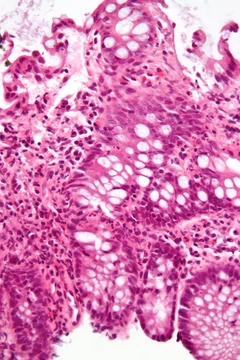
Inflammatory bowel disease
Chronic inflammatory conditions of the colon and small intestine.
Inflammatory bowel disease (IBD) encompasses a group of chronic inflammatory conditions of the colon and small intestine, with Crohn's disease and ulcerative colitis as the principal types. Crohn's disease can affect any part of the gastrointestinal tract from mouth to anus, while ulcerative colitis is restricted to the colon and rectum. These conditions are notable for their complex interplay of genetic and environmental factors leading to persistent intestinal inflammation.
Quick Facts
- Field
- Gastroenterology
- Differential
- Gastroenteritis
- irritable bowel syndrome
- celiac disease
- Frequency
- 11.2 million worldwide (2015)
- Deaths
- 47,400 worldwide (2015)
Facts from the source article.
Did You Know?
- Anemia is the most prevalent extraintestinal complication of inflammatory bowel disease.
- Associated conditions include arthritis, pyoderma gangrenosum, primary sclerosing cholangitis, and non-thyroidal illness syndrome.
- The first gene linked to IBD was NOD2 in 2001.
Causes
IBD arises from interactions between environmental and genetic factors that trigger immunological responses and inflammation in the intestine. Dietary patterns are associated with risk; a healthy dietary pattern correlates with a 79% lower risk of ulcerative colitis. Increased intake of fruits and vegetables, reduction of processed meats and refined carbohydrates, and preference for water for hydration are linked to lower risk of active symptoms, though increased fruit and vegetable intake alone does not reduce symptom risk in Crohn's disease. Gluten sensitivity is common, reported in 23.6% of Crohn's disease patients and 27.3% of ulcerative colitis patients, and is associated with flareups. Diets high in protein (especially animal protein) or high in sugar may increase risk of IBD and relapses. Emerging evidence points to bile acids as important etiological agents; IBD patients show increased primary bile acids (cholic acid, chenodeoxycholic acid) and decreased secondary bile acids (lithocholic acid, deoxycholic acid). The microbiota composition differs in IBD patients compared to healthy individuals, with a decrease in beneficial bacteria such as Bifidobacterium longum, Eubacterium rectale, Faecalibacterium prausnitzii, and Roseburia intestinalis, and an increase in harmful species like Bacteroides fragilis, Ruminococcus torques, and Ruminococcus.
Treatment
Crohn's disease and ulcerative colitis are chronic inflammatory diseases that are not medically curable, though ulcerative colitis can often be cured by proctocolectomy, which may not eliminate extra-intestinal symptoms. An ileostomy collects feces in a bag, or a pouch can be created from the small intestine to serve as the rectum, though between one-quarter and one-half of patients with ileo-anal pouches experience occasional or chronic pouchitis. Surgery cannot cure Crohn's disease but may be needed for complications such as abscesses, strictures, or fistulae; even after resection, Crohn's disease nearly always recurs near the anastomosis. Medical treatment is individualized and depends on the type, distribution, and severity of disease, as well as prognostic factors and patient preferences. Mesalazine is more useful in ulcerative colitis than in Crohn's disease. Depending on severity, immunosuppression with drugs such as prednisone, tumor necrosis factor inhibitors, azathioprine, methotrexate, or 6-mercaptopurine may be required. Steroids like prednisone are frequently used to control flares and were once acceptable as maintenance therapy.
Research
Several treatment strategies not routinely used appear promising. Helminthic therapy with approximately 2,500 ova of Trichuris suis taken twice monthly decreased symptoms markedly in many patients, and it has been speculated that an immunization procedure could be developed by ingesting the cocktail at an early age. Prebiotics and probiotics are of increasing interest; evidence supports the use of certain probiotics in addition to standard treatments for ulcerative colitis, but insufficient data exist for Crohn's disease. The most clinically researched multi-strain probiotic is the De Simone Formulation, with over 70 human trials. The specific strains, combinations, and prebiotic substances suited to intestinal inflammation have not been identified, and the optimal probiotic strain, frequency, dose, and duration are not established. In severely ill patients, there is a risk of bacterial translocation and bacteremia. Live bacteria may not be essential, as beneficial effects appear mediated by DNA and secreted soluble factors, and systemic administration may be more effective than oral. Cannabis has been reported to ease IBD symptoms, possibly through CB1 cannabinoid receptors in the endothelial cells lining the gut, which may be involved in repairing the gut lining.
More in Steroid-responsive Inflammatory Conditions
Spotted an error? Know more?
Reader corrections go straight into our review queue. Suggest an edit · How this site is sourced