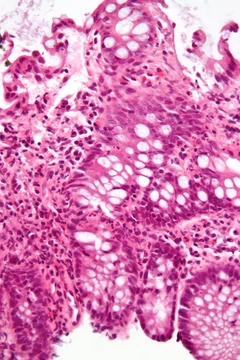
Lupus
An autoimmune disease marked by flares and multi-organ inflammation.
Systemic lupus erythematosus (SLE) is an autoimmune disease in which the immune system attacks healthy tissues throughout the body, causing symptoms that range from mild to severe. It is notable for its variable course, with periods of flares and remission, and for its ability to mimic many other illnesses, earning it the designation of a "great imitator." The name lupus, Latin for "wolf," dates to the 13th century, when the facial rash was thought to resemble a wolf's bite.
Quick Facts
- Field
- Rheumatology
- Symptoms
- Painful and swollen joints
- fever
- chest pain
- hair loss
- mouth ulcers
- swollen lymph nodes
- feeling tired
- red rash
- Onset
- 15–45 years of age
- Duration
- Long term
- Causes
- Unclear
- Diagnosis
- Based on symptoms and blood tests
- Medication
- NSAIDs
- corticosteroids
- immunosuppressants
- hydroxychloroquine
- methotrexate
- Prognosis
- 15 year survival ~80%
Facts from the source article.
Did You Know?
- Some studies have found that vitamin D deficiency often occurs in patients with SLE and that its level is particularly low in those with more active disease, though other studies have not confirmed this association.
- Antinuclear antibody (ANA) testing is highly sensitive for lupus, with the vast majority of individuals testing positive, but it is not specific, as a positive result may or may not indicate lupus.
- In the 1950s, most people diagnosed with SLE lived fewer than five years; today, over 90% survive for more than ten years, and 80–90% can expect a normal lifespan.
Signs and symptoms
SLE is known as one of the "great imitators" because its symptoms vary widely and can mimic other illnesses, making diagnosis elusive. Common initial complaints include fever, malaise, joint pains, muscle pains, and fatigue, though these are not part of the diagnostic criteria unless accompanied by other signs. Symptoms differ between sexes: females tend to have more relapses, low white blood cell count, arthritis, Raynaud syndrome, and psychiatric symptoms, while males more often have seizures, kidney disease, serositis, skin problems, and peripheral neuropathy. Up to 70% of people with lupus have skin symptoms, which fall into three categories: chronic cutaneous (discoid) lupus with thick red scaly patches; subacute cutaneous lupus with red scaly patches having distinct edges; and acute cutaneous lupus, which includes the classic malar or butterfly rash across the nose and cheeks, seen in 30–60% of patients. Hair loss, mouth and nasal ulcers, and other skin lesions may occur. Joint pain, most often in the small joints of the hand and wrist, is the most common reason for seeking medical attention; unlike rheumatoid arthritis, lupus arthritis is less disabling and rarely causes severe joint destruction, with fewer than 10% developing hand or foot deformities. People with SLE are at particular risk of osteoarticular tuberculosis, and a possible association with rheumatoid arthritis has been suggested.
Pathophysiology
SLE is triggered by unknown environmental factors, leading the immune system to produce antibodies against self-proteins, particularly those in the cell nucleus. It is considered a chronic inflammatory disease believed to be a type III hypersensitivity response with potential type II involvement. People with SLE show intense polyclonal B-cell activation with a shift toward immature B cells; memory B cells with increased CD27+/IgD− are less susceptible to immunosuppression, while CD27−/IgD− memory B cells are linked to increased disease activity and renal lupus. T cells have defects in signaling, adhesion, co-stimulation, gene transcription, and alternative splicing. Cytokines such as B-lymphocyte stimulator (BLyS, also known as BAFF), interleukin 6, interleukin 17, interleukin 18, type I interferons, and tumor necrosis factor α are involved in inflammation and are potential therapeutic targets. SLE is associated with low complement C3 levels. Apoptosis is increased in monocytes and keratinocytes, and expression of Fas by B and T cells is elevated; the apoptotic rates of lymphocytes correlate with disease activity. Necrosis is increased in T lymphocytes due to mitochondrial dysfunction, oxidative stress, and ATP depletion. In some patients, tingible body macrophages in germinal centers are reduced and rarely contain apoptotic B-cell material, potentially disrupting immune tolerance.
Treatment
There is no cure for lupus; treatment aims to prevent flares and reduce their severity and duration. Hydroxychloroquine, approved by the FDA for lupus in 1955, is a first-line agent recommended for all people with SLE regardless of disease activity, unless contraindicated by allergy or significant retinal disease. It is associated with a 54% reduction in mortality and reduced disease activity and complications; regular eye exams are advised due to a 2% prevalence of retinal toxicity at 10 years. Corticosteroids and antimalarial drugs are used, and certain types of lupus nephritis, such as diffuse proliferative glomerulonephritis, require intermittent cytotoxic drugs like cyclophosphamide and mycophenolate, which carry risks of infection, pancreas problems, high blood sugar, and high blood pressure. Belimumab (Benlysta) was approved by the FDA in March 2011 for pain and flare-ups. Nonsteroidal anti-inflammatory drugs and antimalarials may be used for mild disease, and medications such as prednisone, mycophenolic acid, and tacrolimus have also been employed. Healthcare utilization and costs are significant, especially for those with moderate or severe disease.
History
The history of SLE is divided into three periods: classical, neoclassical, and modern. The term lupus, Latin for "wolf," was used in the Middle Ages for ulcerating sores, and its use in a context similar to the modern disease is attributed to the 12th-century Italian physician Rogerius Frugard, who described ulcerating sores on the legs. In 1851, French physician Pierre Cazenave documented discoid lupus, adding the word erythematosus (from the Ancient Greek for "redness of the skin") to distinguish it from infectious skin diseases. Cazenave noted that lupus affected adults from adolescence into their early thirties and that a facial rash was its most distinguishing feature. The disease was classified as an autoimmune condition in 1851. No formal treatment existed in the Middle Ages, and resources for physicians were limited. Advances in diagnosis and treatment have dramatically improved life expectancy for people diagnosed with SLE.
Frequently Asked Questions
What are the symptoms of Lupus?
Symptoms of Lupus include painful and swollen joints, fever, chest pain, hair loss, mouth ulcers, swollen lymph nodes, feeling tired and red rash.
What causes Lupus?
Listed causes of Lupus include unclear.
More in Steroid-responsive Inflammatory Conditions
Spotted an error? Know more?
Reader corrections go straight into our review queue. Suggest an edit · How this site is sourced