Lagoon
Shallow, sheltered, and teeming—the lagoon is the nursery where the reef's future is raised.

A lagoon is a semi-enclosed body of shallow marine water separated from the open ocean by a barrier such as a coral reef, sandbar, or coastal spit. Found predominantly along tropical and subtropical coastlines, lagoons form one of the most ecologically productive and structurally diverse habitats in the marine realm. They encompass a mosaic of microhabitats—seagrass meadows, mangrove fringes, patch reefs, sandy flats, and channel edges—that together sustain a disproportionate share of coastal fisheries, nursery populations, and benthic invertebrate communities relative to their surface area.
In marine-biology reference literature, 'lagoon' is treated as a distribution and habitat category distinct from fore-reef, back-reef, and open-ocean zones. Species annotated with a lagoon range are typically euryhaline or at least tolerant of the reduced salinity, variable turbidity, and elevated nutrient loads characteristic of these basins. Understanding lagoon ecology is therefore essential for interpreting the full geographic and behavioral range of countless reef-associated and estuarine species.
- Habitat type
- Semi-enclosed shallow marine basin
- Typical depth
- Shallow; commonly under 10 m, rarely exceeding 30 m
- Barrier structure
- Coral reef, sandbar, or coastal spit
- Principal biomes
- Seagrass meadow, mangrove fringe, patch coral, sandy flat
- Geographic range
- Tropical and subtropical coastlines worldwide
- Key ecological role
- Nursery habitat; nutrient cycling; coastal buffering
Lore & Background
Lagoons occupy a transitional niche between the high-energy fore-reef and the freshwater-influenced estuary. Because the barrier structure attenuates wave energy and tidal range, lagoon waters are comparatively calm, warm, and often stratified. This stability allows benthic communities—seagrass such as Thalassia and Halophila, soft corals, and dense invertebrate assemblages—to establish continuous, multi-year stands. The resulting three-dimensional complexity provides shelter for juvenile reef fish, crustaceans, and molluscs that would be swept away or predated on exposed reef faces.
Nutrient dynamics in lagoons differ markedly from oligotrophic open-reef waters. Terrestrial runoff, mangrove leaf litter, and the slow flushing through limited tidal inlets deliver elevated levels of dissolved organic carbon and particulate matter. While this productivity supports high primary and secondary production, it also makes lagoons acutely sensitive to eutrophication: even modest increases in nitrogen and phosphorus loading can shift the balance from clear-water seagrass and coral communities toward macroalgal dominance and anoxic bottom waters.
From a biogeographic standpoint, lagoons act as both a filter and a corridor. The barrier reef or sandbar restricts the passage of pelagic and large-bodied species, yet the numerous channels, passes, and breach points that punctuate the barrier allow seasonal and life-stage movements of juvenile fish, elasmobranchs, and marine turtles. This selective permeability means that lagoon fauna are often a subset of the adjacent reef community, enriched by estuarine and demersal species that cannot survive in open-ocean conditions.
Reader's Guide
Seagrass meadow (0–5 m, sandy substrate) → Primary benthic nursery; juvenile wrasses, parrotfish, and small elasmobranchs shelter among stipes. Documented across most tropical lagoon basins; local absence noted in heavily dredged or eutrophicated sectors where macroalgae have replaced grass stands.
Mangrove fringe (intertidal to ~2 m subtidal) → Root-architecture habitat for juvenile crabs, shrimps, and mullet. Range extends into brackish upstream reaches; absent where mangroves have been cleared for aquaculture or development.
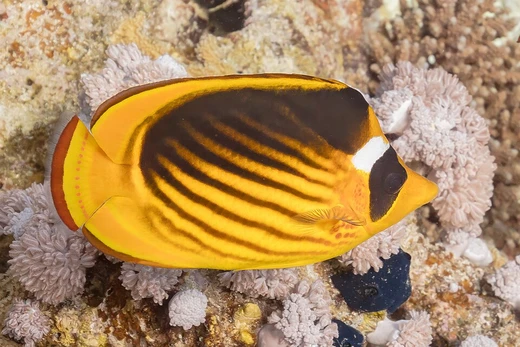
Patch reef (1–15 m, isolated coral outcrops) → Three-dimensional refuge for damselfish, butterflyfish, and benthic invertebrates. Present in most lagoon basins with sufficient light and substrate; locally absent in deep, turbid, or fine-sediment-dominated lagoons.
Sandy flat / channel edge (2–10 m) → Foraging ground for flatfish, rays, and demersal snappers; also a spawning substrate for several teleosts. Widely distributed; range extension noted in atoll lagoons where the flat widens to hundreds of metres.
Barrier-reef pass / breach (0–20 m) → Transitional corridor linking lagoon to fore-reef; seasonal movement route for juvenile elasmobranchs, groupers, and pelagic foragers. Present wherever the barrier is perforated; absent in fully enclosed lagoon basins.
Did You Know?
- Lagoons are among the most carbon-sequestering coastal habitats on Earth, with seagrass and mangrove sediments accumulating organic carbon at rates that can exceed those of terrestrial forests.
- Many lagoon species are euryhaline, tolerating salinities well below full marine levels, which allows them to exploit upstream brackish reaches that oligohaline reef species cannot enter.
- Lagoon water residence time can range from days to months depending on inlet geometry and tidal prism, making nutrient loading and hypoxia management the central conservation challenge for these basins.
More in Distribution & Habitat
Elsewhere in Diagonal butterflyfish
Spotted an error? Know more?
Reader corrections go straight into our review queue. Suggest an edit · How this site is sourced