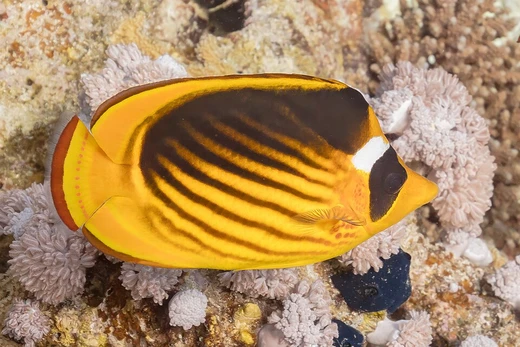
Forereef
Shallow sands and scattered boulders where the long survey of 4546B begins.

Forereef is a shallow marine biome in the 2018 survival-exploration video game *Subnautica* (Unknown Worlds Entertainment), set on the ocean-covered alien planet 4546B. It occupies one of the least-deep zones in the game's vertical world and functions as a transitional habitat between the player's initial crash site and the more vegetated plateaus beyond.
Characterised by a broad sandy floor punctuated by scattered boulder fields, low coral-analogue outgrowths, and sparse drifting vegetation, Forereef presents a visually open, low-contrast environment. In the game's narrative it is one of the first biomes a survivor encounters while surveying the planet, and its relative paucity of large apex predators makes it a de facto safe zone for early exploration and resource gathering.
- Source
- Subnautica (2018, Unknown Worlds Entertainment)
- Type
- Shallow marine biome (fictional)
- Setting
- Planet 4546B
- Substrate
- Sandy bottom with scattered boulder fields
- Threat level
- Low – few or no large apex predators
- Game phase
- Early-game exploration zone
Lore & Background
In the world of *Subnautica*, the player arrives on 4546B after the Aurora's crash and is initially confined to the Safe Shallows. Moving outward, the Forereef is among the first biomes that open up once basic mobility and a modest oxygen supply are in hand. Its open sandy expanse, broken by clusters of rounded boulders and low-lying rock formations, gives it a stark, almost lunar quality compared to the denser kelp forests and plateau grasses that lie further out. The scattered rubble provides cover for small, fast-moving fauna, while the broad flats offer little concealment for anything larger.
The biome's design serves a narrative and mechanical purpose: it introduces the player to the game's vertical depth gradient without the immediate pressure of a Reaper Leviathan or a Stalker. The sparse vegetation and low light-competition create a visually calm, sun-dappled environment that contrasts sharply with the bioluminescent chaos of the mid- and deep-water zones. For players, it is a place to learn the rhythm of oxygen management, to harvest early resources from the rock shelves, and to orient themselves toward the Grassy Plateaus and Dunes that mark the next tier of the planet's ecology.
Within the broader 4546B ecosystem, Forereef sits at the shallow margin where sediment transport from the continental shelf meets the open-water column. Its boulder fields are the game's visual shorthand for 'geological outcrop in a young, tectonically active ocean,' and the scattered debris implies a history of shallow-seafloor upheaval consistent with the planet's volcanic character.
Reader's Guide
Sandy flats (0–15 m) → Open, unobstructed substrate with fine sediment. Small, fast pelagic fauna (Boomerangs, Rockpool Snappers) use the column above for quick lateral dashes; the flat itself offers no structural cover, so larger organisms are absent. No documented range extensions; the zone is consistently shallow across the map.
Boulder fields (5–20 m) → Clusters of rounded, 2–5 m rocks scattered across the sand. The undersides and crevices provide microhabitat for small invertebrate-analogues and serve as ambush points for mid-size predators. The boulders are the primary structural element of the biome and are the only reliable cover in otherwise open water.
Low coral-analogue outgrowths (10–25 m) → Sparse, low-profile branching and encrusting growths on the leeward faces of boulders. These provide minimal three-dimensional complexity compared to the dense kelp or coral of deeper biomes, and their distribution is patchy—some boulder clusters are bare, others carry a thin carpet of growth. Local absence of any single 'dominant' species keeps the visual character open and uncluttered.
Transition margin (15–30 m) → The Forereef floor gradually grades into the Grassy Plateaus to one side and the open Dunes to another. Faunal overlap is minimal; the biome's defining species do not extend significantly past this margin, and no large apex predator is documented as resident.
Did You Know?
- Forereef is one of the shallowest biomes in Subnautica, placing it within the first few metres of the player's vertical exploration range on 4546B.
- Its scattered boulder fields are the only structural cover in an otherwise open sandy environment, making them the primary hunting and hiding spots for mid-size fauna.
- The biome's visual design—pale sand, rounded rocks, sparse growth—deliberately contrasts with the dense, bioluminescent mid-water and deep-water zones to signal low threat to the player.
- In the game's ecosystem, Forereef occupies the shallow margin where tectonic sediment meets the open water column, consistent with 4546B's volcanic geological character.
More in Distribution & Habitat
Elsewhere in Diagonal butterflyfish
Spotted an error? Know more?
Reader corrections go straight into our review queue. Suggest an edit · How this site is sourced