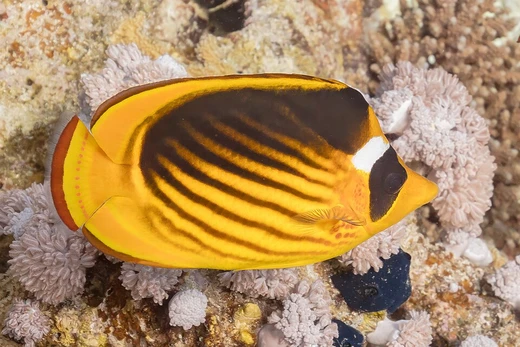
Amphiprion ocellaris
Born male, promoted by death, guarding eggs no one else will touch.

Amphiprion ocellaris, commonly called the ocellaris clownfish or false percula clownfish, is a small reef-dwelling damselfish (family Pomacentridae) native to the western and central Indo-Pacific. It is a sequential protandrous hermaphrodite: every individual is born phenotypically male, and the largest member of a social group reverses to become the breeding female (Wikipedia: "Amphiprion ocellaris"; Wikipedia: "Clownfish").
Its reproductive biology—obligate sex reversal tied to social rank, communal egg-guarding by the male, and a brief planktonic larval phase—makes it one of the best-studied models of alternative reproductive strategies in marine teleosts. FishBase records the species under the authority (Bennett, 1898) and places it in the subfamily Amphiprioninae.
- Common name
- Ocellaris clownfish / False percula clownfish
- Scientific name
- Amphiprion ocellaris (Bennett, 1898)
- Family
- Pomacentridae (subfamily Amphiprioninae)
- Reproductive strategy
- Sequential protandrous hermaphrodite
- Distribution
- Western and central Indo-Pacific (FishBase species record)
- Symbiotic association
- Sea anemones (less obligate than A. percula; also uses other reef structures)
- Social structure
- Hierarchical group: 1 breeding female, 1 breeding male, 1+ subordinate males
Lore & Background
In the social grammar of Amphiprion ocellaris, dominance is not inherited—it is inherited by vacancy. When the breeding female dies or is removed, the largest male undergoes a gonadal sex reversal within weeks, his testes regressing as ovarian tissue differentiates, and he assumes the female role in the group. The next-largest male is then promoted to breeding male. This cascade is documented in both field observations on Indo-Pacific reefs and in long-term aquarium studies (Wikipedia: "Clownfish"; Wikipedia: "Protandry").
The breeding pair's division of labor is stark. The female selects a flat substrate—typically a rock or coral head near the anemone—and the male meticulously cleans the surface over several days before oviposition. On spawning day the female deposits a single clutch of adhesive eggs in a spiral pattern; the male then guards them continuously, fanning with his pectoral fins to maintain oxygenation and removing any fungal spores or dead eggs with his mouth. This paternal care continues until hatching (Wikipedia: "Clownfish," section on reproduction).
After hatching, the larvae enter a planktonic phase lasting roughly one to two weeks during which they drift with currents, feeding on zooplankton. Settlement back onto a reef is a critical bottleneck: the juvenile must locate a suitable anemone or sheltered microhabitat and integrate into an existing social group, where it will occupy the lowest rank and remain male unless higher-ranking individuals are lost (Wikipedia: "Amphiprion ocellaris"; FishBase life-history notes).
Reader's Guide
1. Substrate preparation & oviposition. The breeding male cleans a flat rock or coral surface over several days; the female then deposits a single adhesive clutch in a spiral pattern. Duration of cleaning: several days (aquarium observation; Wikipedia: "Clownfish"). Evidence: repeated aquarium observation and field notes.
2. Paternal incubation. The male guards the clutch continuously, fanning with pectoral fins and removing damaged eggs. Duration: approximately 6–10 days post-spawning (aquarium observation; exact range varies with temperature—data sparse in open literature for A. ocellaris specifically). Evidence: aquarium observation; histology of guarding behavior inferred from field studies on congeneric Amphiprion.
3. Planktonic larval phase. Hatched larvae are translucent, laterally compressed, and drift with currents feeding on zooplankton. Duration: approximately 10–14 days (field/aquarium observation; Wikipedia: "Clownfish" notes a ~1–2 week pelagic phase). Evidence: plankton-net sampling and aquarium rearing studies. Uncertainty: precise PLD for A. ocellaris is less well quantified than for A. percula.
4. Settlement & juvenile integration. Larvae settle onto a reef, locate an anemone or sheltered structure, and join an existing social group at the lowest rank (male). No further sex change occurs unless higher-ranking individuals are lost. Evidence: field observation; Wikipedia: "Amphiprion ocellaris." Data on settlement success rates remain sparse.
5. Sex reversal (if triggered). Upon loss of the breeding female, the dominant male's testes regress and ovarian tissue differentiates over several weeks; he assumes the female role. Evidence: histological studies of gonadal tissue in Pomacentridae; Wikipedia: "Protandry." Timing: on the order of weeks, not days.
Did You Know?
- All Amphiprion ocellaris are born male; only the largest individual in a group ever becomes female, and this reversal is irreversible (Wikipedia: "Clownfish").
- The male cleans the spawning substrate for days before the female will deposit eggs—a courtship behavior documented in both field and aquarium settings (Wikipedia: "Clownfish").
- Unlike the closely related A. percula, A. ocellaris is less strictly anemone-dependent and has been observed using a wider range of reef microhabitats (FishBase habitat notes; Wikipedia: "Amphiprion ocellaris").
More in Life Cycle & Reproduction
Elsewhere in Diagonal butterflyfish
Spotted an error? Know more?
Reader corrections go straight into our review queue. Suggest an edit · How this site is sourced