Silk snapper
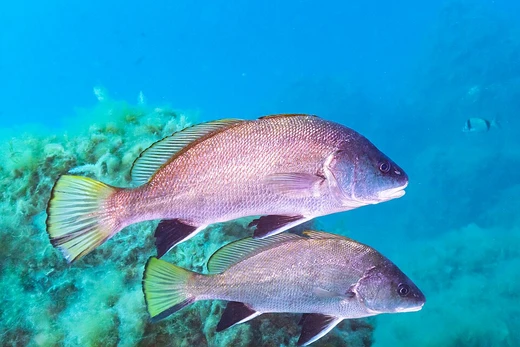
A red snapper with a vivid yellow iris, found in the Western Atlantic.

The silk snapper (Lutjanus vivanus), also called the West Indian snapper, yellow-eyed snapper, or yellow-eyed red snapper, is a marine ray-finned fish in the snapper family Lutjanidae. It lives in the Western Atlantic Ocean.
French zoologist Georges Cuvier first formally described this species in 1828, naming it *Mesoprion vivanus* based on a specimen from Martinique. The species name *vivanus* comes from the local French names *vivaneau* and *vivanet*, which may trace back to *vivax*, meaning "lively."
The silk snapper has a moderately deep, oblong body that is laterally compressed, with a fairly sharp snout. Its front and rear nostrils are simple holes. It has a large mouth with a protruding upper jaw that slides under the cheek bone when closed. Each jaw holds one to two rows of conical teeth, with the front teeth enlarged into canines. On the roof of the mouth, the vomerine teeth form an anchor-shaped patch with a rearward extension, and there are tooth patches on each side. A deep notch marks the lower edge of the preoperculum. The continuous dorsal fin has no incision, with 10 to 11 spines and 13 to 14 soft rays, while the anal fin has 3 spines and 7 to 8 soft rays; both fins are scaled. The pectoral fins are long, about as long as the head in adults, and the caudal fin is emarginate. Overall, the fish is red to pinkish-red, paler on the belly. Some individuals have very thin, wavy yellow lines on their flanks. Its vivid yellow iris sets it apart from similar snapper species in the same area. The fins are reddish, with the anal and dorsal fins tinted yellow; the caudal fin has a dark edge, and the pectoral fins are light yellow. Juveniles have a black or red spot on the upper flanks just below the start of the dorsal fin.
This species ranges from North Carolina and Bermuda through the Caribbean Sea and Gulf of Mexico, south to São Paulo, Brazil, including Trindade Island. It lives at depths of 9 to 450 meters (30 to 1,476 feet), along the edges of continental and island shelves over sand, gravel, and coral bottoms. Juveniles stay in shallower waters than adults.
During the day, the silk snapper stays in deeper water, moving up at night to hunt. It mainly eats fish, but also preys on crabs, isopods, octopus, and shrimp. It can live up to 33 years.
Quick Facts
- Taxon
- Lutjanus vivanus
Facts from the source article.
Lore & Background
The silk snapper was first formally described in 1828 as Mesoprion vivanus by French zoologist Georges Cuvier, with the type locality given as Martinique. The specific name vivanus is derived from vivaneau and vivanet, the local French names for this species on Martinique, possibly originating from vivax, meaning 'lively'. The silk snapper has a moderately deep body with a sharp snout, an oblong shape, and is laterally compressed. Its front and rear nostrils are simple holes, and it has a large mouth with an upper jaw that can be protruded. It has 1-2 rows of conical teeth on each jaw, with front teeth enlarged into canines, and vomerine teeth arranged in an anchor-shaped patch. The dorsal fin is continuous with no incision, and both the dorsal and anal fins are scaled. The overall color is red to pinkish-red, paler on the abdomen, with some individuals marked with very thin wavy yellow lines on the flank. The fins are reddish, with the anal and dorsal fins tinted with yellow, the caudal fin has a dark margin, and the pectoral fins are light yellow. Juveniles have a black or red spot on the upper flanks just underneath the origin of the dorsal fin.
Reader's Guide
The silk snapper is a species of the Western Atlantic Ocean, occurring from North Carolina and Bermuda south through the Caribbean Sea and Gulf of Mexico to São Paulo, Brazil, including Trindade Island. It is found at depths from 9 to 450 m on the edge of continental and island shelves over substrates of sand, gravel, and coral, with juveniles inhabiting shallower waters than adults. The silk snapper spends the day in deeper waters, ascending the water column at night to hunt. It is mainly a predator of fish but also preys on crabs, isopods, octopus, and shrimp. This species has a maximum longevity of up to 33 years. It spawns over much of the year in lower latitudes, but is a spring and summer spawner in more temperate parts of its range. Off Puerto Rico, males attain sexual maturity at 38 cm and females at 50 cm. The silk snapper is caught by commercial, artisanal, and recreational fisheries using traps, hook and line, and sometimes bottom trawls, especially as bycatch in shrimp fisheries in Mexico. There have been reports of cases of ciguatera poisoning related to the consumption of its flesh.
Did You Know?
- The silk snapper's specific name vivanus may originate from vivax, meaning 'lively'.
- It has a vivid yellow iris that differentiates it from similar sympatric congeners.
- This species can live up to 33 years.
More in Snappers and Grunts, Part 3 1-24
Spotted an error? Know more?
Reader corrections go straight into our review queue. Suggest an edit · How this site is sourced