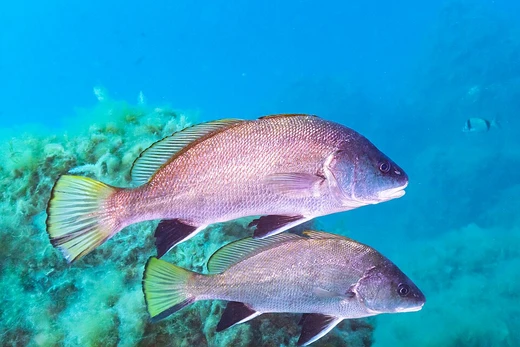
Lutjanus malabaricus
A wide-ranging Indo-Pacific snapper prized as a food fish.

Lutjanus malabaricus, known by numerous common names including Malabar blood snapper, saddletail snapper, red emperor, and scarlet sea-perch, is a species of marine ray-finned fish in the family Lutjanidae. It is native to the Indian Ocean and the western Pacific, ranging east to Fiji and Japan, and is notable for its high-quality flesh, which makes it a target for commercial, artisanal, and recreational fisheries throughout its range.
Quick Facts
- Taxon
- Lutjanus malabaricus
Facts from the source article.
Lore & Background
Lutjanus malabaricus was first formally described in 1801 as Sparus malabaricus by German naturalists Marcus Elieser Bloch and Johann Gottlob Schneider, with the type locality given as the Coromandel coast in eastern India. The specific name malabaricus means 'of Malabar', a coastal region of southern India. The species has a relatively deep body, with a standard length 2.2 to 2.8 times the body depth, a steeply sloped forehead, and a concave upper snout profile. Its dorsal fin has 11 spines and 12-14 soft rays, the anal fin has 3 spines and 8-9 soft rays, and the caudal fin is truncate. Adults are red or reddish-orange on the back and flanks, paler below, with reddish fins. Juveniles display a wide diagonal brown or black band from the upper jaw to the front of the dorsal fin, and an obvious black band across the caudal peduncle with a pearly-white front margin; they may also show thin reddish longitudinal stripes on the flanks. The species can be distinguished from the scarlet snapper (Lutjanus erythropterus) by its larger head and mouth.
Reader's Guide
Lutjanus malabaricus is considered a high-quality food fish and is pursued by commercial, artisanal, and recreational fisheries across its wide Indo-West Pacific range, from the Persian Gulf to Fiji, and from southern Japan to Australia. It is caught using trawls, handlines, and bottom longlines, with some fish exported to international markets. In southern China, the species is grown in mariculture. Overfishing has occurred in many areas, such as the Persian Gulf and Indonesia, leading to population declines. However, in regions like Australia, fishing is strictly regulated, and populations remain stable. The IUCN has assessed the species as Least Concern, reflecting this mixed conservation status. Adults inhabit coastal and offshore reefs, often around sponges and gorgonian corals or over hard muddy bottoms, while juveniles prefer shallow inshore waters. The species forms mixed aggregations with other snappers, notably the crimson snapper in Australia, and is a nocturnal hunter feeding mainly on fish, along with benthic crustaceans, cephalopods, and other benthic invertebrates. Spawning occurs for much of the year near the equator, peaking in spring and summer off New Caledonia and Australia.
Did You Know?
- Lutjanus malabaricus was first described in 1801 as Sparus malabaricus by Bloch and Schneider.
- The species can reach a maximum total length of 100 cm (39 in) and a weight of 7.9 kg (17 lb).
Frequently Asked Questions
Who is Lutjanus malabaricus?
Lutjanus malabaricus is a marine ray-finned snapper in the family Lutjanidae, best known by common names like Malabar blood snapper, saddletail snapper, and red emperor. It is a native Indo-Pacific species found across the Indian Ocean and western Pacific.
How big does Lutjanus malabaricus get?
Most individuals hover around 50 cm (roughly 20 inches), though the species can reach a maximum total length of 100 cm (39 in). The heaviest published specimen weighed 7.9 kg (17 lb).
What are Lutjanus malabaricus's key physical traits?
Its dorsal fin carries 11 spines followed by 12 to 14 soft rays, while the anal fin has 3 spines and 8 to 9 soft rays. The pectoral fin typically bears 16 or 17 rays, and its bold coloration has earned it names like 'scarlet sea-perch' and 'red emperor.'
Why is Lutjanus malabaricus important?
Its high-quality flesh makes it a highly sought-after food fish, sustaining commercial, artisanal, and recreational fisheries across its entire range. For many coastal communities throughout the Indo-Pacific, it is a staple catch and a significant source of protein and income.
Where does Lutjanus malabaricus live?
This snapper ranges widely across the Indian Ocean and the western Pacific, stretching eastward as far as Fiji and Japan. Its broad Indo-Pacific distribution makes it one of the more geographically widespread members of the Lutjanidae family.
More in Snappers and Grunts, Part 3 1-24
Spotted an error? Know more?
Reader corrections go straight into our review queue. Suggest an edit · How this site is sourced