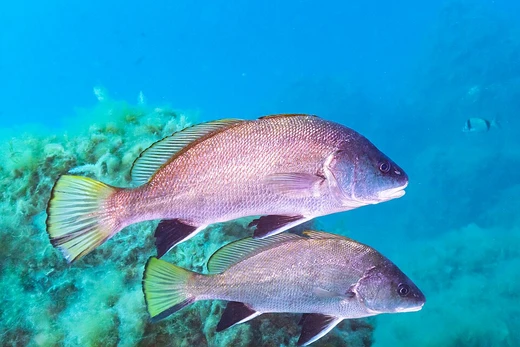
Lutjanus maxweberi
A small snapper from western Pacific fresh and brackish waters.

The pygmy snapper (Lutjanus maxweberi) is a ray-finned fish in the snapper family Lutjanidae. It lives in the western Pacific Ocean and has only been recorded in fresh and brackish waters.
Dutch ichthyologist Canna Maria Louise Popta first scientifically described this species in 1921, using a specimen collected on the Siboga expedition. The type location is Muna Island, off Sulawesi. Popta originally spelled the genus as *Lutianus* and the species name as *max weberi*, but these are now considered misspellings. The species name honors Dutch ichthyologist Max Weber, who led the expedition.
The pygmy snapper has a fairly deep body, with its standard length measuring 2.2 to 2.7 times its deepest point. Its forehead slopes steeply, and the preopercular notch and knob are faint. The vomerine teeth form a crescent or triangular patch without a rearward extension, and the tongue has no teeth. The dorsal fin has 10 spines and 13 soft rays, while the anal fin has 3 spines and 8 soft rays. Both the dorsal and anal fins are rounded or slightly angular at the rear. The pectoral fins have 16 rays, and the caudal fin is emarginate. Juveniles have a whitish body with four dark brown to blackish stripes along the sides. Adults are plain brownish on the back and sides, with whitish undersides. The maximum known standard length is 15 cm (5.9 in).
This species is found in the Philippines, Sulawesi, and New Guinea. Juveniles inhabit mangrove-lined inlets, brackish waters, and freshwater streams, but the habitat of adults is unknown.
Little is known about its biology. It has been observed in small groups.
Quick Facts
- Taxon
- Lutjanus maxweberi
Facts from the source article.
Lore & Background
The pygmy snapper was first formally described in 1921 by the Dutch ichthyologist Canna Maria Louise Popta, with the type locality given as Muna Island off Sulawesi. Popta used the generic name Lutianus and spelt the specific name max weberi, which are now regarded as misspellings. The specific name honours the Dutch ichthyologist Max Weber, who led the Siboga expedition on which the type was collected.
The pygmy snapper has a relatively deep body with a standard length that is 2.2 to 2.7 times as long as the body at its deepest point. It has a steeply sloped forehead, and the preopercular incision and knob are weakly developed. The vomerine teeth are arranged in a crescent-shaped or triangular patch with no central rearwards extension, and there are no teeth on the tongue. The dorsal fin has 10 spines and 13 soft rays, while the anal fin contains 3 spines and 8 soft rays. The rear of the dorsal fin and the anal fin are rounded or weakly angular. The pectoral fins have 16 rays, and the caudal fin is emarginate.
The overall colour of the body of juveniles is whitish marked with 4 sooty brown to blackish longitudinal stripes on the flanks. Adults are plain brownish on the back and flanks with whitish underparts. The maximum known standard length is 15 cm (5.9 in). The pygmy snapper is found in the western Pacific Ocean, recorded from the Philippines, Sulawesi, and New Guinea. Juveniles occur in mangrove-lined inlets, brackish waters, and freshwater streams; the habitat of adults is unknown. Its biology is poorly known, though it has been recorded in small groups.
Reader's Guide
The pygmy snapper is notable as a small, poorly known snapper restricted to fresh and brackish waters in the western Pacific. Its description in 1921 by Canna Maria Louise Popta, with a specific name honoring Max Weber, ties it to the historic Siboga expedition. The species is distinguished by its deep body, steep forehead, and weak preopercular features, as well as its juvenile coloration of four dark stripes on a whitish background, which fades to plain brownish in adults. Its maximum size of 15 cm makes it one of the smaller snappers. The fact that adults have not been observed in the wild highlights a significant gap in knowledge about its ecology. The species is recorded only from the Philippines, Sulawesi, and New Guinea, and its occurrence in mangrove-lined inlets and freshwater streams suggests a dependence on coastal and inland aquatic habitats. The lack of information on adult habitat and biology underscores the need for further research. Its presence in small groups indicates some social behavior, but otherwise its life history remains largely undocumented. The pygmy snapper represents a unique, understudied element of the snapper family, with its restricted distribution and habitat preferences setting it apart from most marine snappers.
Did You Know?
- The pygmy snapper was first described in 1921 by Dutch ichthyologist Canna Maria Louise Popta.
- Its specific name maxweberi honors Dutch ichthyologist Max Weber, leader of the Siboga expedition.
- Juveniles have 4 sooty brown to blackish longitudinal stripes on whitish flanks; adults are plain brownish with whitish underparts.
Frequently Asked Questions
What is Lutjanus maxweberi?
Lutjanus maxweberi, commonly called the pygmy snapper, is a small ray-finned fish belonging to the snapper family Lutjanidae. It reaches a maximum standard length of just 15 centimeters (about 5.9 inches).
Where does Lutjanus maxweberi live?
This species is found in the western Pacific Ocean, where it has only ever been recorded in fresh and brackish water habitats. Its type locality is Muna Island, off the coast of Sulawesi.
Who described Lutjanus maxweberi and when?
Dutch ichthyologist Canna Maria Louise Popta first gave this species its scientific description in 1921, based on a specimen gathered during the Siboga expedition. The species name honors Max Weber, the Dutch ichthyologist who led that expedition.
What are Lutjanus maxweberi's fin characteristics?
The pygmy snapper has a dorsal fin composed of 10 spines followed by 13 soft rays, while its anal fin bears 3 spines and 8 soft rays. These fin structures are typical of the Lutjanidae family.
Why is Lutjanus maxweberi notable among snappers?
Unlike most snappers that inhabit marine environments, this species is restricted to fresh and brackish waters in the western Pacific, making it a rare freshwater representative of the family. It also remains one of the smallest known snappers at just 15 cm in standard length.
More in Snappers and Grunts, Part 3 1-24
Spotted an error? Know more?
Reader corrections go straight into our review queue. Suggest an edit · How this site is sourced