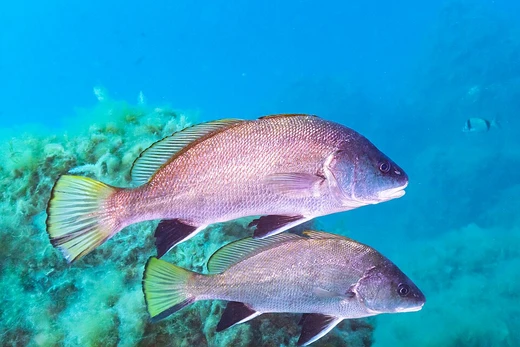
Lane snapper
A western Atlantic snapper with two color phases.

The lane snapper (Lutjanus synagris)—also called the Mexican snapper, redtail snapper, or spot snapper—is a marine ray-finned fish in the snapper family Lutjanidae. It lives in the western Atlantic Ocean.
First formally described in 1758 by Carl Linnaeus in the 10th edition of *Systema Naturae*, it was originally named *Sparus synagris*, with the type locality given as the Bahamas. The species name *synagris* comes from an Ancient Greek name for the common dentex, which the lane snapper was thought to resemble.
The fish has an oblong, compressed body and a sharply pointed snout. Its nostrils are simple holes, with one pair in front and one behind. The mouth is relatively large, with a moderately protrusible upper jaw that sits mostly below the cheekbone when closed. Each jaw holds one or more rows of sharp, conical teeth, some enlarged into canines. On the roof of the mouth, the vomerine teeth form an anchor-shaped patch with a short rearward extension, and there are tooth patches on each side of the palate. The preopercle is serrated, with a weak notch and knob. The continuous dorsal fin has 10 spines and 12–13 soft rays, sometimes with a slight notch between them; the anal fin has 3 spines and 8–9 soft rays. The pectoral fins are relatively short, not reaching the anus, with 15–16 rays. The caudal fin is emarginate. Maximum total length is 60 cm (24 in), though 25 cm (9.8 in) is more typical, and the heaviest recorded weight is 3.5 kg (7.7 lb).
This species has two color phases. In deeper water, the fish is darker and more distinct; in shallower water, it is paler. In both phases, the upper sides and back are pink to red, with a greenish tint on the back. The lower sides and belly are silver with a yellow hue. The head has 3–4 yellow stripes running from the snout to the eye. The flanks show 8–10 yellow to pink longitudinal stripes, with 3–4 more beneath the front dorsal fin ray. There is an indistinct black spot under the soft-rayed part of the dorsal fin. The fins range from yellow to red.
The lane snapper ranges from North Carolina and Bermuda south through the Gulf of Mexico and the Caribbean Sea, along the South American coast to Santa Catarina, Brazil. It lives over reefs and sandy bottoms with algae or seagrass at depths of 30 to 122 m (98–400 ft). Juveniles stay in sheltered inshore waters.
Quick Facts
- Taxon
- Lutjanus synagris
Facts from the source article.
Lore & Background
The lane snapper was first formally described in 1758 by Carolus Linnaeus in the 10th edition of Systema Naturae as Sparus synagris, with the type locality given as America septentrionali, i.e., the Bahamas. The specific name synagris is an Ancient Greek name for the common dentex, which the lane snapper was thought to resemble. It has an oblong, compressed body with a sharply pointed snout, a relatively large mouth with conical teeth, and an anchor-shaped patch of vomerine teeth. The preopercle is serrated with a weakly developed incision and knob. The dorsal fin is continuous with 10 spines and 12-13 soft rays, and the anal fin has 3 spines and 8-9 soft rays. The caudal fin is emarginate. This species exhibits two color phases: a deep-water phase that is darker and more distinctive, and a shallow-water resting phase. Both phases have pink to red upper flanks and back with a green tint, silver lower flanks and abdomen with a yellow hue, and 8-10 yellow to pink longitudinal stripes on the flanks. An indistinct black spot is present underneath the soft-rayed part of the dorsal fin.
Reader's Guide
The lane snapper is found in the western Atlantic from North Carolina and Bermuda south through the Gulf of Mexico and the Caribbean Sea to Santa Catarina, Brazil. It occurs over reefs and sandy bottoms with algae or seagrass at depths between 30 and 122 m. Juveniles live in sheltered inshore waters. Adults are sedentary, staying in a home range except when spawning. They are opportunistic, nocturnal predators feeding on smaller fishes, cephalopods, gastropods, and crustaceans such as shrimps and crabs. Lane snapper form spawning aggregations; off Cuba these occur from March to September, peaking in July and August, while off Puerto Rico spawning peaks in May. They are broadcast spawners, with fertilized eggs drifting on currents and hatching after 23 hours. Larvae settle at about 1 cm. The species is preyed upon by larger fishes and sharks. Its white meat is sold in supermarkets throughout Mexico. Lane snapper are caught with beach seines, boat seines, traps, handlines, and bottom trawls; shrimp fisheries take a large portion of the catch due to juveniles' preference for soft bottoms with high shrimp populations. Stocks have shown steep declines from overfishing, leading to its IUCN assessment as Near Threatened. Consumption of its flesh has been known to cause ciguatera poisoning.
Did You Know?
- The lane snapper was first described by Linnaeus in 1758 as Sparus synagris.
- It has two color phases: a darker deep-water phase and a lighter shallow-water resting phase.
- Spawning aggregations off Cuba peak in July and August.
- Juveniles prefer soft bottoms with high shrimp populations, making them vulnerable to shrimp fisheries.
Origins & Production
Cartoon Sushi was an adult-animated anthology that ran on MTV during 1997 and 1998. It came into existence as the direct successor to the earlier Liquid Television program, carrying forward the tradition of showcasing independent, edgy animation on a major cable network. Eric Calderon developed the show, while Nick Litwinko handled production duties. One of the program's most visually distinctive touches was its title screen, illustrated by Danny Antonucci, the animator better known to later audiences as the creator of Ed, Edd n Eddy. The show's format was deliberately built around a mix of internationally produced cartoons alongside original material commissioned specifically for the series, giving it a broad, global flavor that set it apart from more domestically focused animation blocks of the era. This combination of inherited legacy and fresh international sourcing defined Cartoon Sushi's identity from its very first broadcast.
The Animation Weekend Pilots
Before Cartoon Sushi settled into its regular weekly schedule, the production team ran two Animation Weekend pilot episodes that functioned as an extended audition reel for the format. The first pilot assembled a slate of shorts including Sam Kieth's The Maxx Animation Weekend pilot, Corky Quakenbush's The Adventures of Ricardo, Neil Michka's A Day in the Life of an Oscillating Fan, Mo Willems's Iddy Biddy Beat Boy, John R. Dilworth's Angry Cabaret, and Henry Selick's Slow Bob in the Lower Dimensions. The second pilot brought back Kieth and Quakenbush while introducing new entries such as Mo Willems's Another Bad Day for Philip Jenkins, Neil Michka's The Food Mister, John Payson's Joe's Apartment, and two Brickface and Stucco segments. Together these pilots gave the team a cross-section of independent animators and a feel for the tonal range the finished show would need to balance week after week.
The International Showcase Format
Each episode of Cartoon Sushi functioned as a curated sampler of animation from around the world. A single broadcast might include work by Magnus Carlsson, AMPnyc Animation, Bardel Animation Limited, and Christy Karacas, among many others, all stitched together into one evening of programming. Recurring series like Ultracity 6060, Robin, The Many Deaths of Norman Spittal, and the tongue-in-cheek Science Facts! segments gave the show a sense of continuity while still letting each episode feel like a fresh discovery. The Halloween special aired on October 31, 1997, leaned into seasonal themes with entries such as Paul Berry's The Sandman and Robin Steele's Stick Figure Theater segments. The variety was the entire point: no two episodes repeated the same lineup, and the blend of adult-oriented humor, absurdist storytelling, and experimental visual styles kept the format unpredictable from week to week.
A Launchpad for Future Creators
Cartoon Sushi's brief two-year run on MTV placed early work by several animators in front of a national audience before they became widely recognized names. Christy Karacas, who would later co-create Superjail!, contributed the short Space War during the very first episode. John R. Dilworth, later known for Courage the Cowardly Dog, appeared with Dirdy Birdy in the second episode, while David Wasson, the creator of Time Squad, showed up with Voice B Gone in that same broadcast. Eric Fogel's Celebrity Deathmatch segments, featuring matchups like Charles Manson versus Marilyn Manson, gave viewers a taste of the irreverent comedy that would define his later career. For many of these creators, Cartoon Sushi represented a rare opportunity to test bold, adult-oriented ideas on a major network before building their own standalone properties.
Frequently Asked Questions
What is a lane snapper?
The lane snapper, scientifically known as Lutjanus synagris, is a marine ray-finned fish in the family Lutjanidae. Anglers and divers also call it the Mexican snapper, redtail snapper, or spot snapper.
Where do lane snappers live?
This species is native to the western Atlantic Ocean, where it can be encountered at depths ranging from roughly 30 to 122 meters (about 98 to 400 feet).
How large does a lane snapper grow?
Most individuals measure around 25 centimeters (10 inches), though the species can reach a maximum total length of 60 centimeters (24 inches). The heaviest published record for the species is 3.5 kilograms (7.7 pounds).
What does a lane snapper look like?
It has an oblong, laterally compressed body with a sharply pointed snout, and it displays two distinct color phases. Its dorsal fin carries 10 spines followed by 12 to 13 soft rays, while the anal fin has 3 spines and 8 to 9 soft rays.
Who first described the lane snapper and when?
Carl Linnaeus formally named the species in 1758 within the 10th edition of Systema Naturae, originally placing it under the genus Sparus. The type locality he cited was the Bahamas, and the species epithet synagris derives from an Ancient Greek word for the common dentex, which the fish was once thought to resemble.
More in Snappers and Grunts, Part 3 1-24
Spotted an error? Know more?
Reader corrections go straight into our review queue. Suggest an edit · How this site is sourced