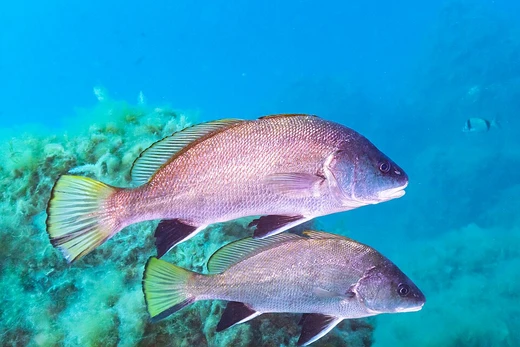
Northern red snapper
A commercially and recreationally important snapper of the western Atlantic.

The northern red snapper (Lutjanus campechanus) is a marine fish from the snapper family Lutjanidae. It lives in the western Atlantic Ocean, Caribbean Sea, and Gulf of Mexico, typically around reefs. This fish is both commercially valuable and popular with sport anglers. It is a close relative of the southern red snapper (Lutjanus purpureus), and the two were once thought to be the same species.
Cuban zoologist Felipe Poey first described the northern red snapper in 1860, naming it *Mesoprion campechanus* after the Mexican state of Campeche, where the type specimen came from.
The fish has a body shape similar to other snappers—like the mangrove, mutton, lane, and dog snappers—with a sloping profile, medium-to-large scales, a spiny dorsal fin, and a flattened body. Its teeth are short, sharp, and needle-like, but it lacks the prominent upper canines seen in mutton, dog, and mangrove snappers. Northern red snappers are large and red. They reach maturity at about 39 cm (15 inches) long. Adults commonly grow to 60 cm (24 inches), but can reach 100 cm (39 inches). The heaviest recorded individual weighed 50 pounds 4 ounces (22.79 kg), and the oldest known lived over 57 years. Their color is light red, darker on the back. They have 10 dorsal spines, 14 soft dorsal rays, three anal spines, and eight to nine soft anal rays. Juveniles under 30–35 cm often have a dark spot on their side below the front soft dorsal rays, which disappears as they age.
Northern red snappers are found from 30 to 620 feet deep in the Gulf of Mexico, Caribbean Sea, and along the southeastern Atlantic coast of Mexico and the United States, and much less commonly as far north as Massachusetts. In Latin American Spanish, they are called *mero*, *huachinango*, *pargo*, or *chillo*. They usually live in waters 9–60 meters (30–200 feet) deep, but can occasionally be caught at 90 meters (300 feet). They stay near the bottom, favoring rocky areas, ledges, ridges, and artificial reefs like oil rigs and shipwrecks. Like most snappers, they are social and form large schools of similarly sized fish around wrecks and reefs. Their preferred habitat changes as they grow: newly hatched fish spread over open bottom areas, then move to low-relief spots like oyster beds. Around one year old, they shift to intermediate-relief habitats as older fish move to high-relief reefs.
Quick Facts
- Taxon
- Lutjanus campechanus
Facts from the source article.
Lore & Background
The northern red snapper was first formally described in 1860 as Mesoprion campechanus by the Cuban zoologist Felipe Poey, with the type locality given as the Mexican state of Campeche. Its body is very similar in shape to other snappers, featuring a sloped profile, medium-to-large scales, a spiny dorsal fin, and a laterally compressed body. It has short, sharp, needle-like teeth but lacks the prominent upper canine teeth found on mutton, dog, and mangrove snappers. Coloration is light red, with more intense pigment on the back, and juvenile fish shorter than 30–35 cm can have a dark spot on their sides that fades with age.
The species is found at depths of 30 to 620 feet in the Gulf of Mexico, the Caribbean Sea, and the southeastern Atlantic coast of Mexico and the United States, and much less commonly northward as far as Massachusetts. It commonly inhabits waters from 9–60 m (30–200 ft) and stays relatively close to the bottom, inhabiting rocky bottoms, ledges, ridges, and artificial reefs including offshore oil rigs and shipwrecks. Northern red snapper are gregarious and form large schools around wrecks and reefs, usually made up of fish of very similar size. Their preferred habitat changes as they grow: newly hatched fish spread over open benthic habitat, then move to low-relief habitats such as oyster beds, then to intermediate-relief habitats, and finally to high-relief reefs. Around artificial reefs, smaller fish spend time in the upper water column while larger adults live in deeper areas, and the larger fish do not allow smaller individuals to share that territory.
Reader's Guide
Northern red snapper are a prized food fish, caught commercially and recreationally. They are sometimes used in Vietnamese canh chua (sour soup). Red snapper is the most commonly caught snapper in the continental US, accounting for almost 50% of the total catch. They eat almost anything but prefer small fish and crustaceans, and can be caught on live and cut bait as well as artificial lures. They are commonly caught up to 4.5 kg (10 lb) and 510 mm (20 in), though fish over 18 kg (40 lb) have been taken. Recreational fishing has been popular for a long time, restricted mostly by fishing limits intended to ensure a sustainable population. The first minimum size limit was introduced in 1984 after a 1981 report described quickly declining harvests. From 1985 to 1990, the annual recreational catch was about 1.5 million; from 1991 to 2005, it varied from 2.5 to 4.0 million. Since 1990, the total catch limit has been divided into 49% for recreational fishermen and 51% for commercial. Interest in recreational fishing has increased dramatically; from 1995–2003, the number of Louisiana fishing charter guide license holders increased eight-fold. In 2017, the Gulf of Mexico Fishery Management Council estimated the commercial value of the red snapper fishery to be $129 million.
Did You Know?
- It can live for more than 50 years, with the oldest reported age being 57+ years.
- The species is known in Latin American Spanish as mero, huachinango, pargo, or chillo.
Anatomy and Living Coloration
The mutton snapper presents a body of moderate depth with an almond-like profile, capped by a nearly crescent-shaped tail. The dorsal fin is almost two-lobed, the anal fin sharply pointed, and the long pectoral fin extends just past the anal fin's origin. Small eyes, a flat forehead, and a wide terminal mouth with a protrusible upper jaw—mostly concealed by the cheek bone at rest—define the head. One to two rows of conical teeth line the jaws, some outer ones enlarging into canine-like points, while a chevron-shaped patch of vomerine teeth sits on the palate. Coloration shifts with behavior: olive-green backs fade to reddish bellies, a black spot marks the gap between the lateral line and spiny dorsal section, and two blue stripes run under the eyes, the upper one reaching the gill cover. The tail carries a black border, and all fins are red. At rest, ten to twelve dark vertical bars stripe the body; in motion, they dissolve into a uniform tone. Fifteen-millimeter juveniles show transparent fins and yellowish-brown bands; older juveniles display bolder yellow bands and a more prominent black spot. Adults reach ninety-four centimeters at maximum, though fifty is typical, and the heaviest recorded fish weighed fifteen point six kilograms.
Spawning Rituals and Life History
The mutton snapper is a predator whose diet evolves across its life. Surface-dwelling larvae graze on plankton; once they settle into turtle grass beds, they shift to larger plankton and small invertebrates. Growing individuals add crustaceans, gastropods, and smaller fishes such as grunts and mullets to their menu, picking at prey throughout the day. Their body coloration responds to feeding context: the dark barred pattern appears when the fish feeds near the bottom. Spawning occurs across the species' entire range, with the northeastern Caribbean serving as the principal gathering ground. Fish assemble in large, transient aggregations and spawn on a fixed lunar-calendar timing each year—February in the Caribbean, summer elsewhere. Females release pelagic eggs, sometimes as many as 1,400,000, which males fertilize externally; hatching follows within twenty hours. Within forty-eight hours of hatching, larvae migrate to shallow-water environments. Once spawning concludes, adults relocate to deeper offshore waters and settle into a sedentary lifestyle. The species can live up to forty years.
Range and Habitat Preferences
Native to the western Atlantic, the mutton snapper ranges from Massachusetts in the north to Brazil in the south, though it is most abundant in the warmer waters of Florida, the Bahamas, the Caribbean Sea, and the Gulf of Mexico. The species favors comparatively shallow, clear waters at depths between twenty-five and ninety-five meters, where temperatures hover between eighteen point nine and twenty-seven point eight degrees Celsius. Adults and larger individuals inhabit offshore reefs and areas of rock rubble, while juveniles remain in inshore waters where they can be found in great numbers in tidal mangrove creeks, canals, and shallow protected bays. Turtle grass beds serve as a critical shelter for young snappers, providing cover during their vulnerable early stages. This separation between adult and juvenile habitats creates a spatial structure that shapes both the fish's ecology and its vulnerability to different types of fishing pressure.
Fisheries Pressure and Conservation Outlook
The mutton snapper is a prized target across recreational, commercial, and artisanal fisheries. Its flesh commands high market prices throughout its range, and the cheek and throat meat of larger specimens is especially regarded as a gourmet delicacy. Anglers and operators use hook and line, seines, gill nets, bottom longlines, traps, and even spearfishing to catch the fish. In Florida, recreational landings concentrate heavily around Cape Canaveral. However, the species' predictable spawning aggregations make it acutely vulnerable to overfishing, and juvenile populations are also harvested in some areas, compounding the pressure. In the northern part of its range, commercial landings have dropped by more than sixty percent, though the stock is not yet classified as overfished and fishing effort has been reduced. In Cuba, the known spawning aggregation has shrunk in size. Parts of Brazil and Colombia face heavy exploitation. Overall, biomass has declined by at least twenty percent over thirty to sixty years, earning the species a Near Threatened listing from the IUCN. If current trends persist, the status could deteriorate to Vulnerable. The IUCN urges precautionary management, better fisheries data collection, and protection of spawning aggregations.
Frequently Asked Questions
What is the northern red snapper?
The northern red snapper (Lutjanus campechanus) is a reef-associated marine fish in the family Lutjanidae, found throughout the western Atlantic, Caribbean Sea, and Gulf of Mexico. It is a popular target for both commercial harvest and recreational sport fishing.
Who first described the northern red snapper and why is it named that way?
Cuban zoologist Felipe Poey gave the species its original formal description in 1860 under the name Mesoprion campechanus. He chose the specific epithet after the Mexican state of Campeche, the location where the type specimen was collected.
How big and old can a northern red snapper get?
Adults commonly measure around 60 cm (24 in), with a maximum recorded length of 100 cm (39 in) and a heaviest published weight of 50 lb, 4 oz (22.79 kg). The oldest documented individual has been estimated at over 57 years of age.
How is the northern red snapper different from the southern red snapper?
The two are very close relatives that were long lumped together as a single species before being formally separated. The northern red snapper (Lutjanus campechanus) is now recognized as distinct from the southern red snapper (Lutjanus purpureus) based on modern taxonomic revisions.
Why is the northern red snapper important to anglers and the fishing industry?
It ranks as one of the most sought-after snappers in the western Atlantic, drawing heavy commercial and recreational effort around reef habitats. Its strong fight, solid flavor, and relatively wide distribution make it a cornerstone species for sport and food fisheries in the region.
More in Snappers and Grunts, Part 3 1-24
Spotted an error? Know more?
Reader corrections go straight into our review queue. Suggest an edit · How this site is sourced