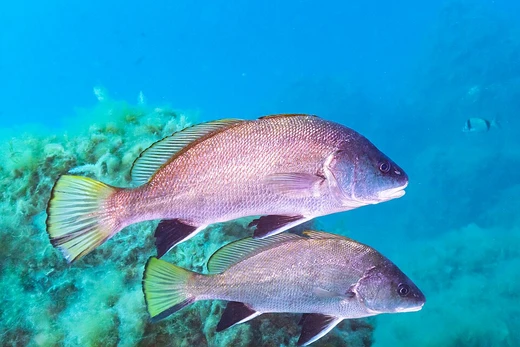
Lutjanus monostigma
A widespread Indo-Pacific snapper with a fading juvenile spot.

The one-spot snapper, also called the onespot seaperch or Moses snapper, is a marine fish in the family Lutjanidae. It lives across the Indo-Pacific region.
French zoologist Georges Cuvier first described it in 1828 as *Mesoprion monostigma*, based on a specimen from the Seychelles. Its scientific name combines *mono* ("one") and *stigma* ("mark"), referring to the black spot beneath the front dorsal fin rays—prominent in juveniles but often fading in adults.
This snapper has a fairly deep body, with a standard length 2.6 to 3.0 times its deepest point. Its forehead slopes gently, and the preopercular notch and knob are weak. The vomerine teeth form a crescent-shaped patch without a rear extension, and the tongue has no teeth. The dorsal fin has 10 spines and 13–14 soft rays; the anal fin has 3 spines and 8–9 soft rays. Both the dorsal and anal fins are rounded or somewhat angular at the rear. Pectoral fins have 15–17 rays, and the tail is truncate or slightly notched. Maximum total length is 60 cm, though 50 cm is more typical. Body color ranges from whitish to pink or grey, with yellow fins and a black spot or blotch on the rear body. As the fish matures, this spot shrinks and becomes more oblong.
The species is widespread from the Red Sea and eastern Africa (south to Sodwana Bay, South Africa) across the Persian Gulf, Indian Ocean islands, Sri Lanka, and Southeast Asia, east to the Marquesas and Line Islands, north to Japan’s Ryukyu Islands, and south to Australia. Adults inhabit coral reef areas, often near caves and coral formations, at depths of 1 to 60 meters.
A nocturnal predator, it feeds mainly on fish and benthic crustaceans. It is usually solitary but sometimes forms small schools. Off Papua New Guinea, half of females reach sexual maturity at about 32 cm total length and 3 years old. Maximum lifespan is estimated at 13 years.
This snapper is important to commercial fisheries, especially in Oceania, where it is caught with handlines, traps, and gillnets and sold fresh. It is known to carry ciguatoxin, particularly in Tuvalu. Because it is widespread and abundant in areas with low fishing pressure, the IUCN classifies it as Least Concern.
Quick Facts
- Taxon
- Lutjanus monostigma
Facts from the source article.
Lore & Background
Lutjanus monostigma was first formally described in 1828 by the French zoologist Georges Cuvier as Mesoprion monostigma, with the type locality given as the Seychelles. The specific name is a compound of mono meaning 'one' and stigma meaning 'mark', a reference to the black spot located underneath the front dorsal fin rays, a feature obvious in juveniles but which fades in many adults. The fish has a relatively deep body, a gently sloped forehead, and weakly developed preopercular incision and knob. Its vomerine teeth are arranged in a crescent-shaped patch with no central rearwards extension, and there are no teeth on the tongue. The dorsal fin has 10 spines and 13-14 soft rays, while the anal fin contains 3 spines and 8-9 soft rays. The pectoral fins have 15-17 rays, and the caudal fin is truncate or weakly emarginate. The overall colour is whitish to pink or grey with yellow fins, and there is a black spot or blotch on the posterior of the body that shrinks and becomes more oblong as the fish matures.
Reader's Guide
Lutjanus monostigma is an important fish for commercial fisheries in many areas where it is found, especially in Oceania. The fish landed are mainly sold as fresh fish, and the fishing methods used are mainly handlines, traps, and gillnets. This species is known to be ciguatoxic, particularly so in Tuvalu. The onespot snapper is a widespread species and is thought to occur in many areas where there is low levels of fishing, and in these areas it is still numerous. For these reasons, the IUCN classifies it as Least Concern. Adults live in coral reef areas, usually close to caves and coral formations, at depths between 1 and 60 meters. It is a nocturnal predator that feeds mainly on fishes, but also on benthic crustaceans. They are typically solitary, but are sometimes encountered in small schools. Off Papua New Guinea, half of the females were estimated to attain sexual maturity at a total length of 32 cm and at 3 years of age. This medium-sized snapper is estimated to have a maximum lifespan of 13 years.
Did You Know?
- The specific name monostigma means 'one mark', referring to the black spot under the front dorsal fin rays.
- The black spot on the body shrinks and becomes more oblong as the fish matures.
- It is known to be ciguatoxic, particularly in Tuvalu.
Frequently Asked Questions
Who is Lutjanus monostigma?
Lutjanus monostigma is a marine snapper in the family Lutjanidae, popularly known as the one-spot snapper or Moses snapper. It is a widespread species native to the Indo-Pacific region.
What does Lutjanus monostigma look like?
This snapper has a fairly deep body with a gently sloping forehead, and its most recognizable feature is a black spot beneath the front dorsal-fin rays. That spot is bold in juveniles but often fades noticeably as the fish reaches adulthood.
Where does Lutjanus monostigma live?
The one-spot snapper is found throughout the Indo-Pacific, occupying depths from roughly 1 meter down to about 60 meters. The original type specimen that Cuvier described in 1828 came from the Seychelles.
How big and long-lived is Lutjanus monostigma?
Adults typically measure around 50 cm (20 in) in total length, with a maximum of about 60 cm (24 in). In the wild, individuals can live up to roughly 13 years.
Why is Lutjanus monostigma called 'monostigma'?
The name blends the Greek 'mono' (one) with 'stigma' (mark), pointing to the single dark spot under the anterior dorsal-fin rays. Cuvier applied that name in 1828 when he first described the species as Mesoprion monostigma.
More in Snappers and Grunts, Part 3 1-24
Spotted an error? Know more?
Reader corrections go straight into our review queue. Suggest an edit · How this site is sourced