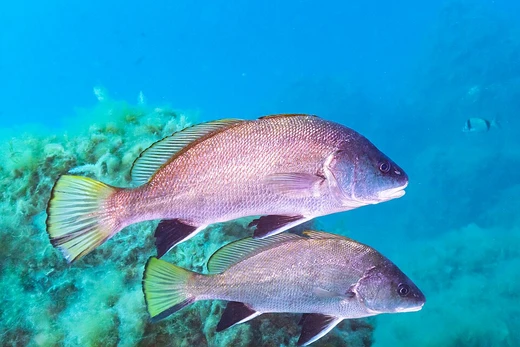
Lutjanus johnii
A wide-ranging Indo-Pacific snapper with a distinctive black blotch and rusty scale spots.

Lutjanus johnii, known commonly as the Golden snapper, John's snapper, fingermark bream, or spotted-scale sea perch, is a species of marine ray-finned fish in the family Lutjanidae. It is native to the western Pacific and Indian Oceans and is notable for its wide Indo-Pacific distribution and its importance in both commercial and recreational fisheries.
Quick Facts
- Taxon
- Lutjanus johnii
Facts from the source article.
Lore & Background
Lutjanus johnii was first formally described in 1792 by the German naturalist Marcus Elieser Bloch, who named it Anthias johnii. The specific name honors the German naturalist Christoph Samuel John, a missionary in India who collected specimens for Bloch at the Danish colony of Tranquebar. The type locality is Surat, where the Tapti River estuary meets the Gulf of Khambhat in the Arabian Sea.
The species has a moderately deep body, with a steeply sloped forehead and weakly developed incision and knob on the preoperculum. Its vomerine teeth form a crescent-shaped patch with no rearward extension, and it has a patch of granular teeth on the tongue. The dorsal fin has 10 spines and 13-14 soft rays, the anal fin has 3 spines and 8 soft rays, and the pectoral fins have 16 or 17 rays. The caudal fin is truncate or weakly emarginate. Overall color is yellow with a bronze or silvery sheen, becoming silvery-white on the abdomen. A rusty spot at the center of each scale creates horizontal lines along the flanks, and a sizeable black blotch is present below the front of the soft-rayed part of the dorsal fin, mostly above the lateral line, though it may be absent in adults.
Lutjanus johnii has a wide Indo-Pacific distribution, from the eastern African coast (southern Red Sea to South Africa) across the Indian Ocean to Fiji, north to the Ryukyu Islands of southern Japan, and south to northern Australia. Adults inhabit coral reefs, while juveniles use mangrove shelter. It is a predatory species feeding on fishes and benthic invertebrates such as crustaceans and cephalopods. Spawning has been observed during September in the Andaman Sea. In Australian waters, it is one of the dominant large snappers in nearshore reef fish fauna, with large adults schooling in turbid waters around hard substrates in silty and sandy coastal and offshore areas.
Reader's Guide
Lutjanus johnii is frequently recorded in markets throughout its range, caught using handlines, bottom longlines, traps, and bottom trawls, and sold fresh or dried salted. It is also a popular game fish for recreational anglers in Australia. The species is more numerous over deep reefs than over shallower reefs, and its wide distribution from the Red Sea to Fiji and from southern Japan to northern Australia underscores its ecological and economic importance across the Indo-Pacific. The article notes that the black blotch on the flank may be absent in adults, indicating variation with age. Its maximum recorded size of 97 cm and weight of 10.5 kg mark it as a substantial snapper, and its presence in both coral reef and mangrove habitats highlights its role in connecting coastal ecosystems. The species' specific name honors Christoph Samuel John, a missionary and collector for Bloch, linking it to early natural history exploration in India.
Frequently Asked Questions
Who is Lutjanus johnii?
Lutjanus johnii is a marine snapper in the family Lutjanidae, most often called the Golden snapper or John's snapper. It was first described in 1792 by Marcus Elieser Bloch, who originally placed it in the genus Anthias.
What does Lutjanus johnii look like?
This snapper stands out with a bold black blotch on its body and scattered rusty-colored spots across its scales. Those two markings together make it easy to tell apart from many other Indo-Pacific lutjanids.
Where can you find Lutjanus johnii?
It has a very broad range spanning the western Pacific and Indian Oceans, one of the widest distributions among snappers. Its type locality is the Tapti River estuary near Surat, where the river meets the Gulf of Khambhat in the Arabian Sea.
How big does Lutjanus johnii get?
Most specimens top out around 50 cm (20 in) in total length, though the species can reach 97 cm (38 in) at its maximum. The heaviest published individual weighed roughly 10.5 kg (23 lb).
Why is Lutjanus johnii important?
It is a key target in both commercial and recreational fisheries throughout its wide Indo-Pacific range. Its ability to occupy depths from just below the surface down to about 80 m makes it accessible to many fishing methods and gives it broad economic and ecological relevance.
More in Snappers and Grunts, Part 3 1-24
Spotted an error? Know more?
Reader corrections go straight into our review queue. Suggest an edit · How this site is sourced