Lutjanus madras
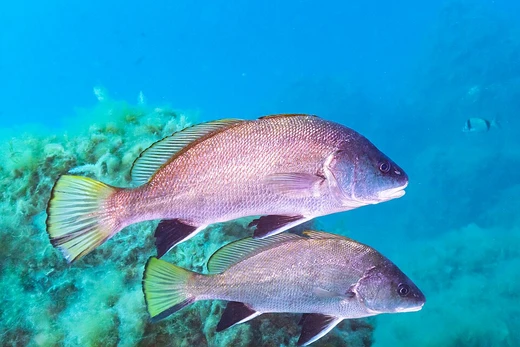
Indian snapper with yellow fins and thin yellow lines.

Lutjanus madras, known as the Indian snapper, is a marine ray-finned fish in the snapper family Lutjanidae. Its range includes the western Pacific and Indian Oceans.
The species was first formally described in 1831 by French zoologist Achille Valenciennes, who named it *Mesoprion madras* based on a specimen from Mahé in the Seychelles. The specific name *madras* is the local Seychellois name for the fish. Records of this species from the Pacific were once attributed to the yellowfin snapper (*Lutjanus xanthopinnis*), described from Japan in 2013.
The Indian snapper has a slender, fusiform body, with a standard length 2.6 to 3.1 times its deepest point. Its forehead slopes gently to moderately, and the preopercular notch and knob are faint. The vomerine teeth form a triangular patch with a rearward extension, or a diamond shape, and the tongue has a patch of grain-like teeth. The dorsal fin has 10–11 spines and 13–14 soft rays; the anal fin has 3 spines and 8–9 soft rays. Both the dorsal and anal fins have angular rear profiles. The pectoral fins have 16–17 rays, and the caudal fin is truncate or slightly emarginate. Maximum total length is 30 cm (12 in), though 20 cm (7.9 in) is more typical. The upper back is brownish, the flanks whitish with very thin yellow lines along each scale row on the lower body. Above the lateral line, fine brownish diagonal lines run. All fins are yellow except the pelvic fins, which are whitish or very pale yellow.
Originally thought restricted to the western Indian Ocean—recorded from Zanzibar, the Seychelles, Oman, southern India, and Sri Lanka—the species was later believed replaced in the Pacific by *L. xanthopinnis*. However, a recent record places *L. madras* in the Philippines. It inhabits coral and rocky reefs at depths of 5 to 90 m (16 to 295 ft).
The Indian snapper gathers in small to large aggregations around coral or rocky outcrops. It spawns pelagic eggs, forming spawning aggregations. It is a daytime predator.
In the Andaman and Nicobar Islands, it is common in fish markets, caught with handlines. Elsewhere, subsistence fisheries use gill nets and traps.
Quick Facts
- Taxon
- Lutjanus madras
Facts from the source article.
Lore & Background
Lutjanus madras was first formally described in 1831 by French zoologist Achille Valenciennes as Mesoprion madras, with the type locality given as Mahé in the Seychelles. The specific name madras is the local name for this fish on Mahé. The yellowfin snapper (Lutjanus xanthopinnis), described from Japan in 2013, was thought to account for the Pacific records of L. madras, but a recent record from the Philippines suggests a wider range.
The species has a fusiform, slender body with a standard length 2.6 to 3.1 times the body depth. Its dorsal fin has 10-11 spines and 13-14 soft rays, the anal fin has 3 spines and 8-9 soft rays, and the pectoral fins have 16-17 rays. The caudal fin is truncate or weakly emarginate. Coloration includes a brownish upper back, whitish flanks with thin yellow longitudinal lines, and yellow fins except for whitish pelvic fins.
Lutjanus madras gathers in small to large aggregations around coral or rocky outcrops. It spawns pelagic eggs, forming aggregations for spawning, and is a predatory species that hunts during the day. It occurs at depths between 5 and 90 m on coral and rocky reefs.
Reader's Guide
Lutjanus madras is a common item in fish markets of the Andaman and Nicobar Islands, where it is caught using handlines. In other areas, subsistence fisheries may use gill nets and traps to catch this species. Its significance lies in its role as a food fish in local markets, particularly in the Indian Ocean region. The taxonomic history of this species is notable: the description of Lutjanus xanthopinnis in 2013 was thought to resolve confusion with Pacific records, but a recent record from the Philippines indicates that L. madras may still occur in the western Pacific. This ongoing uncertainty highlights the importance of careful taxonomic work in understanding the true distribution of snapper species. The species' aggregating behavior and daytime hunting habits make it accessible to artisanal fishers using simple gear.
Did You Know?
- Lutjanus madras was originally described as Mesoprion madras by Achille Valenciennes in 1831.
- The yellowfin snapper (Lutjanus xanthopinnis) was thought to account for Pacific records of L. madras.
- This species attains a maximum total length of 30 cm, though 20 cm is more typical.
Frequently Asked Questions
What is Lutjanus madras?
Lutjanus madras, commonly called the Indian snapper, is a ray-finned marine fish in the snapper family Lutjanidae. It is native to the western Pacific and Indian Oceans.
Who first described Lutjanus madras and when?
French zoologist Achille Valenciennes formally named the species in 1831, originally placing it in the genus Mesoprion based on a specimen collected at Mahé in the Seychelles. The specific name 'madras' derives from the local Seychellois word for the fish.
How large does Lutjanus madras grow?
Most adults measure around 20 cm in total length, and the species tops out at roughly 30 cm.
What does Lutjanus madras look like?
It has a slender, fusiform (spindle-shaped) body, yellow fins, and thin yellow lines running along its flanks.
Why was Lutjanus madras once confused with Lutjanus xanthopinnis?
Pacific records of the Indian snapper were long misattributed to the yellowfin snapper, a species that was not formally described from Japan until 2013. This mix-up meant the true range and identity of the Indian snapper in Pacific waters went unrecognized for a long time.
More in Snappers and Grunts, Part 3 1-24
Spotted an error? Know more?
Reader corrections go straight into our review queue. Suggest an edit · How this site is sourced