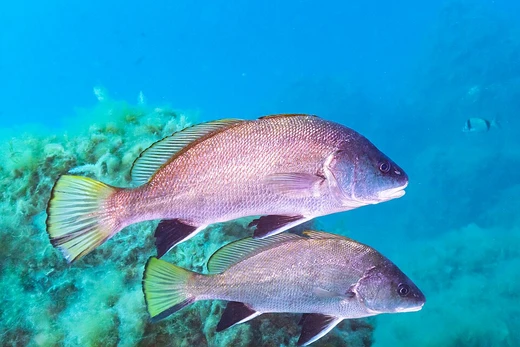
Lutjanus lutjanus
Type species of the genus Lutjanus, found in Indo-West Pacific.

The bigeye snapper (Lutjanus lutjanus) is a species of marine ray-finned fish in the family Lutjanidae. It is notable as the type species of the genus Lutjanus, originally described by Marcus Elieser Bloch in 1790.
Quick Facts
- Taxon
- Lutjanus lutjanus
Facts from the source article.
Lore & Background
The bigeye snapper was first formally described in 1790 by German physician and zoologist Marcus Elieser Bloch, with a type locality given as Japan, though this is thought to be erroneous and actually Indonesia. Bloch named the genus Lutjanus when describing this species, and it became the type species by tautonymy. The name lutjanus derives from the local Indonesian name for snappers, ikhan Lutjang. The species has a fusiform, slender body with a standard length 2.9 to 3.3 times the body's deepest points. It has a gently sloped forehead, weakly developed preopercular incision and knob, and vomerine teeth arranged in a triangular patch with a central rearward extension. The tongue has a patch of grain-like teeth. The dorsal fin has 10-12 spines and 12 soft rays, the anal fin 3 spines and 8 soft rays, and the pectoral fins 16-17 rays. The caudal fin is truncate or weakly emarginate. The upper back is golden-brown with silvery-white flanks, a brown to yellow stripe from snout to caudal peduncle, oblique golden lines above the lateral line, and horizontal stripes below. The dorsal, anal, and caudal fins are vivid yellow. It is found in the Indian Ocean and western Pacific Ocean, from the Red Sea and eastern Africa to Japan and Australia, at depths of 1 to 96 m over coral reefs and inshore soft substrates. It is often observed in large aggregations with congeners and preys on fishes and crustaceans. Spawning has been reported in the Gulf of Aden in March, off eastern Africa in November, and in the Gulf of Suez between January and June.
Reader's Guide
The bigeye snapper holds significance as the type species of the genus Lutjanus, a foundational taxon for snapper classification. Its description by Marcus Elieser Bloch in 1790, though with a disputed type locality, established the genus. The species is widely distributed across the Indo-West Pacific, from the Red Sea and eastern Africa to Japan and Australia, inhabiting depths up to 96 m. It is caught using handlines and bottom trawls, and as bycatch in shrimp fisheries, with catches sold fresh and commonly appearing in fish markets. Between 1979 and 1982, 2,286 tonnes were reported to the FAO from the Gulf of Suez, representing 10-20% of annual snapper landings there. Despite fishing pressure, the species remains locally abundant with stable populations, leading the IUCN to assess it as Least Concern. Its biology includes large aggregations with congeners, predation on fishes and crustaceans, and seasonal spawning in various regions. The species is also known by multiple common names, including bigeye seaperch, red sea lined snapper, golden striped snapper, rosy snapper, and yellow snapper.
Did You Know?
- The bigeye snapper is the type species of the genus Lutjanus by tautonymy.
- It was first formally described in 1790 by Marcus Elieser Bloch.
- The name lutjanus comes from the Indonesian word ikhan Lutjang for snappers.
- Between 1979 and 1982, 2,286 tonnes were reported from the Gulf of Suez.
Taxonomic Origins & the Meaning Behind the Name
In 1862, the American ichthyologist Theodore Nicholas Gill formally introduced this species to scientific literature, designating Baja California as the type locality where the reference specimen was collected. The specific epithet novemfasciatus is Latin for "nine-banded," a direct nod to the faint vertical stripes that adorn the upper flanks of most individuals. This naming convention captures one of the fish's most visually distinctive traits at a glance. Classified within the family Lutjanidae, the Pacific cubera snapper occupies the snapper group of marine ray-finned fishes, a lineage that includes numerous reef-dwelling predators across tropical and subtropical waters. Though it carries the common names "Pacific cubera snapper" and "Pacific dog snapper" in English, its scientific designation remains the most precise identifier, linking it to a broader family of related species while distinguishing it through that characteristic banding pattern. The 1862 description by Gill established the foundational morphological record from which all subsequent taxonomic comparisons and ecological studies of this eastern Pacific endemic have been drawn.
Anatomy of a Reef Giant
As the largest member of the snapper family, this species can reach 170 centimetres in total length and a documented maximum weight of 35.7 kilograms. Its oblong body has a depth equal to roughly one-third of its standard length, producing a robust yet streamlined profile. The head bears a sharp snout with two pairs of simple nostril openings, and the mouth is large and protrusible, lined with conical, canine-like teeth. The frontmost teeth swell into prominent fangs that surpass the pupil's diameter. The preoperculum shows a serrated edge with a modest incision and knob. Within the oral cavity, vomerine teeth form a crescent-shaped patch and the tongue carries several granular tooth clusters, while the inner mouth lining glows orange. The continuous dorsal fin holds ten spines and thirteen to fourteen soft rays; the anal fin has three spines and eight soft rays. Pectoral fins carry sixteen or seventeen rays, and the caudal fin is either truncate or faintly notched. Overall coloration shifts from deep to pale red dorsally, fading to silvery on the belly, with eight or nine indistinct vertical bars marking the upper flanks of most individuals. In juveniles the tail fin is black, while adults display mostly brownish fins.
Range, Habitat & the Nocturnal Rhythm
The Pacific cubera snapper is endemic to the eastern Pacific, with its range stretching from southern California southward to the coast of Peru. Along that vast stretch it frequents the Gulf of California, the Galápagos Islands, Cocos Island, and Malpelo Island. It is fundamentally an inshore, reef-associated species that favors hard substrates, though juveniles have occasionally been recorded venturing into freshwater. The daily life of this fish follows a clear nocturnal pattern: during daylight hours it shelters among reef structures, but once night falls it becomes an active predator, hunting crustaceans and smaller schooling fish such as croakers, grunts, and wrasses. In Mexican waters the species exhibits a seasonal migratory behavior, arriving in inshore areas during early summer in most years. This combination of a broad latitudinal range, a tight association with hard-bottom reef habitats, and a strict night-feeding cycle distinguishes its ecological niche from many of its congeners and underscores its role as a top nocturnal predator in eastern Pacific reef ecosystems.
Sustenance, Commerce & the Spearfisher's Target
For coastal communities across the eastern Pacific, the Pacific cubera snapper occupies a meaningful place in local food economies. In Colombia it figures prominently in subsistence fisheries, providing a vital protein source for households that depend on small-scale harvesting. In Nicaragua the species supports a commercial fishery, indicating a scale of catch that extends beyond individual family needs into market-oriented operations. Perhaps most distinctively, in the Gulf of California the cubera snapper has become a popular target for spearfishers, who pursue it as a challenging and rewarding game species among the region's reef habitats. Its size, strength, and the difficulty of locating a nocturnal, reef-sheltering predator make it a prized catch for those who hunt with a spear rather than a net or rod. Across all three of these human interactions—subsistence, commercial, and recreational—the fish's preference for hard-bottom inshore reefs and its tendency to shelter in daylight create both the conditions that make it accessible to harvesters and the challenge that keeps it a respected quarry rather than an easy one.
Frequently Asked Questions
What is Lutjanus lutjanus?
Lutjanus lutjanus, commonly called the bigeye snapper, is a small marine ray-finned fish belonging to the snapper family Lutjanidae. It is best known as the original type species that gives the entire genus Lutjanus its name.
How big does Lutjanus lutjanus get and where does it live?
Adults top out at roughly 35 cm (about 14 in) in total length. The species ranges across the Indo-West Pacific, occupying depths from just 1 m down to around 96 m.
What are the key fin counts for Lutjanus lutjanus?
It carries 10 to 12 dorsal-fin spines followed by 12 soft dorsal rays, and on the anal side it has 3 spines paired with 8 soft rays. These counts help field-identifiers separate it from look-alike lutjanids.
Who originally described Lutjanus lutjanus and when?
The species was first formally described by the naturalist Marcus Elieser Bloch back in 1790. That 18th-century publication is what anchors its place as the type species of the genus.
Why does Lutjanus lutjanus matter in fish taxonomy?
As the type species of Lutjanus, it serves as the fixed reference point against which every other species in that genus is defined and compared. Without it, the genus name would lack a single, unambiguous anchor species.
More in Snappers and Grunts, Part 3 1-24
Spotted an error? Know more?
Reader corrections go straight into our review queue. Suggest an edit · How this site is sourced