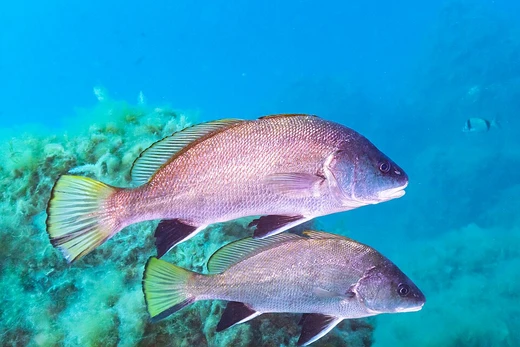
Schoolmaster snapper
A western Atlantic snapper, popular as food and known for schooling behavior.

The schoolmaster snapper, scientifically named *Lutjanus apodus*, is a marine ray-finned fish in the snapper family. It lives in the western Atlantic Ocean and is commonly caught for food.
German naturalist Johann Julius Walbaum first described this species in 1792, calling it *Perca apoda* based on an illustration from the Bahamas. Because the drawing left out the fish's pectoral fins, Walbaum gave it the species name *apoda*, meaning "footless."
This snapper has a sturdy, slightly flattened body with a long, pointed snout and a large mouth. One pair of upper canine teeth is noticeably bigger than the lower jaw's back teeth, visible even when the mouth is shut. The vomerine teeth form a chevron or crescent shape, with a line of similar teeth extending backward from the middle. The preoperculum has a weak notch and knob. The upper jaw can protrude and is mostly hidden by the cheek bone when closed; both nostrils are simple openings. The continuous dorsal fin has a slight notch between its spiny and soft-rayed sections, with 10 spines and 14 soft rays. The rounded anal fin has 3 spines and 8 soft rays. Scale rows on the back run parallel to the lateral line. The tail fin is slightly forked or straight across. The pectoral fins are longer than the distance from the snout tip to the rear edge of the preopercle, reaching the anus. Color ranges from olive gray to brownish on the upper back and sides, with yellow to reddish tones around the head. The lower sides and belly are lighter, and there is no dark spot below the front of the soft dorsal fin. Eight narrow, light vertical bars appear on the sides, though they may fade or vanish in large adults. A solid or broken blue line runs under the eye, sometimes disappearing with age. From the upper jaw to the fleshy opercle tip, this line often breaks into dashes and spots. The fins and tail are bright yellow, yellow-green, or pale orange, and the snout has blue stripes. The fish can reach a fork length of 79.1 cm (31.1 in), though 35 cm (14 in) is more common, and the heaviest recorded weight is 10.8 kg (24 lb).
The schoolmaster snapper lives in the western Atlantic, from Bermuda and the southeastern U.S. coast (Cape Canaveral, Florida, south to the Bahamas), into the Gulf of Mexico from the Florida Keys north to Tampa, then west along the Gulf coast to the Yucatán Peninsula and northwestern Cuba.
Quick Facts
- Genus
- Lutjanus
- Species
- apodus
Facts from the source article.
Lore & Background
The schoolmaster snapper was first formally described in 1792 as Perca apoda by the German physician and naturalist Johann Julius Walbaum, with the type locality given as the Bahamas. Walbaum's description was based on an illustration that omitted the fish's pectoral fins, so he gave it the specific name apoda meaning 'footless'.
The species has a moderately deep, robust body with a long pointed snout and large mouth. Its color is olive gray to brownish on the upper back and sides, with yellow to reddish around the head, and eight narrow light vertical bars on the sides that may fade in large adults. The fins and tail are bright yellow, yellow green, or pale orange, and the snout contains blue stripes. A solid or broken blue line runs beneath the eye.
The schoolmaster snapper forms large resting schools during the day that disperse to forage at night, often sheltering in beds of sea grass. These aggregations are defensive, adopted to minimize the chance of any one fish being predated. The fish spend 84% of the day swimming, 13% resting, 2% eating, and less than 0.5% in other behaviors.
Reader's Guide
The schoolmaster snapper is notable as a food fish sought by both recreational and commercial fishermen, though it is not as frequently targeted by commercial fisheries as other sympatric Lutjanus snappers. Its food quality is reported to be excellent, but consumption has been linked to ciguatera poisoning in humans. Fishing regulations in US state waters include a minimum length of 10 inches total length in Florida, with a catch limit of 10 per fisherman per day as an aggregate for all snapper species. Light spinning and baitcasting tackle are used, with live shrimp and baitfish as best natural bait; jigs are rarely successful.
The IUCN lists this species as Least Concern because it is not routinely targeted by commercial fisheries and separate commercial catch statistics are unavailable. Juveniles are common in mangroves and on shallow reefs that may be threatened by coastal development and climate change. In Colombia, illegal dynamite fishing in the Rosario Islands led to near extirpation of this species. It has been suggested that no-take zones be introduced to reduce fishing pressure and protect the defensive aggregations from increased predation.
Did You Know?
- The schoolmaster snapper was first described in 1792 by Johann Julius Walbaum based on an illustration that omitted the pectoral fins, leading to the species name apoda meaning 'footless'.
- The maximum recorded age for a schoolmaster snapper is 42 years.
- Small schoolmaster snapper less than 70 mm in length have a diet 90% composed of crustaceans, while larger specimens prefer smaller fish.
- The schoolmaster snapper spends 84% of the day swimming and less than 0.5% in other behaviors.
More in Snappers and Grunts, Part 3 1-24
Spotted an error? Know more?
Reader corrections go straight into our review queue. Suggest an edit · How this site is sourced