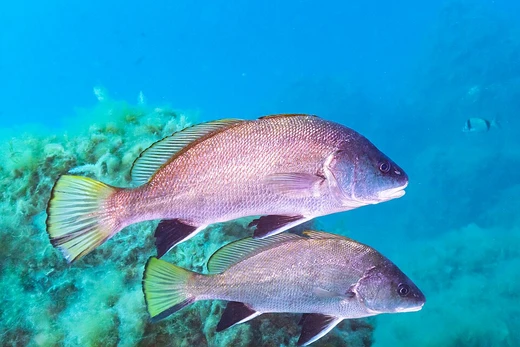
Pinjalo pinjalo
A snapper with a wide Indo-Pacific distribution and modest size.

Pinjalo pinjalo, called the pinjalo, is a marine ray-finned fish in the snapper family Lutjanidae. Its range covers the Indian and Western Pacific Oceans, extending from the Red Sea east to Papua New Guinea, and from Taiwan and the Philippines south to Mozambique, the Persian Gulf, and parts of Australia.
The species was first formally described in 1850 by Dutch scientist Pieter Bleeker, who named it *Caesio pinjalo* based on a specimen from Batavia (now Jakarta) on Java. The specific name comes from the Malay term *ikan Pinjalo*, the local name for this fish near the type locality. When Bleeker later created the genus *Pinjalo*, he proposed *Pinjalo typus* as the type species, but that name was invalid; *Caesio pinjalo* became the type species through tautonymy.
The pinjalo has a moderately deep body with a steep forehead and a convex area between the eyes. Its eye is relatively large, about as wide as or wider than the snout, and has an adipose eyelid. The snout is short and pointed, and the small mouth reaches only to the front of the eye. The jaws hold a single row of small, conical teeth, with larger ones at the front and an inner band of bristle-like teeth. The dorsal fin has 10 spines and 13 to 15 soft rays, while the anal fin has 3 spines and 8 to 10 soft rays. Both dorsal and anal fins have scaly sheaths at their bases. The long pectoral fins extend to the anus and have 18 rays. The caudal fin is slightly notched. Upper body color is greyish to pinkish-grey, fading to silvery pink or silvery-white below. The dorsal and caudal fins are pinkish to pinkish-yellow with darker edges, while the pelvic and anal fins are yellowish. These colors can either quickly fade or intensify. Maximum total length is 80 cm (31 in), though 30 cm (12 in) is more typical.
This species lives at depths of 15 to 100 m (49 to 328 ft) on coral and rocky reefs, both coastal and offshore, as well as on outer reef slopes. It is a schooling fish that feeds mainly on benthic and planktonic invertebrates. Otherwise, its biology is poorly known.
Artisanal fisheries in many parts of its range, especially in Asia, catch the pinjalo using gill nets, handlines, traps, and bottom trawls. It is sold fresh or preserved as salted fish.
Quick Facts
- Taxon
- Pinjalo pinjalo
Facts from the source article.
Lore & Background
Pinjalo pinjalo was first formally described in 1850 as Caesio pinjalo by the Dutch physician, herpetologist and ichthyologist Pieter Bleeker, with the type locality given as Batavia on Java. The specific name derives from the Malay ikan Pinjalo, a local name for this fish around the type locality. When Bleeker created the genus Pinjalo he used the name Pinjalo typus for the type species, but this proved to be a nomen nudum, and Caesio pinjalo was designated as the type species by tautonymy.
The pinjalo has a moderately deep body with a steep dorsal profile on the head and a convex space between the eyes. It has a comparatively large eye with a diameter roughly equal to or greater than the length of the snout, and an adipose eyelid. The snout is relatively short and pointed, and the mouth is small, extending only to the front of the eye. There is a single row of small, conical teeth in the jaws, enlarged in the front, with an inner band of bristle-like teeth. The dorsal fin has 10 spines and 13–15 soft rays, while the anal fin has 3 spines and 8–10 soft rays; both fins have scaly sheaths at their bases. The pectoral fins are long, extending to the level of the anus, with 18 fin rays, and the caudal fin is emarginate.
Coloration is greyish to pinkish-grey on the upper body, becoming silvery pink to silvery-white on the lower body. The dorsal and caudal fins are pinkish to pinkish-yellow with darker margins, while the pelvic and anal fins are yellowish. These colours may either quickly fade or get deeper. The pinjalo attains a maximum total length of 80 cm (31 in), although 30 cm (12 in) is more typical.
Reader's Guide
Pinjalo pinjalo is a schooling species that feeds largely on benthic and planktonic invertebrates, though its biology is otherwise little known. It occurs at depths of 15 to 100 m on coral and rocky reefs, both coastal and offshore, as well as outer reef slopes. Its distribution spans from the Red Sea south to Mozambique, Socotra, the Comoros and the Seychelles, and extends into the Gulf of Aden, the Persian Gulf, and east into the Pacific Ocean as far as Papua New Guinea, north to Taiwan and the Philippines. In Australia, larvae have been recorded at Port Hedland in Western Australia.
The species is taken by artisanal fisheries in many parts of its range, particularly in Asia, using gill nets, handlines, traps and bottom trawls. It is sold as fresh fish or preserved as salted fish. Despite its wide distribution and use in local fisheries, the pinjalo remains poorly studied biologically, with much of its life history unknown.
Did You Know?
- Pinjalo pinjalo was first described in 1850 as Caesio pinjalo by Pieter Bleeker.
- The specific name comes from the Malay ikan Pinjalo, a local name for the fish near Batavia on Java.
- The pinjalo has an adipose eyelid and a comparatively large eye.
- It is taken by artisanal fisheries using gill nets, handlines, traps and bottom trawls.
More in Snappers and Grunts, Part 3 1-24
Spotted an error? Know more?
Reader corrections go straight into our review queue. Suggest an edit · How this site is sourced