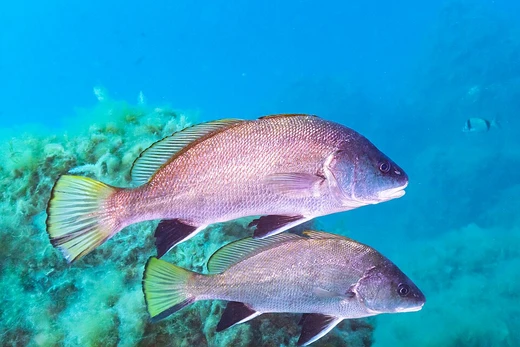
Pinjalo lewisi
A snapper found in Indian and Western Pacific Oceans.

Pinjalo lewisi, also called the slender pinjalo or red pinjalo, is a type of marine ray-finned fish in the snapper family Lutjanidae. Its range covers the Indian and Western Pacific Oceans.
The species was first scientifically described in 1987 by John Ernest Randall, Gerald R. Allen, and William D. Anderson Jr., based on a specimen from the Dumaguete market on Negros, Philippines. Its name honors Anthony D. Lewis (born 1948), then with the Fisheries Division of Fiji’s Ministry of Primary Industries, for providing valuable specimens and photographs and for donating a paratype.
This fish has a moderately deep body with a steep forehead profile and a distinctly convex area between the eyes. Its snout is short and pointed, and its eye is large—about the same length as the snout—with an adipose eyelid. The small mouth reaches only to the front of the eye. Each jaw holds a row of small, conical teeth that are larger at the front, with a band of bristle-like teeth inside. The dorsal fin has 12 spines and 13 soft rays, while the anal fin has 3 spines and 8–9 soft rays; both fins have a scaly sheath at their base. The long pectoral fins reach to the anus and usually have 17 rays. The tail fin is slightly notched. Its overall color is reddish to reddish-orange, with a pale spot on the upper part of the tail stalk. The fish can quickly change its color intensity. It reaches a maximum standard length of 50 cm (20 in).
In the Indian Ocean, it occurs around the Laccadive Islands, Maldives, Sri Lanka, and the Chagos Islands. It has also been recorded from the Andaman and Nicobar Islands, eastward to Fiji, and north to the Ryukyu Islands. In Australia, it appears near Ashmore Reef and Cartier Island in the Timor Sea, northeast of Nhulunbuy in the Northern Territory, and from reefs off Innisfail to Hervey Bay, Queensland. Planktonic larvae have been found south of the main range. The species lives at depths of 20 to 200 m (66 to 656 ft) over deep coral and rocky reefs.
It is often seen in schools and feeds on both bottom-dwelling and planktonic invertebrates, as well as possibly fish. Spawning groups have been reported off Aceh, Sumatra.
Fishermen catch it with handlines, traps, and bottom trawls, and in Australian waters with deep drop-lines. It is usually sold fresh.
Quick Facts
- Taxon
- Pinjalo lewisi
Facts from the source article.
Lore & Background
Pinjalo lewisi was first formally described in 1987 by John Ernest Randall, Gerald R. Allen, and William D. Anderson Jr., with the type locality given as Dumaguete market on Negros in the Philippines. The specific name honors Anthony D. Lewis, then of the Fisheries Division of the Ministry of Primary Industries in Fiji, for providing valuable specimens and photographs; Lewis also donated a paratype. The species has a moderately deep body with a steep dorsal profile, a distinctly convex space between the eyes, and a short, sharp snout. Its eye is large, roughly equal in diameter to the snout length, and has an adipose eyelid. The small mouth reaches to the front of the eye, with each jaw bearing a row of small conical teeth enlarged at the front, and inside those a band of bristle-like teeth. The dorsal fin has 12 spines and 13 soft rays, the anal fin 3 spines and 8-9 soft rays, both with a scaly sheath at the base. The long pectoral fins extend to the level of the anus and typically have 17 rays; the caudal fin is emarginate. Overall color is reddish to reddish-orange, with a pale spot on the dorsal part of the caudal peduncle, and the fish can quickly deepen or lighten its color.
Reader's Guide
Pinjalo lewisi is notable as a species of snapper described relatively recently in 1987, with its taxonomy based on specimens from the Philippines and contributions from a Fijian fisheries official. Its distribution spans the Indian Ocean at the Laccadive Islands, Maldives, Sri Lanka, and Chagos Islands, east to the Pacific as far as Fiji, north to the Ryukyu Islands, and south to Australian waters including the Timor Sea and Queensland reefs. It inhabits depths between 20 and 200 meters over deep coral and rocky reefs. The species is frequently encountered in schools and feeds on benthic and planktonic invertebrates, and may also feed on fishes. Spawning aggregations have been reported from Aceh, Sumatra. In fisheries, it is caught using handlines, traps, bottom trawls, and in Australian waters on deep drop-lines, and is typically marketed as fresh fish. Its ability to quickly change color and its schooling behavior contribute to its ecological role, while its capture methods reflect its importance to local fisheries across its range.
More in Snappers and Grunts, Part 3 1-24
Spotted an error? Know more?
Reader corrections go straight into our review queue. Suggest an edit · How this site is sourced