Pinjalo (genus)
A genus of snappers found in Indian and western Pacific waters.

Pinjalo is a genus of marine ray-finned fish, snappers belonging to the family Lutjanidae. They are native to the Indian Ocean and the western Pacific Ocean. The genus is notable for being originally monotypic and for its inclusion of two recognized species.
Quick Facts
- Taxon
- Pinjalo
- Type Species
- Caesio pinjalo
- Type Species Authority
- Bleeker, 1850
Facts from the source article.
Lore & Background
Pinjalo was created as a monotypic genus by the Dutch physician, herpetologist and ichthyologist Pieter Bleeker, containing only Bleeker's Caesio pinjalo, which he had described in 1850. A second species, P. lewisi, was added in 1987. The generic name Pinjalo is derived from a Malay word for a fish pinialo. The genus is classified within the subfamily Lutjaninae.
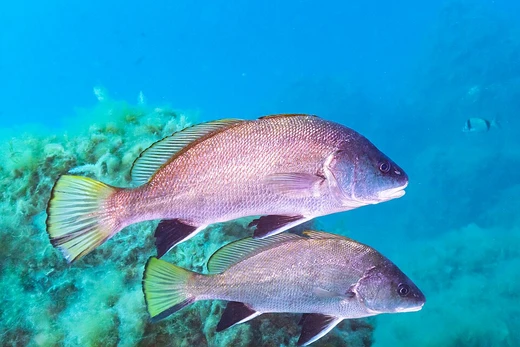
Pinjalo snappers are medium-sized with moderately deep bodies, a comparatively small head, and a pointed snout. The eyes are placed in the middle of each side of the head. They have small teeth in their jaws with no enlarged canine-like teeth; vomerine and palatine teeth are tiny. The dorsal fin is continuous with no notch, having 11-12 spines and 13-14 soft rays, while the anal fin has 3 spines and 9-10 soft rays. The pectoral fins are long, extending to the anus, with 17-18 fin rays, and the caudal fin is emarginate. Overall color is pink or red on the upper body, whitish or silvery on the lower flanks and abdomen, with fins that may be reddish, pink, yellow, or whitish, frequently with thin dusky margins.
Pinjalo snappers are found in tropical waters of the Indian Ocean and the Western Pacific Ocean, on reefs and rocky substrates as deep as around 60 m. They are predatory fish, feeding on benthic and planktonic invertebrates, and may also feed on small fishes. They may form large schools.
Reader's Guide
Pinjalo snappers are important to artisanal fisheries in some parts of their range and are potentially exploitable more widely. They are mostly caught using handlines, traps, and bottom trawls. The flesh is considered to be of good quality and is usually sold fresh. The genus represents a group of snappers that, while not as widely known as some other lutjanids, contribute to local food security and small-scale fishing economies in the Indian and western Pacific Oceans. Their schooling behavior and moderate depth range make them accessible to traditional fishing methods. The addition of a second species in 1987 reflects ongoing taxonomic refinement within the family Lutjanidae. The genus's name, derived from a Malay word, hints at its historical recognition in regional fisheries.
Did You Know?
- Pinjalo was originally a monotypic genus created by Pieter Bleeker.
- The generic name Pinjalo comes from a Malay word for a fish called pinialo.
- Pinjalo snappers have a continuous dorsal fin with no notch.
More in Snappers and Grunts, Part 3 1-24
Spotted an error? Know more?
Reader corrections go straight into our review queue. Suggest an edit · How this site is sourced