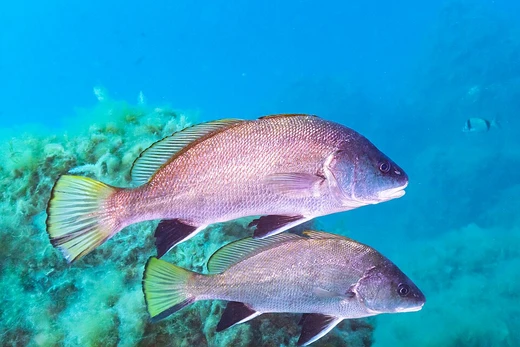
Papuan black bass
A sought-after freshwater and brackish water snapper of the western Pacific.

Lutjanus goldiei, commonly known as the Papuan black bass, Papuan black snapper, New Guinea bass, or Niugini black bass, is a species of freshwater and brackish water ray-finned fish in the family Lutjanidae. It is found in the western Pacific Ocean and is notable for its popularity as a sporting fish, attracting anglers from around the world to New Guinea and Sabah.
Quick Facts
- Taxon
- Lutjanus goldiei
Facts from the source article.
Lore & Background
Lutjanus goldiei was first formally described in 1882 as Mesoprion goldiei by Scots-born Australian naturalist William John Macleay, with the type locality given as Hood Bay in Papua New Guinea. The specific name honors Scots-born merchant, naturalist, and New Guinea explorer Andrew Goldie, who provided Macleay with specimens and notes. The species has a relatively deep body with a steeply sloped forehead, weak preopercular incision and knob, and a crescent-shaped patch of vomerine teeth. It comes in two color phases: one entirely blackish, the other with 6-7 wide greyish bars on the flanks; juveniles are always barred. It was once thought confined to southern New Guinea between Port Moresby and the Fly River, but has since been found in Sabah on Malaysian Borneo and possibly other islands between New Guinea and Borneo. It inhabits streams, rivers, and brackish estuarine environments, and has been recorded up to 828 km inland in the Fly River.
Reader's Guide
Lutjanus goldiei is a popular sporting fish that has fostered a safari-angling economy in New Guinea and Sabah. Game fishers travel to these regions specifically to catch this species, which appears on many anglers' bucket lists. It is caught using rods, spears, handlines, traps, and gill nets, and occasionally appears in the fish market at Port Moresby. The species has not been evaluated by the IUCN. It gained further visibility through appearances on television: it was featured in the fifth episode of the ninth season of River Monsters, titled 'Volcanic Island Terror,' which first broadcast in the United States on 21 May 2017, and also in episode 3 of the fifth season of Extreme Fishing with Robson Green. Despite its popularity, little is known about its biology; juveniles reside further up rivers and in shallower areas for protection, and are also found in mangroves. The larvae are thought to be marine, but there are no records of this species in purely marine environments.
Did You Know?
- Lutjanus goldiei was first described in 1882 as Mesoprion goldiei by William John Macleay.
- The species is named after Andrew Goldie, a Scots-born merchant and explorer who provided specimens.
- The species was featured on the TV series River Monsters and Extreme Fishing with Robson Green.
More in Snappers and Grunts, Part 3 1-24
Spotted an error? Know more?
Reader corrections go straight into our review queue. Suggest an edit · How this site is sourced