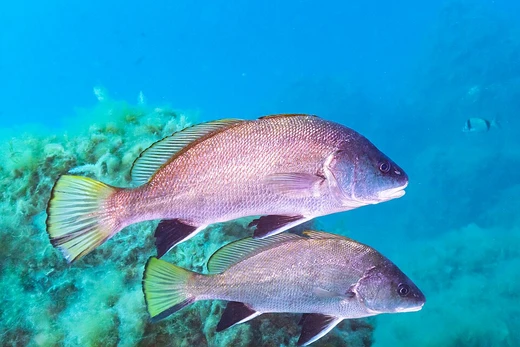
Lutjanus notatus
A small, solitary snapper with blue stripes and a dark spot.

The bluestriped snapper (Lutjanus notatus) is a species of marine ray-finned fish in the family Lutjanidae, found in the southwestern Indian Ocean. It is notable for its distinctive blue horizontal stripes and a dark spot below the dorsal fin.
Quick Facts
- Taxon
- Lutjanus notatus
Facts from the source article.
Lore & Background
The bluestriped snapper was first formally described in 1828 by French zoologist Georges Cuvier, with the type locality given as the Indian Ocean. Its specific name notatus means 'marked', referring to the black spot often visible below the dorsal fin. The species has a relatively deep body, a steeply sloped forehead, and well-developed preopercular incision and knob. The vomerine teeth form a crescent-shaped patch with no central rearward extension, and the tongue lacks teeth. The dorsal fin has 11-12 spines and 12-13 soft rays, while the anal fin has 3 spines and 7-8 soft rays; both fins are rounded posteriorly. The pectoral fins have 15-16 rays, and the caudal fin is truncate or weakly emarginate. The head and upper back are brownish, the flanks yellow, and the abdomen pale yellowish white. Six thin blue horizontal stripes run along the flanks, with the highest three sloping upward toward the dorsal fin base. A dark spot, similar in size to the pupil, often appears on the lateral line below the front of the soft-rayed part of the dorsal fin. The fins are mostly yellow.
Reader's Guide
The bluestriped snapper is a modestly sized snapper, typically reaching 20 cm in length, with a maximum of 25 cm. It inhabits coral reefs in the southwestern Indian Ocean, recorded from South Africa, Mozambique, Madagascar, Mauritius, Réunion, and India. Adults are found at depths between 10 and 50 m. The species is normally solitary but occasionally forms small schools of 5 to 10 individuals. It is a predatory fish, feeding on other fishes and benthic invertebrates. Artisanal fisheries target it wherever it occurs, using handlines, traps, and gill nets, though only small quantities appear in local markets. Its distinctive blue stripes and dark spot make it easily recognizable among snappers, and its description by Cuvier in 1828 contributes to the historical taxonomy of the family Lutjanidae.
Did You Know?
- The bluestriped snapper is found at depths between 10 and 50 m over coral reefs.
- It is taken by artisanal fisheries using handlines, traps, and gill nets.
Frequently Asked Questions
What is Lutjanus notatus?
Lutjanus notatus is a small, solitary marine snapper in the family Lutjanidae, native to the southwestern Indian Ocean. It typically inhabits depths between 10 and 50 meters and is best known for its eye-catching coloration.
What does Lutjanus notatus look like?
The fish is instantly recognizable by bold blue horizontal stripes along its flanks and a conspicuous dark spot sitting just below the dorsal fin. Its dorsal fin bears 11 to 12 spines followed by 12 to 13 soft rays.
How big does Lutjanus notatus get?
Most individuals top out around 20 centimeters in total length, with the species' maximum recorded size reaching roughly 25 centimeters. It stays on the smaller end of the snapper family.
Where can you find Lutjanus notatus in the wild?
Its range is limited to the southwestern Indian Ocean, where it patrols reef and rocky habitats at depths of about 33 to 164 feet. Rather than schooling, it is generally a lone, territorial fish.
Who first described Lutjanus notatus and when?
The species was formally named in 1828 by the French naturalist Georges Cuvier, using material from the Indian Ocean. That same region serves as the type locality referenced in the original description.
More in Snappers and Grunts, Part 3 1-24
Spotted an error? Know more?
Reader corrections go straight into our review queue. Suggest an edit · How this site is sourced