Macolor niger
A predatory snapper with black fins and variable body color.

The black and white snapper (Macolor niger) is a marine ray-finned fish belonging to the snapper family Lutjanidae. It is also called the black and white seaperch or black snapper. This species lives in the Indian Ocean and the western Pacific Ocean.
The fish was first scientifically described in 1775 by Peter Forsskål, a Finnish-born explorer and naturalist, who named it *Sciaena nigra*. The type location was given as Jeddah. Its species name *niger* means "black," referring to the dark color of adult fish. In 1860, the Dutch physician and ichthyologist Pieter Bleeker created the genus *Macolor* and used the name *Macolor* tautonymously for the type species, which was Cuvier's *Diacope macolor*. Bleeker unnecessarily renamed *D. macolor* as *Macolor typus*.
This snapper has a broad Indo-Pacific range. In the Indian Ocean, it appears along eastern Africa from the Red Sea south to South Africa, and around the Seychelles, islands in the Mozambique Channel, Madagascar, the western Mascarenes, the Maldives, Laccadives, the Chagos Islands, Cocos (Keeling) Islands, Christmas Island, and Sri Lanka. In the Pacific, it ranges from western Malaysia, western Indonesia, and the Andaman Sea east to the Marshall Islands, Samoa, and Tonga, south to Australia, and north to central Japan. It has also been recorded from Niue and the Cook Islands. The fish lives at depths between 2 and 90 meters, on steep outer slopes of lagoon reefs, in channels, and on seaward slopes.
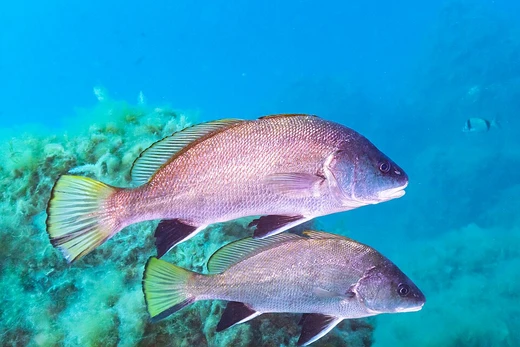
Adults can reach a maximum total length of 75 cm, though most are no longer than 35 cm. Its fins and eyes are black, while the body color varies from light gray to black depending on age. Juveniles usually have stripes, which change to solid black as the fish matures. The body is relatively deep, with a convex head profile and a large mouth that extends back to the front of the eye. Each jaw has an outer band of conical teeth, with the front ones enlarged into canine-like teeth; inside these are bands of bristle-like teeth. The vomerine teeth form a rough chevron without a median posterior extension. There is a deep notch on the lower edge of the preoperculum. The dorsal fin has 10 spines and 13–15 soft rays, while the anal fin has 3 spines and 10–11 soft rays. The rear tips of both the dorsal and anal fins are sharply pointed.
Quick Facts
- Taxon
- Macolor niger
Facts from the source article.
Lore & Background
The black and white snapper was first formally described in 1775 as Sciaena nigra by the Swedish-speaking Finnish-born explorer and naturalist Peter Forsskål, with the type locality given as Jeddah. The specific name niger means 'black', a reference to the blackish colour of the adults. When the genus Macolor was described in 1860 by the Dutch physician, herpetologist and ichthyologist Pieter Bleeker, he used the name Macolor tautonymously for the type species, which was Cuvier's Diacope macolor, and needlessly renamed it Macolor typus.
This species has a relatively deep body with a convex dorsal profile of the head and a large mouth extending back to the front of the eye. Its fins and eyes are black, and its body varies from light grey to black depending on age; juveniles are typically striped, changing to complete black when adult. The dorsal fin contains 10 spines and 13–15 soft rays, while the anal fin has 3 spines and 10–11 soft rays, with both fins having clearly pointed rear tips. The pectoral fins are long, extending to the anus, and the caudal fin is emarginate.
Juveniles are solitary, while adults aggregate in large schools. It is a predatory fish that preys on fishes and crustaceans, and gathers in aggregations to spawn. This species is frequently confused with its congener the midnight snapper (Macolor macularis), with which it is known to form mixed aggregations.
Reader's Guide
The black and white snapper holds significance as a prized food fish, caught both commercially and recreationally, and is also found in the aquarium trade. Its wide Indo-Pacific range extends from the eastern coastline of Africa and the Red Sea, south to South Africa, across the Indian Ocean to the Maldives, Laccadives, Chagos Islands, Cocos (Keeling) Islands, Christmas Island, and Sri Lanka, and into the Pacific from western Malaysia and Indonesia east to the Marshall Islands, Samoa, Tonga, south to Australia, and north to central Japan, with additional records from Niue and the Cook Islands. The species inhabits depths between 2 and 90 m around steep outer slopes of lagoon reefs, channels, and seaward slopes. Its taxonomy includes a first description by Forsskål in 1775 and a later generic reassignment by Bleeker in 1860, who tautonymously used the name Macolor. The species is frequently confused with the midnight snapper, with which it forms mixed aggregations, highlighting the need for careful identification in fisheries and ecological studies. Its biological traits—solitary juveniles, schooling adults, and spawning aggregations—underscore its role in reef ecosystems and its vulnerability to fishing pressure.
More in Snappers and Grunts, Part 3 1-24
Spotted an error? Know more?
Reader corrections go straight into our review queue. Suggest an edit · How this site is sourced