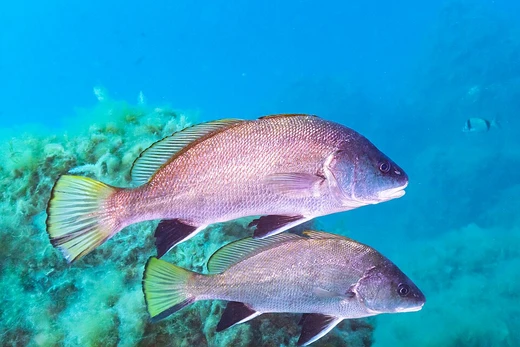
Macolor macularis
A long-lived snapper with piebald juveniles and dark adult coloration.

The midnight snapper, also called the midnight seaperch or black and white snapper, is a marine fish in the Lutjanidae family. It lives in the Indian Ocean and the western Pacific Ocean.
American ichthyologist Henry Weed Fowler first described this species in 1931, based on a specimen from near Ragay Gulf on Luzon. Its scientific name, *Macolor macularis*, means "spotted," likely referring to the gray or blue spots on its scales.
Its range across the Indo-West Pacific is not fully known because it is often confused with the similar species *Macolor niger*. It has been recorded in the Chagos Islands, the Maldives, and southwestern India. In the Pacific, it appears from the Andaman Sea and Sumatra east to Samoa and the Phoenix Islands, north to Taiwan and Japan’s Yaeyama Islands, and south to Australia. In Australian waters, it occurs on offshore reefs in northern Western Australia, Ashmore Reef in the Timor Sea, the Arafura Sea in the Northern Territory, and the Great Barrier Reef in Queensland. It also lives around Coral Sea reefs and Christmas Island.
Adults inhabit steep slopes of lagoons, channels, or seaward reefs, often on deep reef slopes. Juveniles live alone on sheltered reef slopes among crinoids, staghorn coral, or large sponges.
This species reaches a maximum total length of 60 cm (24 in). Adults are dark grey-brown on the upper body, shading to yellow on the head and lower body. Thin blue lines and small spots mark the head, and the body scales have blue lines or dashes. Juveniles have a black-and-white piebald pattern with five white spots on the back. Subadults look similar but have more white spots on the back and small white spots in black areas. Smaller adults still show hints of the juvenile pattern.
The body is moderately deep, with a convex forehead and a large mouth. The preoperculum has a deep notch on its lower edge. The jaws have a row of conical teeth, with larger ones in front, and bands of bristle-like teeth inside the outer row on the sides of the upper jaw and front of the lower jaw. The vomerine teeth form a roughly chevron-shaped patch. The dorsal fin has 10 spines and 13–14 soft rays; the anal fin has 3 spines and 10 soft rays. The rear tips of both dorsal and anal fins are clearly pointed. The long pectoral fins reach the level of the anus and have 17 or 18 rays. The caudal fin is emarginate.
Quick Facts
- Taxon
- Macolor macularis
Facts from the source article.
Lore & Background
Macolor macularis was first formally described in 1931 by American ichthyologist Henry Weed Fowler, with the type locality given as near Ragay Gulf on Luzon. The specific name macularis means 'spotted,' presumed to refer to the description stating 'most every scale with gray or blue spot.' Its wide Indo-West Pacific range is not well known because of confusion with Macolor niger. Adults occur over steep slopes of lagoon, channel, or seaward reefs, commonly on deep reef slopes. Juveniles live solitarily on sheltered reef slopes with crinoids, in staghorn coral or large sponges. The species attains a maximum total length of 60 cm. Adults are dark grey-brown on the upper body, shading to yellow on the head and lower body, with thin blue lines and small spots on the head. Juveniles have a piebald pattern of black and white including five white spots on the back; subadults show many more white spots. Smaller adults retain traces of the juvenile patterning. The body is moderately deep with a convex forehead and large mouth; the preoperculum has a deep incision on its lower margin. The dorsal fin has 10 spines and 13-14 soft rays, the anal fin 3 spines and 10 soft rays, and the long pectoral fins extend to the level of the anus with 17 or 18 rays. Smaller juveniles have very elongated pelvic fins.
Reader's Guide
Macolor macularis is a nocturnal predatory species that feeds on larger zooplankton, fishes, and crustaceans. It can be found solitary or in schools, sometimes in mixed schools with Macolor niger. It is a long-lived fish, with many attaining ages of 40–50 years; the oldest recorded individual was from Rowley Shoals in Western Australia, known to be 81 years old. The species is often recorded in fish markets, largely as fresh fish, and is caught using handlines, gill nets, traps, and spearfishing. Its significance lies in its longevity and its role in reef ecosystems as a predator, as well as its commercial value in local fisheries. The confusion with Macolor niger has hindered precise knowledge of its distribution, but it has been documented from the Chagos Islands and Maldives to Samoa, Taiwan, and Australia, including the Great Barrier Reef and Coral Sea reefs.
Did You Know?
- The specific name macularis means 'spotted,' referring to the gray or blue spots on each scale.
- The oldest recorded individual was 81 years old, from Rowley Shoals in Western Australia.
- It is sometimes found in mixed schools with Macolor niger.
More in Snappers and Grunts, Part 3 1-24
Spotted an error? Know more?
Reader corrections go straight into our review queue. Suggest an edit · How this site is sourced