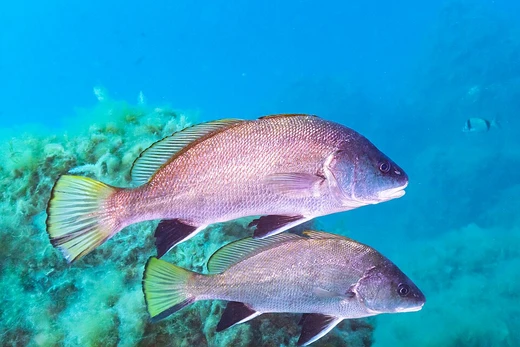
Lutjanus vitta
A snapper with a single stripe, found across the Indo-Pacific.

Lutjanus vitta, known commonly as the brownstripe red snapper, brownstripe snapper, broadband seaperch, brownstripe seaperch, one-band sea-perch, one-lined snapper, or striped seaperch, is a species of marine ray-finned fish in the family Lutjanidae. It is notable for its wide Indo-Pacific distribution and its distinctive single longitudinal stripe, which gives rise to many of its common names.
Quick Facts
- Taxon
- Lutjanus vitta
Facts from the source article.
Lore & Background
Lutjanus vitta was first formally described in 1824 as Serranus vitta by French zoologists Jean René Constant Quoy and Joseph Paul Gaimard, with the type locality given as Waigeo in Indonesia. The specific name vitta means 'band' or 'ribbon', likely referring to the single longitudinal stripe along the body. The species has a moderately deep body with a standard length 2.6 to 3.0 times its depth, a moderately steep forehead, and poorly developed preopercular incision and knob. Its vomerine teeth form a triangular patch with a rearward extension or a rhombus, and the tongue bears a patch of small grain-like teeth. The dorsal fin has 10 spines and 12-14 soft rays, the anal fin has 3 spines and 8-9 soft rays, and the caudal fin is truncate or weakly emarginate. Overall color is whitish to pinkish, with a yellowish-brown to black stripe along the middle of the flanks, thin oblique stripes above the lateral line, and slender longitudinal brown stripes below it. The back and median fins are yellow. Juveniles and subadults have a wider, blacker stripe than adults.
Reader's Guide
Lutjanus vitta is a widely distributed snapper of the Indo-Pacific, ranging from the Seychelles and Socotra in the west, through the Maldives, southern India, and Sri Lanka, to the western Pacific from Thailand and Indonesia east to New Caledonia, the Gilbert Islands, the Marshall Islands, and south to Australia, extending north to southern Taiwan. It occurs at depths between 10 and 72 m on coral reefs and in areas with low coral outcrops, sponges, and sea whips. The species may be encountered singly or in schools of up to about 30 fish. It is a predator feeding on fishes, shrimps, crabs, and other benthic invertebrates. Spawning occurs throughout the year off New Caledonia, peaking in spring and summer, and the species forms spawning aggregations. It is targeted by fisheries throughout its range and is a common species in fish markets, typically sold fresh and caught using handlines, traps, and bottom trawls. Its significance lies in its consistent presence in commercial catches across a vast geographic area, making it a familiar food fish in many regions.
Did You Know?
- It was first described in 1824 as Serranus vitta by Quoy and Gaimard, with the type locality at Waigeo, Indonesia.
- It can be found at depths from 10 to 72 meters.
More in Snappers and Grunts, Part 3 1-24
Spotted an error? Know more?
Reader corrections go straight into our review queue. Suggest an edit · How this site is sourced