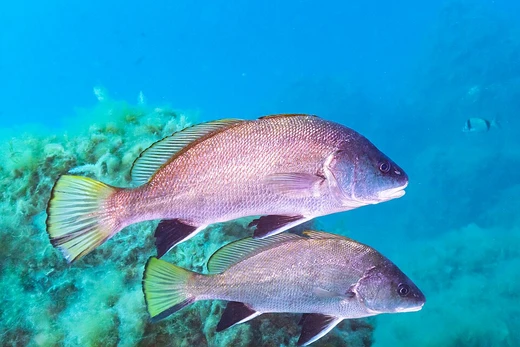
Lutjanus sebae
A slow-growing, long-lived Indo-Pacific snapper with red bars.

Lutjanus sebae, known commonly as the red emperor, emperor red snapper, emperor snapper, government bream, king snapper, queenfish, or red kelp, is a species of marine ray-finned fish in the family Lutjanidae. It is native to the Indian Ocean and the western Pacific Ocean, and is notable for its deep body, striking coloration, and commercial importance.
Quick Facts
- Taxon
- Lutjanus sebae
Facts from the source article.
Lore & Background
Lutjanus sebae was first formally described in 1816 by French zoologist Georges Cuvier as Diacope sebae, though Cuvier did not give a type locality; it is thought to be either the Coromandel Coast of India or somewhere in Indonesia. The specific name honors Albertus Seba, a Dutch pharmacist and naturalist, whose 1734 Thesaurus included an illustration of this species. The fish has a very deep body, a steep forehead, and a weakly forked caudal fin. Juveniles and subadults display a distinctive pattern of dark red bands: one from the snout through the eye to the dorsal fin, a wide band from the middle of the spiny dorsal fin to the pelvic fin, and an oblique band from the rear dorsal spine to the ventral lobe of the caudal fin. Adults are reddish to pink with red fins. This species inhabits rocky and coral reefs, preferring flat areas with sandy or gravel substrate, and is found from eastern Africa to the western Pacific, including Australia and southern Japan, with recent reports in the Mediterranean Sea near Greece and Sicily.
Reader's Guide
Lutjanus sebae is a predatory fish that feeds on fish, benthic crustaceans, and cephalopods, and may form schools of similar-sized individuals or be solitary. It is slow-growing: off the Seychelles, the mean age of first sexual maturity for both sexes is estimated at 9 years, with 50% maturity at fork lengths of 61–63 cm. After maturity, females grow more slowly than males, and adult males reach larger sizes. Spawning aggregations form between October and April, with broadcast spawning of eggs and milt. Maximum longevity is up to 40 years. Juveniles have been observed swimming among sea urchin spines, and larger adults move to deeper waters but return to shallower water in winter. The species is commercially important, farmed, sought as a game fish, and appears in the aquarium trade. In Australasia, it is called government bream because the red bars on juveniles suggest the fish is wrapped in red tape.
Did You Know?
- The specific name sebae honors Dutch naturalist Albertus Seba, who published an illustration of this fish in 1734.
- Juveniles have been observed swimming among the spines of sea urchins.
- Maximum longevity for this species is as much as 40 years.
- It is called government bream in Australasia because the red bars on juveniles resemble red tape.
More in Snappers and Grunts, Part 3 1-24
Spotted an error? Know more?
Reader corrections go straight into our review queue. Suggest an edit · How this site is sourced