Lutjanus russellii
A western Pacific snapper targeted by fisheries and aquaculture.

Lutjanus russellii goes by several common names, including Russell's snapper, Moses snapper, fingermark bream, Moses seaperch, and Russell's sea-perch. This marine ray-finned fish belongs to the snapper family Lutjanidae and is found in the western Pacific Ocean.
The species was first formally described in 1849 by Dutch physician and ichthyologist Pieter Bleeker, who named it *Mesoprion russellii*. The type specimen came from Jakarta, Java, in Indonesia. Its specific name honors Patrick Russell, a Scottish surgeon and herpetologist who illustrated the fish in 1803 without formally naming it. Within the genus *Lutjanus*, this species is most closely related to the Indian Ocean *Lutjanus indicus*.
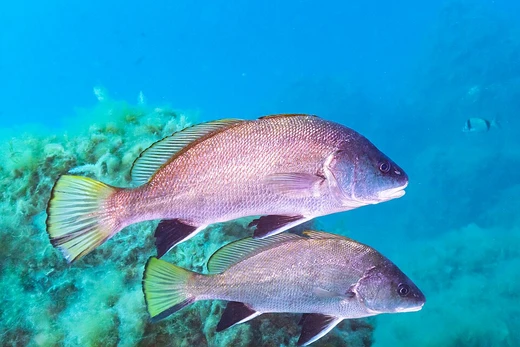
The body of *Lutjanus russellii* ranges from moderately deep to slender, with a standard length about 2.6 to 2.8 times its depth. The forehead may be steep or moderately sloped, and the preopercle has poorly developed knob and incision. The vomerine teeth form either a triangular patch with a rearward extension or a rhombus shape, and there is a small patch of tiny teeth on the tongue. The dorsal fin has 10 spines and 14 soft rays, while the anal fin has 3 spines and 8 soft rays; both fins have rounded rear edges, though the anal fin tip can be pointed. The pectoral fins have 16 to 17 rays, and the caudal fin is either truncate or weakly emarginate. Maximum total length is 50 cm (20 in), though 30 cm (12 in) is more typical. Coloration is whitish to silvery greyish-pink with a brownish back. An indistinct black spot, sometimes very faint, appears on the lateral line below the front part of the dorsal fin. The dorsal and caudal fins are reddish, while the other fins are yellow. Juveniles are white with four brown to blackish longitudinal stripes along the flanks (which may be interrupted) and a horizontally elongated black spot or ocellus on the lateral line.
This species mainly occurs in the western Pacific, from the Gulf of Thailand and Sumatra east to Tonga, north to southern Japan, and south to Australia. In Australian waters, it ranges from Shark Bay and offshore reefs in Western Australia, Ashmore Reef in the Timor Sea, around the northern and eastern coasts down to Wollongong, and possibly to Jervis Bay in New South Wales. It inhabits depths between 3 and 80 m (9.8 and 262.5 ft) on offshore coral reefs as well as inshore rocky and coral reefs.
Quick Facts
- Taxon
- Lutjanus russellii
Facts from the source article.
Lore & Background
Lutjanus russellii was first formally described in 1849 as Mesoprion russellii by the Dutch physician, herpetologist and ichthyologist Pieter Bleeker, with the type locality given as Jakarta, Java in Indonesia. The specific name honours Patrick Russell, the Scottish surgeon and herpetologist who described and depicted, without naming, this species in 1803. Within the genus Lutjanus, L. russellii is closest to the Indian Ocean L. indicus.
The species has a moderately deep body to slender, with a standard length 2.6-2.8 times its depth. Its colour is whitish to silvery greyish-pink with a brownish back, and an indistinct black spot on the lateral line below the front portion of the dorsal fin. Juveniles are white with four brown to blackish longitudinal stripes and a horizontally-elongated black spot or ocellus on the lateral line. It is found at depths between 3 and 80 m on offshore coral reefs as well as inshore rocky and coral reefs, and juveniles inhabit mangrove lined estuaries and lower parts of freshwater streams.
Reader's Guide
Lutjanus russellii is a predatory fish that preys on benthic fishes and invertebrates. It reaches sexual maturity at 28.1 cm fork length, around 4 years of age, and has an average longevity of about 17 years. The species is a target for artisanal fisheries and is frequently sold in fish markets wherever it occurs. Fishers catch it using handlines, traps and bottom trawls. It is also taken live and sold within the Hong Kong live fish trade, and is extensively cultured in aquaculture. Its distribution spans the western Pacific Ocean from the Gulf of Thailand and Sumatra east to Tonga, north to southern Japan and south to Australia, including Australian waters from Shark Bay and offshore reefs in Western Australia, Ashmore Reef in the Timor Sea, and along the northern and eastern coasts as far south as Wollongong and possibly Jervis Bay in New South Wales.
Did You Know?
- This species is extensively cultured in aquaculture and is also sold live in the Hong Kong live fish trade.
- It reaches sexual maturity at about 4 years of age and has an average longevity of around 17 years.
More in Snappers and Grunts, Part 3 1-24
Spotted an error? Know more?
Reader corrections go straight into our review queue. Suggest an edit · How this site is sourced