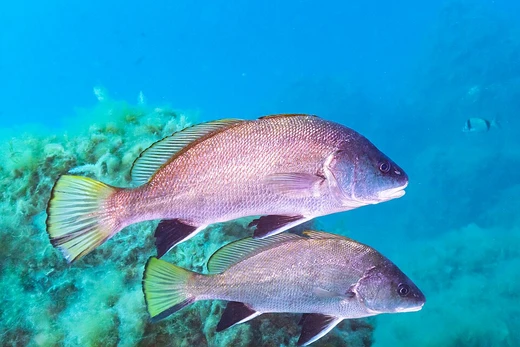
Lutjanus purpureus
A red snapper of the western Atlantic and Caribbean.

Lutjanus purpureus, commonly called the southern red snapper or Caribbean red snapper, is a marine ray-finned fish belonging to the snapper family Lutjanidae. Its natural range covers the western Atlantic Ocean and the Caribbean Sea.
The species was first formally described in 1867 by Cuban zoologist Felipe Poey, who named it *Mesoprion purpureus*. No type locality was given, but Cuba is the most likely origin. Poey may have based his description on a painting with an unclear subject, making it uncertain exactly which fish he meant. The species has often been treated as a synonym of the northern red snapper (*Lutjanus campechanus*). The scientific name *purpureus* means "purple," which adds to the confusion, as this fish is not purple. Some past authors called it *Lutjanus aya*, but that name actually refers to a drum, not a snapper.
The body of this snapper is moderately deep and compressed, with a short head and a rounded upper profile. Its snout is short and blunt, and it has two pairs of simple nostrils. The eye is large, and the preoperculum is serrated with a weakly developed incision and knob. The vomerine teeth form a chevron- or crescent-shaped patch with a short rearward extension. The dorsal fin has 10 spines and 14 soft rays; the anal fin has 3 spines and 8–9 soft rays and becomes pointed in fish over 5 cm long. The long pectoral fin reaches the anus and has 17 rays. The tail fin is strongly forked, with the upper lobe slightly longer than the lower. Maximum total length is 100 cm, though 65 cm is more typical, and the heaviest recorded weight is 10 kg. The back and upper sides are deep red, while the lower sides and belly are pinkish with a silvery sheen. The fins are mostly red, and there may be a small dark spot at the upper base of the pectoral fin. Juveniles have a round black spot on the upper side below the front of the soft-rayed part of the dorsal fin, which fades and disappears as they grow.
This species occurs throughout much of the Caribbean Sea, from Cuba south to northeastern Brazil. It is most abundant over the continental shelf between Honduras and the Guianas, and less common around the Greater and Lesser Antilles, where it is restricted to deeper waters. It lives over rocky bottoms at depths of 30 to 160 m, most often between 70 and 120 m. Juveniles prefer sand or mud substrates.
Quick Facts
- Taxon
- Lutjanus purpureus
Facts from the source article.
Lore & Background
Lutjanus purpureus was first formally described in 1867 as Mesoprion purpureus by the Cuban zoologist Felipe Poey, with no type locality given but most probably Cuba. The description is ambiguous, as Poey may have based it on a painting with an unclear subject, and the specific name purpureus means 'purple' despite the fish not being purple. It has been treated as a synonym of the northern red snapper (Lutjanus campechanus), and past authors have referred to it as Lutjanus aya, but that name was shown to belong to a drum, not a snapper.
The species has a moderately deep, compressed body with a short, blunt snout, large eye, and a weakly developed incision and knob on the serrated preoperculum. Its dorsal fin has 10 spines and 14 soft rays, the anal fin has 3 spines and 8–9 soft rays, and the pectoral fin has 17 rays. The back and upper flanks are deep red, lower flanks and abdomen pinkish with silver, and fins largely red; juveniles have a round black spot on the upper flanks that fades with age.
It is found over the continental shelf from Honduras to the Guianas, less abundant around islands where it is restricted to deeper water. It prefers rocky substrates at depths of 30–160 m, commonest at 70–120 m, while juveniles favor sand or mud. Its diet includes fishes, shrimps, crabs, cephalopods, and zooplankton, and spawning occurs in spring and summer, with a lifespan of 12–18 years.
Reader's Guide
Lutjanus purpureus is not of great importance to commercial fisheries despite being regarded as a good quality food fish. It is mainly caught using long lines, hand lines, bottom trawls, and gillnets. There have been reports of ciguatera poisoning in humans following consumption of this species, which adds a cautionary note to its culinary value. The species' taxonomic history—including confusion with Lutjanus campechanus and the misapplication of the name Lutjanus aya—highlights the challenges in snapper identification and classification. Its distribution across the Caribbean and western Atlantic, with higher abundance over the continental shelf and deeper occurrence near islands, reflects its ecological preferences. The maximum size of 100 cm and weight of 10 kg, along with its typical length of 65 cm, provide practical benchmarks for fisheries and biological studies. The presence of a juvenile spot that fades with age is a key identification feature for younger individuals.
Did You Know?
- Lutjanus purpureus was first described in 1867 by Cuban zoologist Felipe Poey as Mesoprion purpureus.
- The specific name purpureus means 'purple', but the fish is not purple in color.
More in Snappers and Grunts, Part 3 1-24
Spotted an error? Know more?
Reader corrections go straight into our review queue. Suggest an edit · How this site is sourced