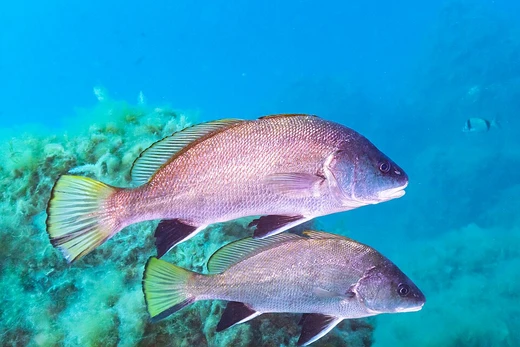
Lutjanus novemfasciatus
Largest snapper species, reaching 170 cm and 35.7 kg.

Lutjanus novemfasciatus, called the Pacific cubera snapper or Pacific dog snapper, is a marine ray-finned fish from the snapper family Lutjanidae. It lives in the eastern Pacific Ocean and holds the record as the biggest snapper species, growing up to 170 cm long and weighing as much as 35.7 kg.
First described in 1862 by American ichthyologist Theodore Nicholas Gill, its type location is Baja California. The name *novemfasciatus* means "nine-banded," referring to the faint bands on its sides.
The fish has an oblong body with a depth of 31 to 35 percent of its standard length. Its snout is sharp, with two pairs of simple nostrils—one in front, one behind. The mouth is large and can extend outward, with conical and canine-like teeth on the jaws; the front teeth are enlarged into fangs longer than the pupil's diameter. The preoperculum is serrated, with a weakly developed incision and knob. Vomerine teeth form a crescent-shaped patch with no rear extension, and the tongue has several patches of granular teeth. The dorsal fin is continuous, with 10 spines and 13–14 soft rays; the anal fin has 3 spines and 8 soft rays, both with rounded rear ends. Pectoral fins have 16 or 17 rays, and the caudal fin is either truncate or slightly notched. Color ranges from dark to pale red, shading to silver on the belly. Juveniles and most adults show 8–9 vertical bars on the upper flanks, though these may fade quickly after death. Adults have mostly brownish fins; juveniles have a black caudal fin and a black margin on the spiny part of the dorsal fin. The skin inside the mouth is orange.
This species ranges from southern California to Peru, including the Gulf of California, Galápagos Islands, Cocos Island, and Malpelo Island. It is an inshore, reef-associated fish that prefers hard substrates, though juveniles have been recorded entering freshwater.
A nocturnal predator, it feeds at night on crustaceans and schooling fish like croakers, grunts, and wrasses, sheltering during the day. In Mexico, it migrates inshore in early summer in most years.
It is an important catch for subsistence fisheries in Colombia and commercial fisheries in Nicaragua, and is a popular target for spearfishing in the Gulf of California.
Quick Facts
- Taxon
- Lutjanus novemfasciatus
Facts from the source article.
Lore & Background
Lutjanus novemfasciatus was first formally described in 1862 by American ichthyologist Theodore Nicholas Gill, with the type locality given as Baja California. The specific name novemfasciatus means 'nine-banded', referring to the nine indistinct bands on its flanks. The species has an oblong body with a depth of 31% to 35% of its standard length, a sharp snout with two pairs of simple-hole nostrils, and a large protrusible mouth with conical and canine-like teeth, including enlarged fangs at the front longer than the pupil diameter. The dorsal fin is continuous with 10 spines and 13-14 soft rays, the anal fin has 3 spines and 8 soft rays, and the caudal fin may be truncate or weakly emarginate. Overall color varies from dark to pale red, shading to silver on the abdomen; juveniles and most adults have 8-9 vertical bars on the upper flanks that may fade quickly after death. The inside of the mouth is orange.
Reader's Guide
Lutjanus novemfasciatus is an inshore, reef-associated fish preferring hard substrates, found from southern California to Peru, including the Gulf of California, Galápagos Islands, Cocos Island, and Malpelo Island. Juveniles have been recorded entering freshwater. It is a nocturnal predator, feeding at night on crustaceans and smaller schooling fish such as croakers, grunts, and wrasses, and sheltering during daylight. In Mexico, this species is migratory, arriving in inshore waters in early summer in most years. It is an important quarry for subsistence fisheries in Colombia and for commercial fisheries in Nicaragua, and is a popular target for spearfishing in the Gulf of California. Its significance lies in its size as the largest snapper and its role in both subsistence and commercial fisheries in the eastern Pacific.
Frequently Asked Questions
Who is Lutjanus novemfasciatus?
It is the Pacific cubera snapper (also called the Pacific dog snapper), a ray-finned marine fish belonging to the snapper family Lutjanidae. American ichthyologist Theodore Nicholas Gill first formally described the species in 1862, using specimens from Baja California as the type locality.
What are Lutjanus novemfasciatus's powers and role?
As the largest snapper species known, it can reach 170 cm in total length and tip the scales at 35.7 kg, making it a top-tier predator in eastern Pacific waters. Its oblong body, with a depth of roughly 31–35 percent of standard length, and its 10 dorsal-fin spines give it a powerful, armored profile in the water column.
Why is Lutjanus novemfasciatus important?
Holding the record as the biggest snapper in the family, it occupies a keystone predator niche that helps regulate smaller fish populations across its range. Its sheer biomass and position near the top of the food web make it a critical indicator of the health of eastern Pacific marine ecosystems.
What does the name 'novemfasciatus' actually mean?
The Latin epithet translates to 'nine-banded,' a nod to the faint horizontal stripes that run along the flanks of the fish. Gill chose this descriptor in 1862 to capture that distinctive banding pattern as a key identifying feature.
More in Snappers and Grunts, Part 3 1-24
Spotted an error? Know more?
Reader corrections go straight into our review queue. Suggest an edit · How this site is sourced