American Civil War
Civil war between the Union and Confederacy over slavery and secession.

Wikipedia / Wikimedia Commons
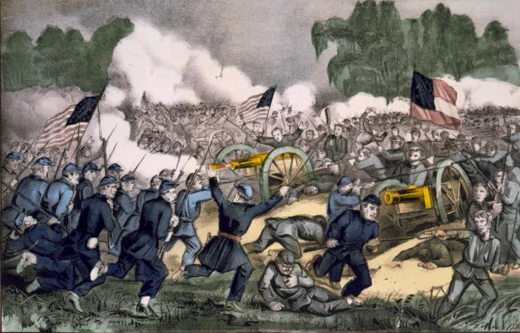
From April 12, 1861, to May 26, 1865, the United States was torn apart by a civil war between the Union (the North) and the Confederacy (the South). The Confederacy was created in 1861 by Southern states that left the Union specifically to keep slavery alive. The conflict ended when the Union won, the Confederacy dissolved, and slavery was abolished, resulting in the freedom of four million African Americans. This war remains the deadliest in American history and was one of the first to employ industrial warfare.
The fight over slavery had been brewing for decades. It came to a head when Abraham Lincoln, a Republican who opposed expanding slavery into new territories, won the 1860 presidential election. In response, seven slave states seceded and formed the Confederate States of America. The Confederacy then took over U.S. forts and other federal property in the South. The shooting started on April 12, 1861, when the Confederates bombarded Fort Sumter in South Carolina. A burst of war fever swept both the North and South, and military recruitment skyrocketed. After the war began, four more Southern states joined the Confederacy, which, led by President Jefferson Davis, eventually included eleven states holding about one-third of the U.S. population. The next four years saw intense fighting, mostly on Southern soil.
In the western theater during 1861–1862, the Union made lasting gains, but in the eastern theater the fighting was indecisive. On January 1, 1863, Lincoln issued the Emancipation Proclamation, making the abolition of slavery a Union war goal. It declared all slaves in rebel states free, covering more than 3.5 million of the country's 4 million enslaved people. Out west, the Union destroyed the Confederacy's river navy by summer 1862, crippled much of its western armies, and captured New Orleans. In 1863, the Union's successful siege of Vicksburg split the Confederacy in two along the Mississippi River. Meanwhile, Confederate General Robert E. Lee's invasion of the North failed at the Battle of Gettysburg. General Ulysses S. Grant's successes in the West led Lincoln to put him in charge of all Union armies in 1864.
The Union tightened a naval blockade around Confederate ports and used its superior resources and manpower to attack from every direction.
Quick Facts
- Location
- United States, Atlantic Ocean
- Result
- Union victory
- Territory
- Dissolution of the Confederate States of America
- Conflict
- American Civil War
Facts from the source article.
Lore & Background
Decades of controversy over slavery culminated when Abraham Lincoln, a Republican who opposed slavery's expansion, won the 1860 presidential election. Seven slave states in the Deep South responded by seceding and forming the Confederate States of America, seizing US forts and federal assets. The war began on April 12, 1861, when the Confederacy bombarded Fort Sumter in South Carolina. Four more Southern states seceded after the war began, and the Confederacy, led by President Jefferson Davis, comprised eleven states containing a third of the US population.
Reader's Guide
The American Civil War is one of the most extensively studied episodes in US history. Its primary cause was the Southern desire to preserve slavery, as confirmed by secession documents and modern historical consensus. The war's legacy includes the abolition of slavery via the Thirteenth Amendment, the destruction of much of the South's infrastructure, and the beginning of the Reconstruction era. The conflict introduced industrial warfare—railroads, telegraphs, steamships, ironclad warships, and mass-produced weapons—and its brutality foreshadowed the world wars. The Lost Cause ideology, which denies slavery as the principal cause, remains a subject of historiographical debate.
Did You Know?
- The war began when the Confederacy bombarded Fort Sumter in South Carolina on April 12, 1861.
- Lincoln's Emancipation Proclamation of January 1, 1863 declared all slaves in rebel states free, applying to more than 3.5 million enslaved people.
- The Union siege of Vicksburg in 1863 split the Confederacy in two at the Mississippi River.
- The war left an estimated 700,000 soldiers dead, making it the deadliest in American history.
The Roots of Disunion
The American Civil War was, at its core, a conflict over the institution of slavery. Twenty-first-century historians overwhelmingly concur that the preservation of slavery was the driving force behind Southern secession, a conclusion reinforced by the seceding states' own declarations. Mississippi, for instance, explicitly identified its position with the institution of slavery, calling it the greatest material interest of the world. The political flashpoint was whether slavery would spread into the Western territories destined to become new states. For decades, Congress had admitted states in pairs—one free, one slave—maintaining a delicate Senate balance, but the North's growing population in the House of Representatives made that equilibrium increasingly untenable. When Abraham Lincoln, a Republican opposed to slavery's expansion, won the 1860 presidential election, seven Deep South states whose cotton economies depended on enslaved labor declared their withdrawal from the Union. The North, motivated by a commitment to American nationalism and the preservation of the Union, refused to acquiesce. As a 2011 panel of historians summarized it, slavery was the primary cause of disunion, and it was that disunion itself that ignited the war.
Turning Points on the Battlefield
The war's trajectory shifted dramatically between 1861 and 1865. In the western theater, the Union achieved lasting territorial gains, destroying the Confederate river navy by the summer of 1862 and capturing New Orleans. The eastern front, by contrast, remained largely inconclusive during that same period. A pivotal moment arrived on January 1, 1863, when Lincoln issued the Emancipation Proclamation, declaring all enslaved people in rebel states free—a declaration that applied to more than 3.5 million of the four million enslaved in the nation. That same year, the Union's successful siege of Vicksburg bisected the Confederacy along the Mississippi River, while Robert E. Lee's northern campaign collapsed at Gettysburg. Grant's sustained western victories earned him command of all Union armies in 1864. From that point, the Union pressed from every direction: a tightening naval blockade strangled Confederate ports, Sherman captured Atlanta and then marched to the sea, taking Savannah. The final act centered on the grueling ten-month Siege of Petersburg, the gateway to Richmond. When the Confederates abandoned their capital, Lee surrendered to Grant at Appomattox Court House on April 9, 1865, effectively ending the conflict.
Industrial Warfare and Human Cost
The Civil War marked a watershed in the nature of American conflict, as it was among the first wars to harness the full machinery of industrial production. Railroads moved armies and supplies across vast distances, the electrical telegraph compressed the time between battlefield events and command decisions, steamships dominated waterways, ironclad warships transformed naval combat, and mass-produced weapons turned engagements into slaughter on an unprecedented scale. The technology and brutality of this conflict foreshadowed the world wars that would follow decades later. The human toll was staggering: an estimated 700,000 soldiers lost their lives, alongside an undetermined number of civilian deaths, making it the deadliest war in American history. The physical destruction was equally profound. By the war's end, much of the South's infrastructure had been obliterated, leaving the region in ruins. The conflict did not merely change political boundaries; it fundamentally altered how warfare was waged, how nations mobilized their industrial capacity, and how the cost of war was measured in human lives. The scale of loss and the mechanization of killing set a precedent that would echo through the twentieth century.
Aftermath, Legacy, and Enduring Debate
The war's conclusion on May 26, 1865, brought the dissolution of the Confederacy and the ratification of the Thirteenth Amendment, which abolished slavery and freed four million African Americans. The nation then entered the Reconstruction era, an ambitious attempt to rebuild a shattered country, reintegrate the former Confederate states, and extend civil rights to newly freed people. Yet the war's shadow has never fully receded. It remains one of the most extensively studied and written-about episodes in American history, a subject of persistent cultural and historiographical debate. The pseudo-historical Lost Cause narrative, which denies that slavery was the principal driver of secession, continues to circulate despite being contradicted by the seceding states' own documents. The war's final days carried a bitter irony: Lincoln lived to witness the Union's victory but was shot by an assassin on April 14, 1865, dying the following day. The conflict thus left the nation not only with a reconstituted Union and a freed population, but with a legacy of unresolved questions about race, memory, and national identity that continue to shape American discourse.
Gallery

Frequently Asked Questions
Who is American Civil War?
The American Civil War was a four-year armed conflict (1861–1865) pitting the Northern Union against the Southern Confederacy. It was fundamentally a war fought over whether the institution of slavery could survive in the nation.
What are American Civil War's powers/role?
Its central role was to resolve the crisis of secession and the future of slavery through large-scale military force. It also marked one of the first conflicts to deploy industrial-scale weaponry, resulting in roughly 700,000 soldier deaths.
Why is American Civil War important?
It stands as the deadliest war in U.S. history and permanently reshaped the nation's political and moral foundations. By ending legal slavery and reaffirming the Union's indivisibility, it set the stage for modern American civil rights.
What sparked American Civil War?
Decades of escalating political and moral disputes over slavery led Southern states to secede from the Union in early 1861. The first shots fired at Fort Sumter on April 12, 1861, officially opened hostilities between the two sides.
More in Rebellions against the United States 1-23
Spotted an error? Know more?
Reader corrections go straight into our review queue. Suggest an edit · How this site is sourced