Coherer
Early radio detector using metal filings that cohered under radio signals.

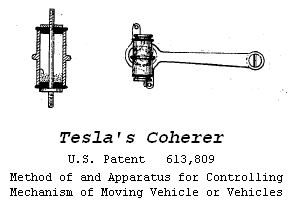
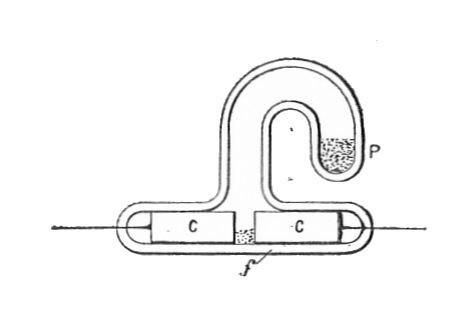
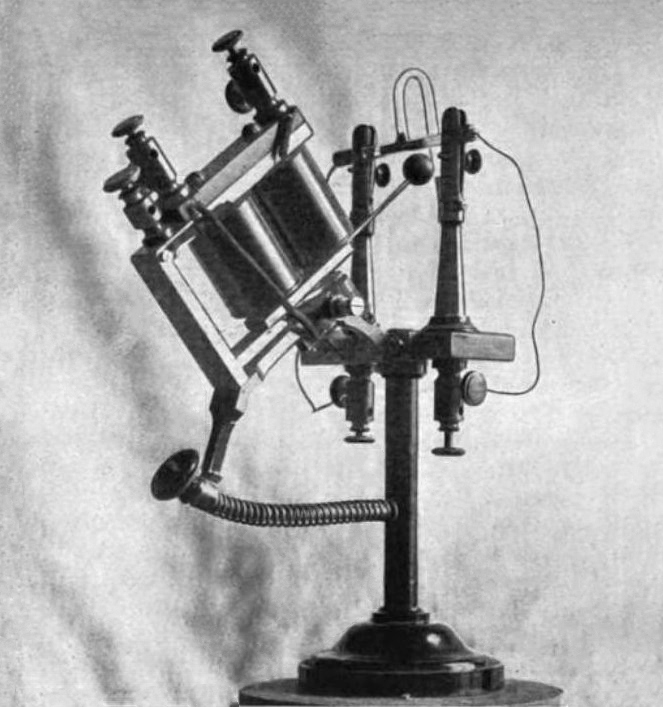
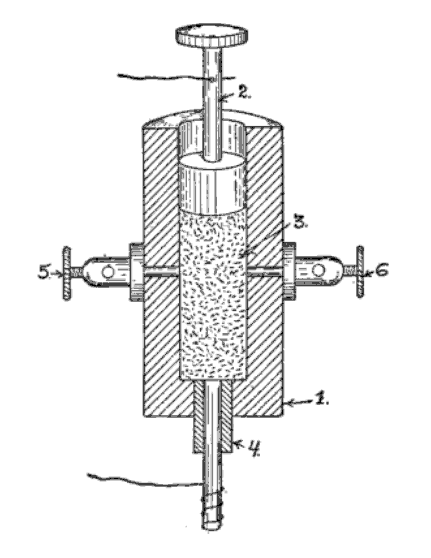
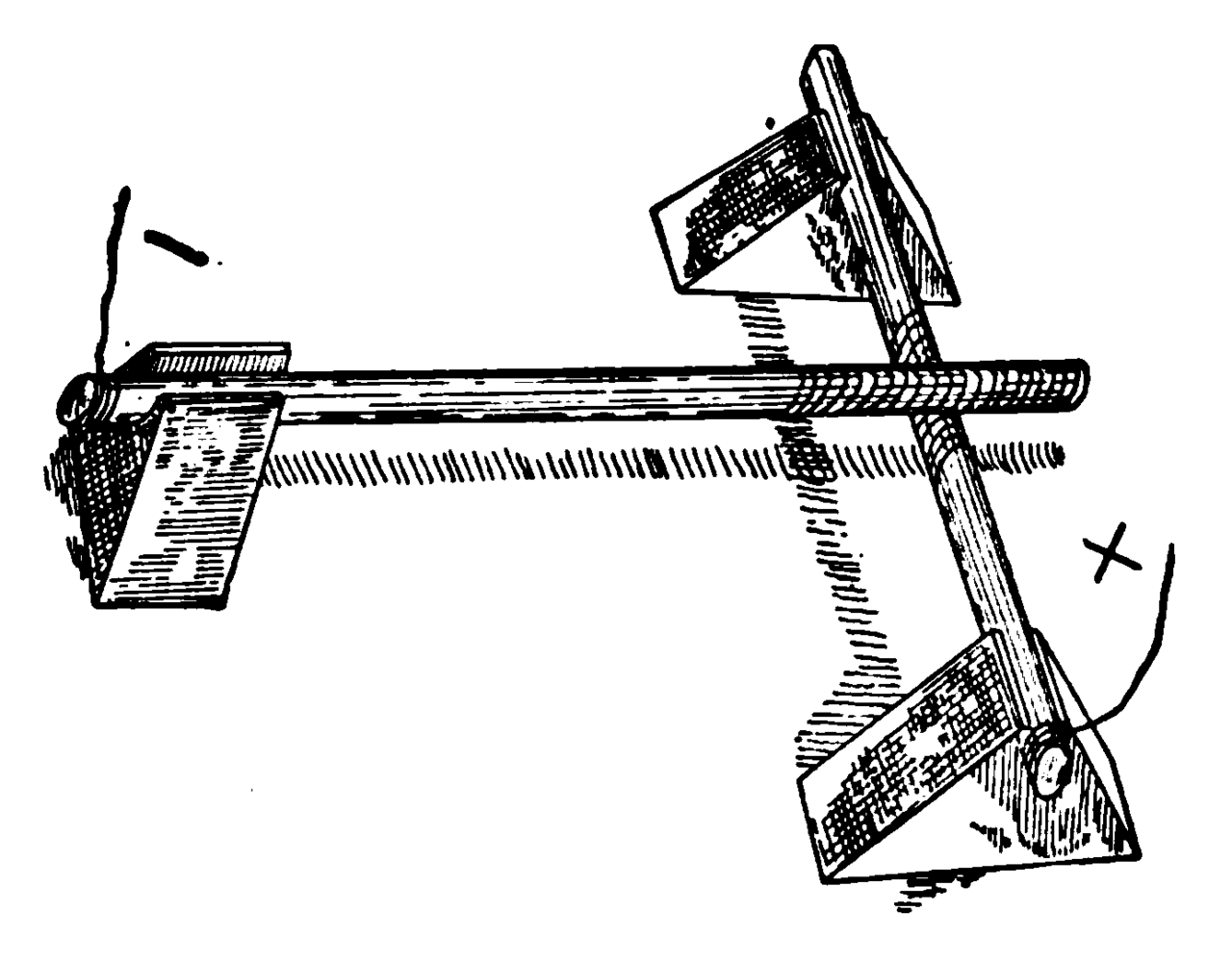
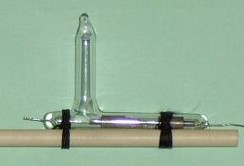
The coherer was an early device for detecting radio signals, used in the first wireless telegraphy receivers around the start of the 1900s. Its operation in radio came from work published in 1890 by French physicist Édouard Branly, which was then refined by other scientists and inventors over the following decade. The device was a tube or capsule holding two electrodes with a small gap between them, filled with loose metal filings. When a radio frequency signal reached the device, the metal particles stuck together—or "cohered"—which lowered the normally high resistance of the filings. This let a much stronger direct current flow through the circuit. In a receiver, that current could ring a bell or drive a Morse paper tape recorder to log the incoming signal. Because the filings stayed conductive after the signal ended, the coherer had to be "decohered" by a small hammer or clapper, powered by an electromagnet, that tapped the tube each time a signal was received, restoring the filings to their original loose state. Coherers were widely used until around 1907, when more sensitive electrolytic and crystal detectors took their place.
- Inventor of the underlying effect
- Édouard Branly (1890)
- Named by
- Oliver Lodge (1894)
- Primary era of use
- Until about 1907
- Replaced by
- Electrolytic and crystal detectors
- Key component
- Tube or capsule with two electrodes and loose metal filings
Lore & Background
The behavior of metal filings in the presence of electricity was noticed in many experiments before Branly's 1890 paper. In 1835 Swedish scientist Peter Samuel Munk observed a change of resistance in a mixture of metal filings near a spark discharge from a Leyden jar. In 1850 Pierre Guitard found that electrified dusty air caused particles to collect in strings. English engineer Samuel Alfred Varley's 1866 lightning bridge used powdered carbon to ground high-voltage lightning strikes while blocking low-voltage telegraph signals. In 1879 Welsh scientist David Edward Hughes noted that loose contacts in a microphone responded to nearby sparks. Temistocle Calzecchi-Onesti in Italy studied copper filings between brass plates that clung together when voltage was applied, and found other metal filings reacted to distant electric sparks, which he thought could detect lightning. His papers were published in 1884, 1885 and 1886.
In 1890, Édouard Branly published his investigation of the effect of minute electrical charges on metal filings. In one circuit, filings in a glass or ebonite tube between two metal plates caused a large galvanometer deflection when an electric discharge occurred nearby, even when the tube was in another room 20 yards away. Branly devised many devices based on imperfect metal contacts. His filings tube came to light in Great Britain in 1892 when Dr. Dawson Turner described it at a meeting of the British Association in Edinburgh. Scottish engineer George Forbes suggested the tube might react to Hertzian waves (radio waves). In 1893 physicist W.B. Croft exhibited Branly's experiments, though it was unclear whether the filings reacted to sparks or to light from the sparks. George Minchin wrote a paper on the action of electromagnetic radiation on films containing metallic powders. These papers were read by Oliver Lodge, who saw a way to build an improved Hertzian wave detector. On 1 June 1894, Lodge delivered a memorial lecture on Hertz, demonstrating an improved version of Branly's filings tube, which he named the 'coherer', as a detector. In May 1895, after reading about Lodge's demonstrations, Russian physicist Alexander Popov built a lightning detector using a coherer. That same year, Guglielmo Marconi demonstrated a wireless telegraphy system using a coherer. Russian radio pioneer Simeon Aisenstein used a coherer in his initial laboratory established as a hobby in 1904.
The coherer remained in widespread use until about 1907, when it was replaced by more sensitive electrolytic and crystal detectors. One minor modern use was by Japanese tin-plate toy manufacturer Matsudaya Toy Co., which beginning in 1957 used a spark-gap transmitter and coherer-based receiver in a range of radio-controlled toys called Radicon, including a boat, an Oldsmobile car, and a bus.
Reader's Guide
The coherer was the most successful of many detector devices tried in early radio. Unlike modern AM radio, early transmitters used on-off keying to produce Morse code pulses of unmodulated carrier wave. The coherer merely had to detect the presence or absence of the radio signal. Its operation is based on electrical contact resistance: metal particles cohere and conduct much better after being subjected to radio frequency electricity. The radio signal from the antenna was applied directly across the coherer's electrodes. When a dot or dash came in, the coherer became conductive, and a DC circuit powered by a battery created a click in earphones or a telegraph sounder, or a mark on paper tape. However, the reduction in resistance persisted after the signal ended, so a decoherer mechanism tapped the coherer to mechanically disturb the particles and reset it to high resistance. If a dash was being transmitted, the radio frequency was still present when the tap occurred, so the coherer immediately became conductive again, producing multiple dots close together on the tape. The coherence of particles by radio waves is an obscure phenomenon not well understood even today; recent experiments seem to have confirmed the hypothesis that the particles cohere by an unspecified mechanism. The coherer was replaced around 1907 by simpler and more sensitive electrolytic and crystal detectors, becoming obsolete.
Did You Know?
- The coherer was named by English physicist Oliver Lodge in 1894.
- The metal filings in a coherer had to be 'decohered' by tapping with a clapper after each signal.
- Japanese toy maker Matsudaya used a coherer-based receiver in Radicon radio-controlled toys starting in 1957.
- The coherer was replaced around 1907 by electrolytic and crystal detectors.
A Long Prehistory of Metallic Curiosity
The phenomenon behind the coherer was observed by multiple scientists decades before it became a practical device. In 1835, Swedish scientist Peter Samuel Munk noticed resistance changes in metal filings near a Leyden jar spark discharge. Pierre Guitard in 1850 observed electrified dust particles forming string-like clusters. Samuel Alfred Varley applied the principle in 1866 with his lightning arrester for telegraph lines, using powdered carbon between metal spikes that blocked low-voltage signals but conducted high-voltage strikes. David Edward Hughes in 1879 noticed loose carbon contacts and metallic granules in a microphone responding to nearby sparks. Italian researcher Temistocle Calzecchi-Onesti published papers in 1884, 1885, and 1886 in il Nuovo Cimento, documenting how copper filings between brass plates became conductive under voltage and even reacted to distant electric sparks—a behavior he proposed could detect lightning. These scattered observations laid the groundwork for what would become the coherer.
Branly's Breakthrough and the Birth of a Name
In 1890, French physicist Édouard Branly published a detailed investigation titled "On the Changes in Resistance of Bodies under Different Electrical Conditions," describing how minute electrical charges affected metal filings sealed in glass or ebonite tubes between two metal plates. He observed that an electric discharge—even one occurring in a room twenty yards away—caused a large galvanometer deflection, proving the filings reacted to the charge at a distance. Branly developed numerous variations using what he called "imperfect" metal contacts. The device gained wider attention in 1892 when Dr. Dawson Turner presented it at a British Association meeting in Edinburgh. Scottish engineer and astronomer George Forbes then proposed the revolutionary idea that the filings might be responding to Hertzian waves—airborne electromagnetic radiation proven by Heinrich Hertz. This reframing transformed a curious laboratory oddity into a potential radio detector.
Wiring the Wireless World
The coherer moved from theoretical curiosity to practical radio technology in rapid succession. In 1893, W.B. Croft demonstrated Branly's experiments in London, while George Minchin theorized the tube reacted to electromagnetic radiation similarly to a solar cell. Oliver Lodge, reading these papers, recognized the potential for an improved Hertzian wave detector. On June 1, 1894, months after Hertz's death, Lodge delivered a memorial lecture in which he transmitted waves over a short distance and detected them using his improved filings tube, which he named the "coherer." In May 1895, Alexander Popov built a lightning detector using a coherer, and that same year Guglielmo Marconi demonstrated a wireless telegraphy system based on the device. In operation, radio pulses caused metal particles to cling together, dropping resistance and allowing current to ring a bell or drive a Morse tape recorder. An electromagnet-driven clapper then tapped the tube to "decohere" the filings, resetting it for the next signal.
Obsolescence and a Toy-Box Afterlife
The coherer's reign as the standard radio detector was brief. By approximately 1907, more sensitive and simpler electrolytic and crystal detectors had rendered it obsolete in professional receivers, ending a little over a decade of widespread use in wireless telegraphy. Yet the device found an unexpected second life in the most unlikely of places: children's playthings. Beginning in 1957, Japanese tin-plate toy manufacturer Matsudaya Toy Co. incorporated a spark-gap transmitter paired with a coherer-based receiver into a line of radio-controlled toys marketed under the name "Radicon," an abbreviation for Radio-Controlled. The range included a Radicon Bus (the most popular model), a Radicon Oldsmobile Car (rare), and a Radicon Boat (very rare). All shared the same RC system, meaning a Victorian-era physics curiosity was still guiding a tin bus through a living room more than half a century after it had been retired from the radio laboratory.
Gallery
More in Radio Electronics 1-24
Spotted an error? Know more?
Reader corrections go straight into our review queue. Suggest an edit · How this site is sourced