Cavity perturbation theory
Analytical method for resonant frequency and Q factor changes.

Cavity perturbation theory provides a set of mathematical tools for calculating how a cavity resonator's performance shifts when it is altered. Such alterations come in two main forms: placing a small foreign object inside the cavity, or slightly changing the shape of its walls. These methods are relevant to microwave systems and the broader study of electromagnetism.
When a cavity is perturbed—for instance, by inserting an object with different material properties or by making a minor shape change—the electromagnetic fields inside it adjust. As a result, every resonant mode (also called a quasinormal mode) of the original cavity shifts slightly. The core assumption is that the fields after the change differ only very little from the fields before it. Using Maxwell's equations for both the original and the perturbed cavity, one can derive formulas for the new resonant frequency and linewidth (or Q factor) that rely solely on the original, unperturbed mode.
The theory was first developed in optics by Bethe and Schwinger, and in the radio-frequency domain by Waldron. Their early formulas were based on stored energy, which is intuitive: the largest frequency shift occurs when the perturbation is placed where the cavity mode is strongest. However, energy conservation in electromagnetism only holds for Hermitian systems where no energy is lost. A cavity is an open, non-Hermitian system because it leaks energy and can absorb it. The stored-energy approach thus works only in the limit of very small leakage (infinite Q). For example, that approach predicts a Q change only if the perturber is absorbent, but in reality a dielectric perturbation can either increase or decrease the Q factor.
To handle non-Hermitian systems, the theory shifts from energy products (involving ε and μ) to products that are complex quantities, whose imaginary part accounts for leakage. The resonant modes in such leaky systems are called quasinormal modes. In this framework, both the frequency shift and the Q change are predicted by a different formula. That formula has been verified in many complicated geometries. For low-Q cavities like plasmonic nanoresonators used in sensing, it accurately predicts both the shift and the broadening, whereas the older energy-based formula does not.
- Initial proposers
- Bethe-Schwinger (optics) and Waldron (radio frequency domain)
- Underlying assumption
- Electromagnetic fields inside the cavity after the change differ by a very small amount from the fields before the change
Lore & Background
Cavity perturbation theory was initially proposed by Bethe-Schwinger in optics and by Waldron in the radio frequency domain. These initial approaches relied on formulae that consider stored energy, which are intuitive since common sense dictates that the maximum change in resonant frequency occurs when the perturbation is placed at the intensity maximum of the cavity mode. However, energy considerations in electromagnetism are only valid for Hermitian systems for which energy is conserved; for cavities, energy is conserved only in the limit of very small leakage (infinite Q's).
The problems stem from the fact that a cavity is an open non-Hermitian system with leakage and absorption. The theory of non-Hermitian electromagnetic systems abandons energy products and rather focuses on products that are complex quantities, the imaginary part being related to the leakage. In this framework, the resonance modes are often referred to as quasinormal modes. For low-Q cavities, such as plasmonic nanoresonators used for sensing, the quasinormal-mode formula has been shown to predict both the shift and the broadening of the resonance with high accuracy, whereas the stored-energy formula inaccurately predicts both. For high-Q photonic cavities, such as photonic crystal cavities or microrings, experiments have evidenced that the quasinormal-mode formula accurately predicts both the shift and the Q change, whereas the stored-energy formula accurately predicts the shift only.
Reader's Guide
Cavity perturbation theory provides analytical expressions for the resulting resonant frequency shift and linewidth change (or Q factor change) by referring only to the original unperturbed mode. The theory has many industrial applications for cavity resonators, including microwave ovens, microwave communication systems, and remote imaging systems using electromagnetic waves. How a resonant cavity performs can affect the amount of energy required to make it resonate, or the relative stability or instability of the system.
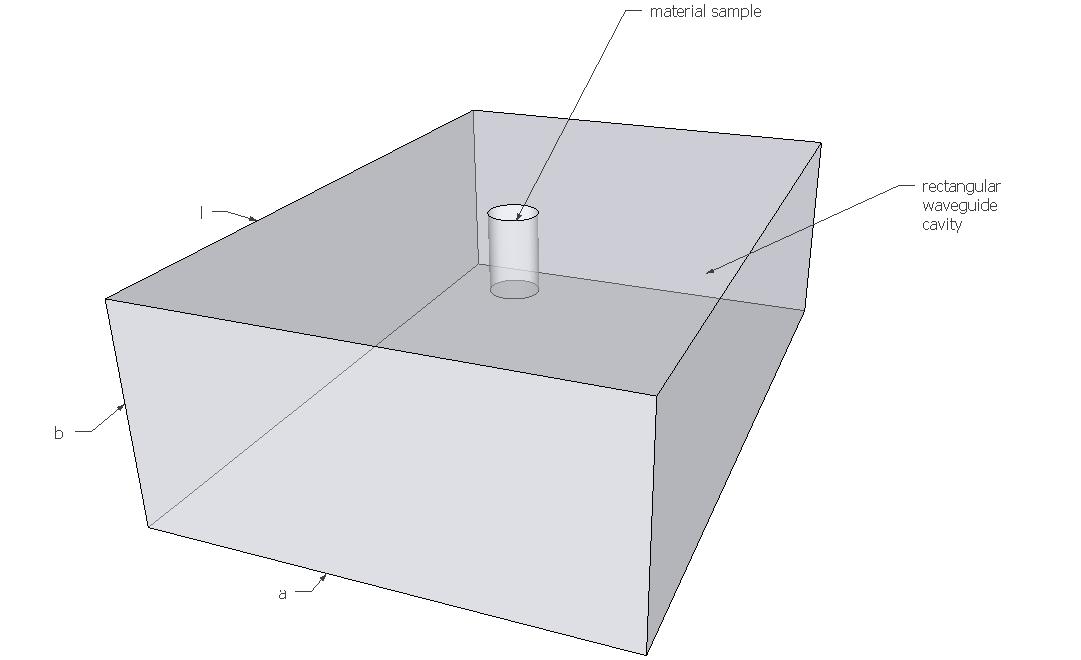
Microwave measurement techniques based on cavity perturbation theory are generally used to determine the dielectric and magnetic parameters of materials and various circuit components such as dielectric resonators. These measurement techniques generally make use of standard resonant cavities where resonant frequencies and electromagnetic fields are well known, such as rectangular and circular waveguide cavities and coaxial cable resonators. Cavity perturbation measurement techniques for material characterization are used in many fields ranging from physics and material science to medicine and biology. The accuracy of the quasinormal-mode formula has been verified in a variety of complicated geometries.
Core Framework and Mathematical Foundations
Cavity perturbation theory offers a systematic method for predicting how a resonant cavity's performance shifts when subjected to a minor disturbance—whether a small foreign object with distinct material properties is placed inside, or the cavity's boundary undergoes a slight deformation. The central premise is that the electromagnetic fields within the cavity after the change differ only marginally from those before it. This small-difference assumption lets researchers work exclusively with the well-characterized fields of the original, unperturbed mode rather than solving for the new configuration. Applying Maxwell's equations to both the original and perturbed geometries yields analytical expressions for two key outcomes: the resonant frequency shift and the linewidth change, equivalently the quality-factor change. Cavity frequencies are represented as complex numbers, with the real part giving the angular resonant frequency and the imaginary part encoding the inverse mode lifetime. Because real cavities leak energy, their resonant modes are properly termed quasinormal modes, setting them apart from the normal modes of perfectly closed, Hermitian systems.
Historical Origins and Theoretical Evolution
The theoretical foundations of cavity perturbation were established independently in two distinct domains. In optics, Bethe and Schwinger first proposed the foundational approach, while in the radio-frequency domain, Waldron developed a parallel formulation. Both of these pioneering treatments relied on stored-energy considerations, using the electromagnetic fields of the unperturbed mode to estimate how a perturbation would alter the cavity's response. The energy-based picture carries a natural intuition: the largest frequency shift should occur when the perturbing object sits at the intensity peak of the cavity mode. However, this conservation-based framework is strictly valid only for Hermitian systems where energy is perfectly conserved, which for a cavity corresponds to the idealized limit of infinite quality factor and negligible leakage. Real cavities, being open systems with radiation and absorption, do not satisfy this condition. Recognizing this gap, later theoretical work moved beyond simple energy products and instead focused on complex field products whose imaginary components naturally capture leakage. This shift to a non-Hermitian framework produced a more general perturbation formula that correctly predicts both frequency shifts and quality-factor changes across a broad range of cavity types.
The Q-Factor Problem and Non-Hermitian Resolution
A revealing shortcoming of the classical energy-based perturbation formula lies in its treatment of the quality factor. The original expression predicts a change in the imaginary part of the complex frequency—equivalently, a change in Q—only when the perturbing material possesses a complex permittivity, meaning it must be absorbent. Yet experimental reality contradicts this: a purely dielectric perturbation, with no absorption at all, can either increase or decrease the cavity's Q. This contradiction exposed a deeper issue. A resonant cavity is fundamentally an open, non-Hermitian system subject to both leakage and absorption, and the simple energy-conservation assumption baked into the old formula does not hold. The resolution came through the theory of non-Hermitian electromagnetic systems, which replaces real-valued energy products with complex field products. The imaginary part of these products carries information about energy leakage, enabling the framework to capture Q-factor changes even for non-absorbing perturbers. In this corrected picture, resonant modes are properly called quasinormal modes, reflecting their open-system character, and the resulting formula accurately predicts both frequency shifts and linewidth changes regardless of whether the perturbing object absorbs energy.
From Microwave Ovens to Nano-Optics
The practical reach of cavity perturbation theory spans an extraordinary range of scales and technologies. At the macroscopic end, cavity resonators are integral components of microwave ovens, microwave communication systems, and remote imaging systems that exploit electromagnetic waves. In each of these applications, the precise performance of the resonant cavity—how much energy is required to drive it into resonance, and whether the system operates stably or exhibits instability—directly affects functionality. At the nanoscopic end, the same theoretical tools apply to plasmonic nanoresonators used in sensing, where low-quality-factor cavities experience both frequency shifts and resonance broadening when a small analyte is introduced. The non-Hermitian perturbation formula has been verified to predict both effects with high accuracy in these low-Q regimes, where the older energy-based formula fails to capture either quantity correctly. For high-quality-factor photonic structures such as photonic crystal cavities and microrings, experimental measurements have confirmed that the refined formula accurately predicts both the shift and the Q change. This universality, from radio-frequency engineering to present-day nano-optics, underscores the theory's foundational importance across the entire spectrum of electromagnetics.
Gallery
More in Radio Electronics 1-24
Spotted an error? Know more?
Reader corrections go straight into our review queue. Suggest an edit · How this site is sourced